





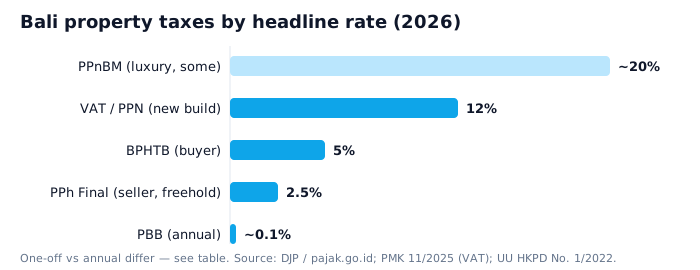
Owning property in Bali is cheap; transacting is where the tax sits. Annual PBB runs about 0.1% of assessed value. Buyers pay 5% BPHTB, sellers 2.5% PPh Final on freehold, new developer builds carry 12% VAT, and rental income is taxed at 10% for residents or 20% for non-residents.
Written by Stanislav Sadovnikov, Founder, Magnum Estate ·
Reviewed by Magnum Estate legal & tax desk (named certified tax advisor / PPAT before publish) ·
Last updated 18 September 2026
Bali property taxes 2026: summary
Holding a villa in Bali is cheap to own but taxed at every transaction. Here is the same picture with the numbers attached:
- Cheapest line: annual PBB (~0.1% of NJOP), e.g. ~IDR 310,000/yr on a IDR 310M NJOP villa.
- Biggest one-offs: BPHTB 5% (buyer), PPh Final 2.5% (seller, freehold), VAT 12% (new build).
- Ongoing drag: rental-income tax (10% resident / 20% non-resident) + management 30-50% of gross rent.
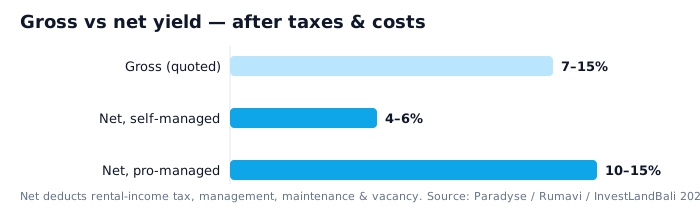
- Net-return impact: a 7-15% gross yield becomes ~4-6% net self-managed, ~10-15% net pro-managed.
- Not advice: rates and treaty relief vary, confirm with a certified Indonesian tax advisor and notary (PPAT).
"Transparency: Magnum Estate develops property in Bali, so we have a commercial interest. This guide to Bali property taxes is educational, not tax or legal advice . Tax rates, thresholds and double-taxation treaty relief change and depend on your structure and nationality, verify every figure against the official sources cited below and engage a certified Indonesian tax advisor and a licensed notary (PPAT) before you buy, sell or let."
Transparency
This Bali property taxes guide turns Indonesia’s property-tax system into one coherent 2026 cost map for foreign villa buyers. Indonesia taxes a property across its whole life cycle, when you own it, buy it, sell it and rent it out. The annual cost of simply owning is small (PBB at roughly 0.1% of assessed value), but the transaction and rental taxes are what actually move your net return. Below is every rate with its source, the notary and management costs around it, and how the whole stack converts a headline gross yield into the net yield you keep. All IDR examples use ~IDR 16,000/USD; treat them as indicative and confirm live figures with a tax advisor.
The Bali property taxes you face, by stage (2026)
It helps to map taxes to the moment they are triggered rather than as one undifferentiated bill. Four taxes are one-off (BPHTB, PPh Final, VAT/PPN, PPnBM and the small BBN name-change fee); two are recurring (PBB each year, and rental-income tax whenever you let the villa). The recurring ones look trivial next to the transaction taxes, but compounded over a 5-10 year hold they shape your net yield more than most buyers expect.
Bali property taxes 2026: the full rate table
The table below is the core reference, each tax, who pays it, the rate, and when it falls due. Rates are national-framework figures cross-checked against the Directorate General of Taxes (DJP) and the local-tax law; thresholds (NJOP allowances, non-taxable BPHTB portions) are set locally and change, so treat the IDR worked examples as illustrative.
Bali property taxes 2026: every tax, who pays, and when it falls due
| Tax | Who pays | Rate | When / on what |
|---|---|---|---|
| PBB (Land & Building Tax) | Owner | ~0.1% effective (ceiling 0.5%) | Annual, on assessed value (NJOP) |
| BPHTB (acquisition duty) | Buyer | 5% of taxable base | At purchase (value or NJOP minus threshold) |
| PPh Final (income tax on sale) | Seller | 2.5% (freehold); leasehold differs\* | At sale, before notary signs deed |
| VAT / PPN | Buyer (new build) | 12% of building value | Buying from a VAT-registered developer (from 1 Jan 2025) |
| PPnBM (luxury goods tax) | Buyer | ~20% | First sale of certain high-end villas\* |
| BBN (name-change / certificate) | Buyer | ~1% of value | Updating the land certificate to the buyer |
| Rental-income tax (PPh) | Owner/landlord | 10% resident; 20% non-resident\* | Recurring, on gross rent (treaty relief may apply) |
| Construction-services tax | Owner (building) | ~2-4% of contract | On construction services contracted |
Rates as of 2026; *marked items vary by structure, classification and tax treaty, confirm with a tax advisor. Sources: DJP / pajak.go.id; PMK 11/2025 (VAT 12%); UU HKPD No. 1/2022 (PBB & BPHTB). ~IDR 16,000/USD.
Structure changes the bill. Whether you hold via leasehold (Hak Sewa), Hak Pakai or a PT PMA (HGB) affects which taxes apply and at what rate, and nominee arrangements create both legal and fiscal risk. Get the ownership route right first in our legal guide to buying in Bali as a foreigner.
Buying & selling: one-off Bali property taxes and notary fees
The largest single tax events are at acquisition and exit. On a IDR 1.2 billion (~USD 75,000) purchase with a IDR 60M non-taxable portion, BPHTB at 5% is roughly IDR 57 million (~USD 3,560), paid by the buyer. If you buy a new villa from a developer, add VAT/PPN at 12% of the building value (in force from 1 January 2025), and on certain luxury first sales a PPnBM of around 20%. On the way out, the seller pays PPh Final at 2.5% of the freehold sale price before the notary signs the deed.
On top of taxes, budget notary/PPAT fees of roughly 0.5-1% of the transaction plus due diligence and certificate (BBN ~1%) costs. These are not “taxes” but they are unavoidable transaction friction that belongs in any honest acquisition model. For how these one-offs sit against purchase price by area, see our Bali property prices 2026 guide.
Rental-income tax on a Bali villa
Once the villa earns, rental income is taxed. Indonesian tax residents generally pay a final 10% on gross rental income. Foreign non-residents are subject to 20% withholding on gross rent, which a double-taxation treaty often reduces to around 10%, but treaty relief depends on your country of residence and correct documentation, so confirm it with a tax advisor rather than assuming the lower figure.
Rental tax is charged on gross rent, not profit, which is why it bites harder than PBB. Model it inside your cash-flow alongside management and vacancy; see how the numbers stack up in our Bali villa ROI guide and long- vs short-term rental strategy.

Ongoing holding & management costs
Taxes are only part of the annual carry. Combined property taxes and related levies often total roughly 0.5-2% of land/building value per year, but the larger recurring number is operations: professional management, staff, utilities, insurance and routine maintenance commonly run 30-50% of gross rental income for full-service villas. Bali’s humid, coastal climate also forces recurring capex, roofing, air-conditioning, repainting and waterproofing every few years, plus new tourism levies that fund local infrastructure and environmental programmes.
Annual holding costs on a Bali villa, 2026 (indicative)
| Annual holding cost | Typical range | Basis |
|---|---|---|
| PBB (annual property tax) | ~0.1% of NJOP | Assessed value |
| All property taxes & levies | ~0.5-2% of value | Property type & location |
| Management, staff & utilities | 30-50% of gross rent | Service level & size |
| Maintenance & capex reserve | budget recurring | Climate-driven wear |
| Rental-income tax | 10% / 20% of gross rent | Residency & treaty |
Indicative 2026 ranges. Management/levy bands from 2025-2026 villa cost-of-ownership analyses; tax lines from DJP. Verify locally.
How Bali property taxes hit your net return
Here is the part most headline yields hide. A villa quoted at a 7-15% gross yield (annual rent ÷ price, before any costs) does not deliver that to your pocket. After rental-income tax, management, maintenance and vacancy, the net yield typically lands at roughly 4-6% when self-managed and 10-15% under professional management. The gap is operations, not the tax rate, but tax is a fixed input you cannot optimise away.
The takeaway: prime coastal areas carry higher absolute taxes (higher NJOP and transaction values) but can still deliver superior after-tax ROI; emerging areas mean smaller tax bills but thinner income. Pick the area on after-tax net yield, not the headline, compare zones in our best areas to buy in Bali 2026 guide.
Limitations & suitability
This guide is not for readers seeking definitive tax filing advice or a substitute for a licensed adviser. Indonesian property tax depends on your ownership structure (leasehold, Hak Pakai, PT PMA), your tax residency and your home-country treaty, figures here are framework rates and indicative ranges, not a calculation for your specific deal. Local thresholds and the NJOP on your parcel can change the IDR amounts materially. If you need treaty-optimised, structure-specific numbers, this article is a starting map only; commission a certified Indonesian tax advisor and a notary (PPAT) before acting.
Methodology & sources
Tax rates are stated as 2026 national-framework figures, cross-checked against the Directorate General of Taxes (DJP / pajak.go.id), the VAT regulation (PMK 11/2025, PPN 12%) and the local-tax law (UU HKPD No. 1/2022, which sets the PBB ceiling and BPHTB framework). IDR worked examples use ~IDR 16,000/USD and are illustrative, local NJOP and thresholds vary. Gross yields are rent ÷ price before costs; net yields deduct rental-income tax, management, maintenance and vacancy. Items marked with * (leasehold PPh, PPnBM scope, non-resident rental rates) vary by structure and treaty. Always verify against the cited sources and a tax advisor before relying on any figure.
Conclusion
In 2026, Bali rewards investors who price tax in from the start. Owning is cheap (PBB ~0.1%), but the 5% BPHTB on entry, 2.5% PPh on exit, 12% VAT on new builds and 10-20% on rent are the lines that decide your after-tax return. Model them inside your cash-flow, choose an ownership structure that fits your tax profile, and judge each area on its realistic net yield (4-6% self-managed, 10-15% professionally managed), not the headline gross.

FAQ: Bali property taxes 2026
How much are Bali property taxes per year (PBB)?
Annual PBB is low, an effective ~0.1% of the assessed value (NJOP) after an allowance. A villa with an NJOP of ~IDR 310,000,000 pays about IDR 310,000/year. The legal ceiling under UU HKPD No. 1/2022 is 0.5%, but residential rates in Bali typically resolve near 0.1%.
What Bali property taxes apply when I buy?
The buyer pays BPHTB at 5% of the taxable base. A new developer build adds VAT (PPN) at 12% of the building value (from 1 Jan 2025), and certain luxury first sales add PPnBM (~20%). A name-change/certificate fee (BBN) of ~1% may also apply.
What Bali property taxes apply when I sell?
The seller pays PPh Final at 2.5% of the sale price on freehold transfers, before the notary signs the deed. Leasehold assignments can be taxed differently (commonly ~10%, or 20% without an NPWP).
How is rental income from my villa taxed?
Tax residents generally pay a final 10% on gross rent; foreign non-residents face 20% withholding, often reduced to ~10% under a tax treaty. Confirm your treaty position with an advisor.
How do Bali property taxes affect net yield?
Annual taxes are small, but rental-income tax plus management, maintenance and vacancy turn a 7-15% gross yield into ~4-6% net self-managed or ~10-15% net professionally managed.
Is VAT really 12% on Bali property now?
VAT (PPN) is 12% of the building value on purchases from a VAT-registered developer, in force from 1 January 2025, confirm the current rate against pajak.go.id, as VAT policy can change.
Are tourism levies a big part of holding costs?
No, they are modest versus villa revenue, but they are real and fund local infrastructure. Treat them as a small operating cost, not a return-killer.
References & official sources
- DJP, Directorate General of Taxes / Ministry of Finance: PBB, BPHTB, PPh Final, VAT (PPN), rental-income tax, pajak.go.id
- PMK 11/2025 (Ministry of Finance regulation): VAT/PPN 12% basis on property from 1 Jan 2025, pajak.go.id (verify the governing PMK before publish).
- UU HKPD No. 1/2022 (Regional Taxes & Levies Law): PBB ceiling (0.5%) & BPHTB framework administered by local government, pajak.go.id
- ATR/BPN: land titles, Hak Pakai / HGB & certificate (BBN) processes, atrbpn.go.id
- BKPM / Invest Indonesia: PT PMA & foreign-ownership rules affecting tax structure, investindonesia.go.id
- BPS, Statistics Indonesia / Bali: tourism & occupancy context, bali.bps.go.id
- Market data (2026): Paradyse Homes & Rumavi holding-cost / yield studies; Prestige Property Bali; InvestLandBali market report (net-yield bands).
- Magnum Estate portfolio data (after-tax net yields by project).
About the author
Stanislav Sadovnikov is the founder of Magnum Estate (PT Magnum Estate International), an award-winning full-cycle Bali real estate developer with 8 projects and 575 units since 2019 (Berawa, Sanur, Umalas, Sky Stars, Sky Royal). He writes about Bali pricing, yields, ownership rules and regulation for international buyers.