






Written by Stanislav Sadovnikov, Founder, Magnum Estate ·
Reviewed by Magnum Estate legal & investment desk (PPAT review pending) ·
Last updated 3 June 2026
"9 checks Before you transfer any money · PBG + SLF Permits that replaced IMB · ~0.1% Annual PBB land & building tax · PPAT Notary who verifies title at BPN"
Key figures (2026)
Bali property due diligence 2026: summary
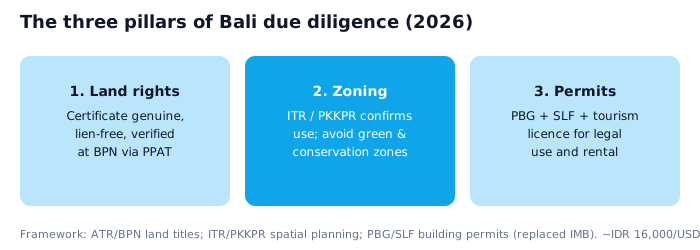
Bali property due diligence 2026, the short answer: before sending a single dollar, a foreign buyer must verify the title and BPN registration, the zoning (ITR/PKKPR), and the building permits (PBG/SLF), all through an independent licensed notary (PPAT), never on an agent’s word alone. The three pillars are land rights, spatial planning and permits/licences.
- Title first: confirm the certificate is genuine, lien-free and matches the seller’s identity and boundaries at the National Land Agency (BPN).
- Zoning kills deals: land in a green/agricultural or conservation zone marketed as “villa-ready” is the #1 red flag, unauthorised builds can be sealed or demolished.
- Permits = legal use: no SLF means no insurance and a fragile rental licence (Pondok Wisata); PBG replaced the old IMB.
- No nominees: a local fronting Hak Milik for a foreigner conflicts with Agrarian Law No. 5/1960, use leasehold, Hak Pakai or PT PMA (HGB).
- Lease terms: verify remaining years, fixed extension price and that the lessor is the registered owner.

"Transparency: Magnum Estate develops property in Bali, so we have a commercial interest. This guide is educational, not legal or tax advice, verify every point independently and engage a certified Indonesian notary (PPAT), an independent land lawyer and a tax advisor before you transfer any funds. Laws and permit regimes change; confirm the current rules at the time of purchase."
Transparency
This Bali property due diligence 2026 checklist is built for foreign buyers who want to know exactly what to verify, and in what order, before committing to a villa, apartment or land plot. By 2026 Bali’s market has moved into a “fundamentals” phase: tighter zoning enforcement, a new building-permit regime (PBG/SLF replacing the old IMB) and more active action against illegal villas and unlicensed rentals mean that the deal-maker is no longer the price, it is the paperwork. Skip a step and you risk land you cannot legally build or rent on, or worse, land with unresolved claims. Below is the full pre-purchase workflow, point by point, with where to verify each item.
Why Bali property due diligence 2026 matters more than ever
Two forces converged in recent years. First, rapid tourism-led land conversion exposed weaknesses in Bali’s land regulation, fuelling boundary disputes, gentrification pressure and customary-land (adat) tension. Second, the authorities tightened the rules: zoning confirmation (ITR / PKKPR), the new building approval (PBG) and the occupancy certificate (SLF) are now mandatory gates before serious construction or legal operation. The practical effect is simple, legal clarity and engineering quality now define investment-grade property. For the broader ownership framework, start with our pillar guide on buying property in Bali as a foreigner; this article is the pre-purchase verification companion to it.
The Bali property due diligence 2026 checklist (9 points)
Work through these nine checks in order. Each one tells you what to verify, why it matters, and where to verify it. Treat any gap as a stop sign until it is resolved in writing.
| # | Check (item) | Why it matters | Where to verify |
|---|---|---|---|
| 1 | Land certificate authenticity | Fake or mismatched certificates void the sale and your money | BPN / ATR-BPN via a PPAT notary |
| 2 | Encumbrances & disputes (liens, double certs, inheritance) | Hidden claims can surface after purchase and override you | BPN search; PPAT certificate check |
| 3 | Zoning / spatial plan (ITR & PKKPR) | Wrong zone = no PBG, no legal villa or rental | GISTARU/RTRW; DPMPTSP office |
| 4 | Permitted use vs your plan | Green/conservation land can be sealed or demolished | ITR zoning + local planning office |
| 5 | Building & tourism permits (PBG, SLF, Pondok Wisata) | No SLF = uninsurable; no licence = no legal daily rental | Local building authority; OSS/DPMPTSP |
| 6 | Lease term & extension (leasehold) | Short or unpriced extensions destroy resale value | Lease deed + BPN owner match |
| 7 | Tax clearance & holding costs (PBB, BPHTB, PPh) | Arrears transfer with the land; unpaid tax blocks transfer | DJP / pajak.go.id; PPAT |
| 8 | Ownership structure (leasehold / Hak Pakai / PT PMA) | Nominee freehold is unenforceable for foreigners | BKPM; independent land lawyer |
| 9 | Contracts & deed (PPJB then AJB / lease deed) | Verbal promises are worthless; the deed is the asset | PPAT notary |
| The nine-point Bali property due diligence 2026 checklist. Each item is a stop sign until resolved in writing. Sources: ATR/BPN, BKPM, DJP, Agrarian Law No. 5/1960. |
Checks 1-2: Title and BPN registration
Everything starts with the certificate. Formal land registration with the National Land Agency (BPN / ATR-BPN) is the only basis for legal certainty, historic documents such as pipil may signal a claim but must be converted into a formal certificate before they mean anything. Your PPAT notary verifies that the certificate type (Hak Milik, HGB, Hak Pakai) is genuine, free from encumbrances, and that the registered name, boundaries and area match the parcel and the seller’s identity.
Order matters: never pay a deposit before the BPN certificate check clears. Confirm there are no double certificates, mortgages/liens, inheritance disputes or tax arrears. Foreigners cannot hold Hak Milik directly, understand which right you can actually hold in freehold vs leasehold for Bali property investors.
Checks 3-4: Zoning (ITR/PKKPR) and permitted use
Bali’s land is now tightly categorised into green (agricultural), residential, tourism/commercial and conservation zones, visible through the ITR and PKKPR tools. Use the parcel coordinates to query the official spatial databases (GISTARU/RTRW) and request a zoning confirmation (ITR) from the local DPMPTSP office. Buying “villa-ready” land that turns out to sit in a green or conservation zone is one of the most expensive mistakes a foreign buyer can make, unauthorised development can be sealed or demolished, and no PBG will ever be issued.
The takeaway: zoning confirmation is cheap and fast relative to the loss it prevents. Match the zone to your actual plan (own-use villa vs daily rental), not the agent’s pitch. Dig deeper into the costliest zoning traps in our
9 costly mistakes Bali investors still make
and the land-safety walkthrough in how to find legally safe land in Bali.
Check 5: Building and tourism permits (PBG / SLF / Pondok Wisata)
The old IMB permit has been replaced by the PBG (Persetujuan Bangunan Gedung) for design and construction approval, and the SLF (Sertifikat Laik Fungsi) for final safety and occupancy certification. A property without an SLF is not legally fit for use and is difficult to insure. If you intend to rent daily, the building must also hold the correct tourism licence, a Pondok Wisata or a Sertifikat Standar, and the location must permit short-stay rental at all.
| Permit / licence | What it certifies | Replaces / note |
|---|---|---|
| PBG | Design & construction approval | Replaced the old IMB |
| SLF | Building is safe & fit for occupancy | Required for insurance & licences |
| Pondok Wisata / Sertifikat Standar | Legal short-stay (daily) rental | Location must allow tourism use |
| PKKPR | Spatial-use suitability for the project | Gate before PBG on undeveloped land |
| Permit regime as of 2026. Verify each via the local building authority and the OSS/DPMPTSP system. Source: ATR/BPN & BKPM/Invest Indonesia guidance. |
Check 6: Lease term and extension
Most foreign buyers in Bali hold via leasehold (Hak Sewa). A villa marketed as “25 + 25 years” is only worth the headline if the extension is contractually secured. Read the lease deed for the exact remaining years, the pre-agreed extension term, and, critically, the extension price or formula. Then confirm the lessor named on the deed is the same person registered as the title holder at BPN. An extension with no fixed price is an open-ended negotiation that can quietly erase your resale value.
Resale reality: a leasehold’s value decays as the term runs down, so the extension mechanism is the asset. Weigh leasehold against company ownership (PT PMA / HGB) in freehold vs leasehold, and see how structure affects returns in our Bali villa investment & ROI guide.
Want title, zoning and permits checked for you?
Magnum Estate’s legal desk runs full pre-purchase due diligence on every unit we sell, and on third-party deals for serious buyers.
View Magnum projects
Book a free consultation
Check 7: Tax clearance and holding costs
Tax due diligence protects you twice: unpaid land-and-building tax (PBB, roughly 0.1% of assessed value annually) can block a clean transfer, and the transaction itself triggers taxes you should budget for. The buyer typically pays BPHTB (a land/building acquisition duty, commonly ~5% of the taxable transfer value) while the seller settles income tax (PPh) on the gain. Confirm the PBB is current and that any tax owed is cleared before closing, arrears effectively travel with the land. (Rates and thresholds change; confirm current figures on DJP / pajak.go.id and with a tax advisor.)
Budget the full cost of ownership, not just the price tag, recurring PBB, management, maintenance and rental-income tax all bite into yield. We break this down in our Bali property taxes & holding costs guide.
Checks 8-9: Ownership structure and the PPAT notary
Foreigners cannot legally hold Hak Milik freehold. A nominee structure, an Indonesian holding freehold on your behalf, conflicts with Agrarian Law No. 5/1960 and gives weak protection: a court can side with the registered local owner, leaving you exposed. The compliant routes are
leasehold (Hak Sewa), Hak Pakai (right to use), or a PT PMA
foreign-investment company holding HGB (right to build). For apartments, foreigners can hold properly structured strata rights (HMSRS) in qualifying projects, verify both the project’s land/permits and the unit-level foreign-ownership rules.
Tie it together with the right professional and the right paperwork. The PPAT (Pejabat Pembuat Akta Tanah) is the state-licensed land-deed official who verifies title at BPN, drafts the binding deed and registers the transfer, independent of the seller, and mandatory for a valid transaction. The contract chain usually runs from a PPJB (conditional sale/purchase agreement) to the AJB (deed of sale) or a registered lease deed. Make sure every agreement reflects the actual zoning and permit reality, not informal promises.
Use independent counsel. The seller’s notary is not your advocate. Engage your own PPAT and an independent Indonesian land lawyer, and align the structure to your goals using the foreign-buyer legal guide.
Red flags to walk away from
| Red flag | What it usually means |
|---|---|
| “Villa-ready” land in a green/agricultural or conservation zone | No PBG possible; build risks being sealed or demolished |
| Seller offers a nominee to “own” freehold | Unenforceable under Agrarian Law No. 5/1960; you are exposed |
| No SLF on an existing building | Not legally fit for use; insurance and rental licence at risk |
| Lease “extension” with no fixed price or formula | Open-ended cost that can erase resale value |
| Pressure to pay a deposit before the BPN title check | Classic way to lock you into an unverifiable deal |
| Certificate name/boundaries don’t match the seller or parcel | Possible double certificate, dispute or fraud |
| Daily-rental income promised with no Pondok Wisata licence | Illegal rental; income and asset both at risk |
| Any single red flag is grounds to pause the deal until it is resolved in writing by your own counsel. |
Methodology & sources
This checklist describes the legal and technical process for pre-purchase verification in Bali as of 2026, synthesised from Indonesian land and investment law (Agrarian Law No. 5/1960; ATR/BPN title rules; BKPM/Invest Indonesia foreign-ownership rules; DJP/pajak.go.id tax rules) and Magnum Estate’s transaction experience. Tax figures (PBB ~0.1%; BPHTB commonly ~5%) are indicative and convert at ~IDR 16,000/USD; rates, thresholds and permit names change, so confirm current rules with a PPAT and tax advisor before purchase. This is educational content, not legal or tax advice.
Conclusion
In 2026, Bali rewards buyers who verify before they pay. Run the nine checks in order, title, encumbrances, zoning, permitted use, permits, lease terms, tax clearance, ownership structure and the deed, and treat any gap as a stop sign. The cost of proper Bali property due diligence 2026 is trivial next to the cost of a sealed villa, an unenforceable nominee or a lease you can’t extend. Do it once, do it independently, and only then transfer funds.
Buy with the paperwork already done
Magnum Estate’s Berawa, Sanur and Uluwatu residences come with verified title, zoning and PBG/SLF, transparent, legally clean, investment-grade.
Uluwatu, Sky Stars
Berawa
Sanur
FAQ: Bali property due diligence 2026
What is the most important step in Bali property due diligence in 2026?
Verifying the land certificate at the National Land Agency (BPN/ATR-BPN) through a licensed PPAT notary, before any money moves. It confirms the title is genuine, matches the seller and boundaries, and is free of liens, double certificates, inheritance disputes or tax arrears.
Do I need a notary (PPAT) for due diligence?
Yes. Only a PPAT can legally verify the certificate at BPN, draft the binding deed (AJB) or lease deed, and register the transfer. The PPAT is independent of the seller and mandatory for a valid transaction.
Are nominee structures a safe way for foreigners to own freehold land?
No. A nominee holding Hak Milik for a foreigner conflicts with Agrarian Law No. 5/1960 and offers weak protection. Use leasehold (Hak Sewa), Hak Pakai or a PT PMA (HGB) instead, vetted by independent counsel.
How do I check Bali zoning before buying?
Use the parcel coordinates to query GISTARU/RTRW and the ITR/PKKPR system, and request a zoning confirmation from the DPMPTSP office. Confirm the zone permits your intended use and isn’t green/agricultural or conservation.
What permits must an existing villa have?
A PBG (which replaced the old IMB) for construction and an SLF for occupancy. For daily rentals it must also hold a Pondok Wisata or Sertifikat Standar tourism licence, and the location must allow short-stay rental.
How do I verify the lease term and extension?
Read the lease deed for the remaining years, the pre-agreed extension term, and a fixed extension price or formula, then confirm the lessor is the registered title holder at BPN.
What taxes apply when buying property in Bali?
Annual PBB is ~0.1% of assessed value; the buyer typically pays BPHTB acquisition duty (~5%) and the seller PPh income tax on the gain. Confirm current rates on pajak.go.id and clear any arrears before closing.
References & official sources
- ATR/BPN, National Land Agency: land titles (Hak Milik / Hak Pakai / HGB), certificate verification & registration, atrbpn.go.id
- BKPM / Invest Indonesia: PT PMA & foreign-ownership rules, Positive Investment List, investindonesia.go.id
- DJP / Ministry of Finance: PBB, BPHTB & PPh property taxes, pajak.go.id
- Agrarian Law No. 5/1960 (Basic Agrarian Law): foundation of Indonesian land rights & foreign-ownership limits, via faolex.fao.org
- GISTARU / RTRW spatial planning & ITR/PKKPR: zoning confirmation via the local DPMPTSP and OSS systems.
- Magnum Estate transaction & legal-desk experience (process verification): based on in-house due-diligence on Magnum projects, 2024-2026.
About the author
Stanislav Sadovnikov is the founder of Magnum Estate (PT Magnum Estate International), an award-winning full-cycle Bali real estate developer with 8 projects and 575 units since 2019 (Berawa, Sanur, Umalas, Sky Stars, Sky Royal). He writes about Bali pricing, yields, ownership rules and regulation for international buyers.