





Written by Stanislav Sadovnikov, Founder, Magnum Estate ·
Reviewed by Magnum Estate legal & investment desk ·
Last updated 3 June 2026
"7-15% Gross yield (the headline) · 4-6% / 10-15% Net yield (self vs pro-managed) · $250-1,900 Land per m² (Ubud, Seminyak) · 6.95M 2025 foreign arrivals (+9.7%)"
Key figures (2026)
How to invest in Bali, in one paragraph
How to invest in Bali the data-driven way: treat every deal as a hypothesis to disprove, not a dream to fund. Run the same six steps each time, define your profile and horizon, set a target net yield, verify title and zoning, benchmark the land price per m² and the realistic net yield for that exact area, then stress-test the model, and walk away from anything that only works on a glossy “gross” number.
- The core trap: listings quote gross yield (7-15%); what you keep is net (≈4-6% self-managed, ≈10-15% professionally managed).
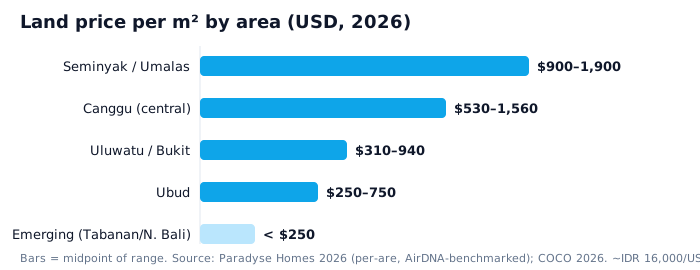
- Benchmark first: land runs from under $250/m² (emerging) to $900-1,900/m² (Seminyak), know the area number before you negotiate.
- Title is binary: foreigners can’t hold Hak Milik directly, use Leasehold (Hak Sewa) or a PT PMA (HGB), verified by a PPAT.
- Horizon: model Bali as a 5-10-year operating business, not a flip.
- Demand is real: 6.95M foreign arrivals in 2025 (+9.7%); prime occupancy 70-85%, but it varies sharply by micro-location.

"Transparency: Magnum Estate develops property in Bali, so we have a commercial interest. This guide is educational, not investment or legal advice, verify every figure independently and consult a certified Indonesian notary (PPAT) and tax advisor before you commit capital."
Transparency
If you’re learning how to invest in Bali in 2026, the hard part isn’t finding opportunities, it’s filtering them. The market has shifted from a vibe-driven boom into a more selective, data-driven phase: demand is genuinely strong, but headline returns are routinely overstated and a meaningful share of “investment-grade” listings fail a basic title or zoning check. This is a process guide, not a strategy thesis. It gives you a repeatable, due-diligence-first method to pressure-test any single deal against real benchmarks, so the deal proves itself with data, not with marketing. For the bigger-picture strategy, see our Bali property investment 2026 pillar; for where the market is heading, see the 2026 market forecast.
Why a method beats a hunch in 2026
Bali drew 6,948,754 foreign visitors in 2025, up 9.72% year-on-year, pushing prime-area occupancy to 70-85% (island-wide closer to ~65%). Land appreciated roughly 15-30% over two years, and like-for-like prices are growing about 7-15% a year in strong micro-markets. That demand is real, but it’s exactly why the hype is loud. The same boom that drives genuine returns also fills your inbox with “guaranteed 18%” pitches that quietly mean gross, before any costs. A method protects you from that: it forces every deal through the same filters in the same order, so you compare like with like and your decision rests on numbers you’ve checked yourself.
The mindset shift: a good Bali deal should survive scrutiny. If the only way the return works is by quoting gross yield, skipping the title check, or assuming 100% occupancy, it isn’t a deal, it’s a story. Run the same six steps every time.
Step 1, Define your profile, horizon & budget
Before you look at a single listing, decide what kind of investor you are, because it changes which benchmarks matter. Are you yield-first (you want monthly cash flow), lifestyle-plus-yield (you’ll use it and rent the rest), or appreciation-focused (you’re buying land/location for the exit)? Then lock a 5-10-year horizon, Bali rewards operators, not flippers, and a realistic all-in budget. Use the table below as a sanity check on what your capital actually reaches in 2026.
| Budget (USD) | What it realistically reaches in 2026 |
|---|---|
| 60k, 150k | Off-plan / co-ownership unit, or land in an emerging area |
| 150k, 300k | Villa in an emerging zone (Tabanan, Seseh) or a small Ubud villa |
| 300k, 500k | Investor-grade villa in Canggu, Ubud or second-row Uluwatu |
| 500k, 1.2M+ | Ocean-view Uluwatu or prime Seminyak / central Canggu villa |
| Prices reconciled at ~IDR 16,000/USD. Budget extra for taxes, due diligence and a furnishing / working-capital buffer. |
Match your profile to a location before you fall for a specific villa. Compare the two coasts in Canggu vs Uluwatu and the full ranking in best areas to buy property in Bali 2026.
Step 2, Set a target net yield (the hype-vs-reality step)
This is the step that separates data from hype. Almost every yield you’ll be quoted is gross: annual rent ÷ price, before a single cost. Across Bali that’s typically 7-15%, and by area it ranges from North Bali (6-10%) up to Canggu/Berawa (12-18%). What you actually keep is the net yield, after management, tax, maintenance and vacancy, and the gap is large enough to flip a “great” deal into a mediocre one.
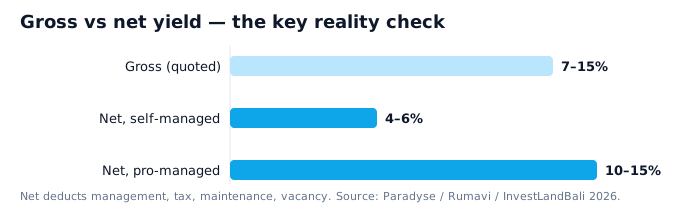
Read the chart as your reality filter: a property pitched at “12% yield” is almost certainly quoting the light-blue gross bar. If you self-manage from abroad, your realistic outcome is the 4-6% net bar; the 10-15% net bar is achievable, but only with professional operations, data-driven pricing, OTA distribution and tight cost control. So write your target as a net number (“I need ≥8% net at conservative occupancy”) and reject any deal that can’t reach it once you’ve subtracted real costs.
| Cost line (annual, indicative) | Typical drag on gross |
|---|---|
| Professional management (incl. OTA fees) | ~15-25% of rent |
| Maintenance, pool, garden, repairs | ~5-10% of rent |
| Rental-income & local taxes | varies, model with a tax advisor |
| Vacancy (use realistic, not peak, occupancy) | 15-35% of nights |
| Annual PBB property tax | ~0.1% of assessed value |
| Illustrative cost structure, the cumulative reason gross 7-15% becomes net 4-6% self-managed. Confirm tax treatment with a licensed advisor. |
The whole gap between 4-6% and 10-15% net is operations. Model holding costs with our taxes & holding costs guide, and see how management drives the difference in our Bali villa ROI guide.
Step 3, Benchmark the land price per m² by area
Once you have a target net yield, anchor the price side. The single most useful, and most inconsistently quoted, number in Bali is land price per m². Land is sold per are (100 m²) locally; convert to per-m² at ~IDR 16,000/USD and the 2026 ranking is clear and monotonic, prime central zones costing the most and emerging belts the least. Know the area number before you negotiate, so you can tell a fair price from a hopeful one.
| Area | Land per m² | Typical villa price | Gross yield |
|---|---|---|---|
| Seminyak / Umalas | ~$900-1,900 | $500k, 1.2M | 10-14% |
| Canggu / Berawa | ~$530-1,560 | $400-800k | 12-18% |
| Uluwatu / Bukit | ~$310-940 | $500-900k (3BR ocean view) | 10-16% |
| Ubud | ~$250-750 | $250-500k | 10-15% |
| Emerging (Tabanan, Seseh, N. Bali) | < $250 | $100-600k | 6-18% |
| Island median villa ≈ $256-299k; full range $60k, $6M. Build cost adds ~$1,000-1,800/m². Sources: Bali Villa Realty, Paradyse, Prestige 2026. Gross yields are before costs (see Step 2). |
How to use it: divide the asking price by the buildable land area and compare to the band above. A central-Canggu plot at $1,900/m² isn’t necessarily overpriced; a “Canggu” plot 20 minutes out at the same number probably is. The trade-off for cheaper land is rental demand, not just scenery.
Pressure-test a real 2026 deal
See transparent pricing and projected net yields across Magnum Estate’s Berawa, Sanur and Uluwatu developments, the same benchmarks this method uses.
View Magnum projects
Book a free consultation
Step 4, Verify title, zoning & permits
Numbers mean nothing if the legal foundation is wrong. In Indonesia, foreigners cannot hold Hak Milik (freehold) directly; the compliant routes are Leasehold (Hak Sewa) or a PT PMA holding Hak Guna Bangunan (HGB). Beyond the title class, the property must be legally permitted for what you intend to do with it, short-term tourist rental, in particular, depends on zoning and permits. This is a binary check: it either passes or you walk. Have a certified notary (PPAT) confirm every item below before any money moves.
| Check | What you’re confirming |
|---|---|
| Title class & holder | Leasehold (Hak Sewa) or PT PMA / HGB, never foreign Hak Milik; certificate matches seller |
| Zoning (PKKPR / spatial plan) | Land is zoned for tourism/accommodation, not green-belt or residential-only |
| Building permits (PBG / SLF) | Approval to build and a certificate the structure is fit for use |
| Lease term & extension | Years remaining, renewal terms and price, who controls extension |
| Encumbrances & access | No liens or disputes; legal road access and utilities |
| A PPAT (licensed Indonesian land notary) should verify each line in writing. This is not optional due diligence. |
Legal: ownership structure is the foundation of every Bali return. Get the full framework in our buying property in Bali as a foreigner legal guide before you sign anything.
Step 5, Build the deal model & stress-test it
Now combine Steps 2-4 into one model and try to break it. The discipline that protects beginners is conservative inputs: use realistic occupancy (not peak-season), use a net yield (not gross), include every cost line, and assume a soft year. If the deal still clears your target, it’s robust; if it only works on optimistic assumptions, it’s a story.
- Revenue: realistic ADR × realistic occupancy (model 65-75%, not 90%).
- Subtract costs: management, maintenance, tax, vacancy (from Step 2) to get net income.
- Net yield: net income ÷ all-in price (purchase + furnishing + due-diligence + buffer).
- Stress test: re-run at −20% ADR and +10% costs. Does it still clear your target?
- Exit: sanity-check appreciation against like-for-like growth (~7-15%/yr), not the headline listing jump.
Be honest about the headline-vs-reality gap on resale too: average listing prices can look like they jumped 50% in a year, but that mostly reflects a shift in stock mix toward larger prime builds, not appreciation. Pressure-test your numbers further with our investment pillar’s ROI framework.
Step 6, Decide, then operate like a business
A deal that survives all five steps earns a decision. After that, the return is no longer about the purchase, it’s about operations. The gap between 4-6% and 10-15% net is made (or lost) in pricing, distribution, guest experience and cost control over the 5-10-year hold. Either commit to professional management or accept the self-managed net band; don’t budget for one and resource the other. Buy on data, then run on data. Buying from a full-cycle Bali real estate developer that builds and operates its own projects is one way to resource that commitment from day one.
Limitations & who this method isn’t for
This is a process guide, not financial advice, and the benchmarks are indicative 2026 ranges reconciled across market datasets at ~IDR 16,000/USD, individual deals vary by view, access, lease term and product. The method assumes a 5-10-year horizon: it is not for short-term flippers, for buyers who can’t tolerate FX swings against the rupiah, or for anyone unwilling to commission independent title and zoning due diligence. If you want a guaranteed return or fully passive income with zero operations, Bali real estate is probably not the right vehicle. When figures can’t be sourced, treat them as estimates and avoid false precision.
Conclusion
Learning how to invest in Bali in 2026 is really about adopting a filter that hype can’t pass: define your profile, set a net target, benchmark land per m², verify title and zoning, then stress-test the model before you decide. Do that consistently and the strong demand becomes an advantage rather than a trap, you’ll recognise the rare deal that proves itself with data, and you’ll calmly pass on the many that only shine in the brochure.
Ready to apply the method to a real project?
Explore Magnum Estate’s ocean-view residences in Uluwatu, Berawa and Sanur, transparent pricing and projected net yields you can run through every step above.
Uluwatu, Sky Stars
Berawa
Sanur
FAQ: how to invest in Bali in 2026
How do I start investing in Bali as a beginner?
Follow a method, not a mood: define your profile and horizon, set a target net yield, verify title and zoning (PPAT, PKKPR, PBG/SLF), benchmark land per m² and the realistic net yield for the area, then stress-test the model before signing. Treat any quoted gross yield as marketing.
What is the difference between gross and net yield in Bali?
Gross is rent ÷ price before costs, typically 7-15% and the number most listings quote. Net deducts management, tax, maintenance and vacancy: ~4-6% self-managed, ~10-15% professionally managed.
What net yield is realistic in Bali in 2026?
About 4-6% net self-managed and 10-15% net professionally managed. Gross figures of 10-18% by area are before costs and should never be used as your expected return.
How much money do I need to invest in Bali property?
Roughly $60k, 150k for off-plan/co-ownership or emerging-area land; $300k, 500k for an investor-grade villa in Canggu, Ubud or second-row Uluwatu; $500k, 1.2M+ for ocean-view Uluwatu or prime Seminyak, plus taxes, due diligence and a buffer.
What are the biggest risks when investing in Bali?
Buying on a gross headline, weak or wrong-class title (foreigners can’t hold Hak Milik), zoning that bans tourist rental, single-market over-supply, and FX swings against the rupiah, all avoidable with documented due diligence.
Can foreigners legally own property in Bali?
Not as freehold (Hak Milik). Foreigners invest via Leasehold (Hak Sewa) or a PT PMA company holding HGB, see our foreigner legal guide.
How long should I hold a Bali investment?
Model it as a 5-10-year operating business. Returns come from net rental income plus appreciation, both of which depend on operations over the hold, not on a quick flip.
Where should a first-time investor look?
Match area to profile: Canggu/Berawa for deepest year-round demand, Uluwatu for view premiums and land appreciation, Ubud for low-volatility long-stay, emerging zones for more land per dollar. Compare in best areas to buy in Bali 2026.
Methodology & sources
Figures are indicative 2026 ranges, reconciled across multiple market datasets and converted at ~IDR 16,000/USD. Land prices are stated per m² (from per-are data; 1 are = 100 m²). Gross yields are rent ÷ price before costs; net yields deduct management, tax, maintenance and vacancy. Yield, land and villa-price bands match the canonical dataset used across this blog for consistency. Always commission an independent appraisal and notary (PPAT) due diligence before purchase.
References & official sources
- BPS, Statistics Indonesia / Bali: 2025 foreign arrivals (6,948,754, +9.72%), occupancy, bali.bps.go.id
- Bank Indonesia, Residential Property Price Index: official price-growth & FX data, bi.go.id
- DJP / Ministry of Finance: PBB & transaction taxes, pajak.go.id
- ATR/BPN: land titles (Hak Milik / Hak Sewa / HGB) & zoning, atrbpn.go.id
- BKPM / Invest Indonesia: PT PMA & foreign-ownership rules, investindonesia.go.id
- Market data (2026): Bali Villa Realty price guide; Paradyse Homes price-per-are study; Prestige Property Bali area/yield analysis; InvestLandBali market report.
- Magnum Estate portfolio data (net yields by project).
About the author
Stanislav Sadovnikov is the founder of Magnum Estate (PT Magnum Estate International), an award-winning full-cycle Bali real estate developer with 8 projects and 575 units since 2019 (Berawa, Sanur, Umalas, Sky Stars, Sky Royal). He writes about Bali pricing, yields, ownership rules and regulation for international buyers.