





Written by Stanislav Sadovnikov, Founder, Magnum Estate ·
Reviewed by Magnum Estate legal & investment desk ·
Last updated 3 June 2026
"6-18% Gross yield by area · 4-6% / 10-15% Net yield: self vs pro-managed · $250-1,900 Land per m² (Ubud, Seminyak) · 6.95M 2025 foreign arrivals (+9.7%)"
Key figures (2026)
Bali real estate investment 2026: summary
Bali real estate investment 2026, the short answer: it is a maturing, selective market that rewards a clear strategy over hype. Pick a return profile
by area, then benchmark every deal on net yield, not the headline gross number.
- Aggressive yield: Canggu/Berawa (12-18% gross) and Uluwatu/Bukit (10-16% gross).
- Defensive income: Sanur, Nusa Dua and Ubud (10-15% gross), steadier, longer stays.
- Appreciation play: Tabanan, Kedungu and North Bali, cheapest land, 7-10-yr horizon.
- Gross ≠ net: net is ~4-6% self-managed, ~10-15% professionally managed.
- Legal: foreigners use Leasehold (Hak Sewa) or PT PMA (HGB), never nominee freehold.
- Demand: 6.95M foreign arrivals in 2025 (+9.7% YoY); prime occupancy 70-85%.

"Transparency: Magnum Estate develops property in Bali, so we have a commercial interest. This guide is educational, not investment or legal advice, verify figures independently and consult a certified Indonesian notary (PPAT) and tax advisor before buying."
Transparency
This Bali real estate investment 2026 guide is the strategy hub: it maps the island’s areas by return profile, shows how to benchmark a deal honestly, and walks the risk and buying process for foreign buyers. By 2026 the market has shifted from its post-pandemic boom into a more selective, data-driven phase, prices keep rising in prime hotspots, but the picture varies enormously by area. For the underlying numbers we link down to the detailed spokes: see exact figures in our Bali property prices 2026 guide and the villa investment ROI guide.
Why 2026 is a strategic year to invest in Bali
Bali drew 6,948,754 foreign visitors in 2025, up 9.72% year-on-year, pushing prime-area occupancy to 70-85% (island-wide average closer to ~65%). Land values appreciated roughly 15-30% over the past two years, while like-for-like price growth is closer to 7-15% a year in strong micro-markets. The headline change for 2026 is not the demand, it’s the discipline: supply is slowing in saturated zones, buyers are more selective, and the gap between a good deal and a poor one now comes down to location quality and operations, not luck.
Research on foreign buyers in Southern Bali consistently finds that location is the single strongest driver of investment outcomes, outweighing the complex ownership rules, which deter committed investors far less than people assume. So the first decision is not “should I buy in Bali?” but “which return profile am I buying?”
Best areas for Bali real estate investment 2026, at a glance
Group the island into three return profiles. This hub gives the shape; for street-level area detail see best areas to buy property in Bali 2026.
| Profile | Areas | Gross yield | What you’re buying |
|---|---|---|---|
| Aggressive yield | Canggu / Berawa | 12-18% | Deepest year-round short-stay demand; rising land cost & dense supply demand careful micro-location. |
| Aggressive yield | Uluwatu / Bukit (incl. Bingin, Pandawa) | 10-16% | View-driven luxury with pricing leverage; highly sensitive to design, branding and management. |
| Defensive income | Ubud & central highlands | 10-15% | Wellness & long-stay; steadier occupancy, lower volatility, needs a strong concept. |
| Defensive income | Seminyak | 10-14% | Most established; best exit liquidity, highest land cost per m². |
| Defensive income | Sanur / Nusa Dua | moderate, stable | Families, retirees, MICE; predictable income, low trend exposure. |
| Appreciation play | Tabanan, Kedungu, North Bali | 6-10% | Cheapest land; land-banking and eco-resort horizon of 7-10+ years. |
| All yield figures are GROSS (before costs). Source: Prestige Property Bali 2026. Sanur/Nusa Dua described qualitatively (defensive sub-markets). ~IDR 16,000/USD. |
The takeaway: yield and land cost move in opposite directions, the cheapest land (North Bali, Tabanan) carries the lowest gross yield but the most appreciation upside. Match the area to your horizon. Compare the two southern coasts in best areas to buy in Bali 2026, and choose a letting model in our long-term vs short-term rental strategy.
Bali ROI benchmarks: gross vs net
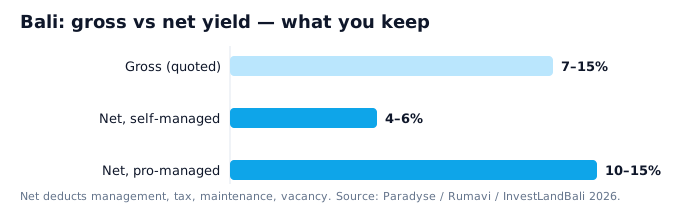
Most “7-18% yield” claims you’ll see, including in the area table above, are gross: annual rent ÷ price, before costs. The number that decides whether a deal works is the net yield, after management, tax, maintenance and vacancy. This single distinction is the biggest source of disappointed Bali investors.
| Metric | Range | Meaning |
|---|---|---|
| Gross yield (quoted) | 7-15% | Annual rent ÷ price, before any costs. Use only as a starting screen. |
| Net yield, self-managed | 4-6% | After management, tax, maintenance and vacancy when you run it ad-hoc. |
| Net yield, professionally managed | 10-15% | Same asset, but with dynamic pricing, OTA distribution and cost control. |
| The gap between 4-6% and 10-15% net is operations, not the building. Source: Paradyse / Rumavi / InvestLandBali 2026. |
The gap between 4-6% and 10-15% net is operations: data-driven pricing, OTA distribution and cost control. Factor holding costs with our taxes & holding costs guide, and see the full location-by-location math in the villa investment ROI guide.
How to benchmark a Bali deal before you buy
A repeatable five-step screen separates a real opportunity from a sales pitch. Run every deal through it before you put down a deposit:
| # | Step | What to check |
|---|---|---|
| 1 | Land price per m² | Compare the asking land cost against the area range (under $250/m² emerging, $900-1,900/m² Seminyak). Overpaying for land caps your exit. |
| 2 | Convert yield to net | Strip the gross headline down to net: deduct management, tax, maintenance and vacancy. Expect 4-6% self-managed, 10-15% pro-managed. |
| 3 | Stress-test | Re-run the model at lower ADR and occupancy. If it only works at 80%+ occupancy, it’s fragile. |
| 4 | Title & lease years | Confirm Leasehold years remaining or PT PMA / HGB status, zoning and building permits. Plan the exit at entry. |
| 5 | Operator | A credible management track record is what moves you from the 4-6% band to the 10-15% band. |
| ROI = (Net Profit ÷ Total Investment Cost) × 100. Treat all area ranges as targets to stress-test, not guarantees. |
Benchmark a real 2026 deal, not an average
Compare live pricing and projected net yields across Magnum Estate’s Berawa, Sanur and Uluwatu developments.
View Magnum projects
Book a free consultation
Legal structures for foreign investors
Foreigners cannot hold freehold (Hak Milik) residential title in their own name. The two compliant routes are:
| Structure | What it is | Best for |
|---|---|---|
| Leasehold (Hak Sewa) | Long-term lease, commonly 25-30 years with extension options. | Lifestyle and rental villas; simpler, lower setup cost. |
| PT PMA (Hak Guna Bangunan) | Foreign-owned company holding a right-to-build title. | Stronger control and business rights; higher setup, compliance and operating cost. |
| Avoid nominee freehold arrangements, they conflict with Indonesian law. Source: ATR/BPN; BKPM Positive Investment List. |
Legal: the structure you choose should follow the location and yield decision, not the other way round. Full walkthrough in our legal guide to buying property in Bali as a foreigner. Always use independent counsel familiar with Bali foreign-ownership rules and a certified notary (PPAT).
Risk & the buying process
The two risks investors most often under-price in 2026 are oversupply (real in parts of Canggu and Seminyak) and operational drag (the difference between 6% and 13% net in the same area). Both are managed the same way: buy a strong micro-location and insist on professional management. A disciplined process looks like this:
- Pick a return profile (aggressive yield / defensive income / appreciation) and an area to match.
- Benchmark the deal using the five-step screen above, land price, net yield, stress-test, title, operator.
- Verify zoning, building permits, licences and lease years with independent counsel.
- Choose a structure (Leasehold or PT PMA) and complete notary (PPAT) due diligence.
- Plan the exit at entry, for leaseholds, model resale demand and remaining years up front.
Limitations & who this is not for
This is a strategy hub, not a deal sheet. The ranges here are indicative 2026 figures reconciled across market datasets; your individual property will differ by road access, view, zoning and lease term. Bali real estate investment is not suited to buyers who need guaranteed income, a short (under 5-year) horizon, or fully passive ownership with no management partner, those investors will more likely land in the 4-6% net band and may be disappointed. It also isn’t ideal for anyone unwilling to use a compliant ownership structure. If that’s you, a lower-risk asset class is the more honest choice.
Methodology & sources
Figures are indicative 2026 ranges, reconciled across multiple market datasets and converted at ~IDR 16,000/USD. Land prices are stated per m² (from per-are data, 1 are = 100 m²). All area yield figures in this hub are GROSS (rent ÷ price, before costs); net yields deduct management, tax, maintenance and vacancy, and are stated only as ~4-6% self-managed or ~10-15% professionally managed. Always commission an independent appraisal and notary (PPAT) due diligence before purchase.
Conclusion
In 2026, Bali rewards strategy over averages: choose a return profile, benchmark on net not gross, stress-test the operations, and verify title before you commit. The strongest plays pair a proven hotspot (Canggu, Uluwatu, Seminyak) with an emerging-zone position (Tabanan, North Bali) for growth, and pair both with a management partner that can defend the net yield.
Ready to put the strategy to work?
Explore Magnum Estate’s ocean-view residences in Uluwatu, Berawa and Sanur, transparent pricing and projected net yields, or take the short route through our invest in Bali overview, which puts each project’s projected net ROI next to its entry price.
Uluwatu, Sky Stars
Berawa
Sanur
FAQ: Bali real estate investment 2026
Is 2026 a good time for Bali real estate investment?
Yes, 2026 is a maturing phase: pricing is more realistic, supply is slowing in saturated zones, and demand stays strong (6.95M arrivals in 2025, +9.7%). It rewards selective, data-driven buyers.
What ROI should I expect on a Bali property in 2026?
Gross yields run ~6-18% by area. Net is what matters: ~4-6% self-managed or ~10-15% professionally managed, after fees, tax, maintenance and vacancy. Treat ranges as targets, not guarantees.
Which Bali areas are best for investment in 2026?
Aggressive gross yield: Canggu/Berawa (12-18%) and Uluwatu/Bukit (10-16%). Defensive income: Sanur, Nusa Dua, Ubud (10-15%). Appreciation: Tabanan, Kedungu, North Bali.
Can foreigners legally invest in Bali real estate?
Not via freehold in their own name. Use long-term Leasehold (Hak Sewa) or a PT PMA company holding HGB. Avoid nominee freehold setups, which conflict with Indonesian law.
How do I benchmark a deal before buying?
Check land price per m² against the area range, convert any quoted yield to net, stress-test at lower occupancy and ADR, and verify zoning, title and remaining lease years.
What is the ideal holding period?
Most investors plan 5-10 years to capture both rental income and capital growth, especially in emerging areas like Tabanan, Kedungu and North Bali.
How much does the property itself cost?
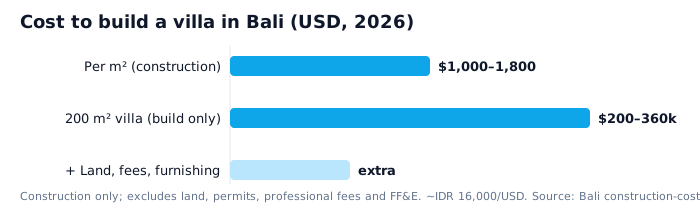
Most investor-grade villas sit between USD 300,000 and USD 600,000; see the full breakdown in our Bali property prices 2026 guide.
References & official sources
- BPS, Statistics Indonesia / Bali: 2025 foreign arrivals (6,948,754, +9.72%), occupancy, bali.bps.go.id
- Bank Indonesia, Residential Property Price Index: official price-growth data & IDR rate, bi.go.id
- BKPM / Invest Indonesia: PT PMA & foreign-ownership rules (Positive Investment List), investindonesia.go.id
- ATR/BPN: land titles (Hak Milik / Hak Sewa / HGB) & zoning, atrbpn.go.id
- DJP / Ministry of Finance: PBB & transaction taxes, pajak.go.id
- Market data (2026): Prestige Property Bali area/yield analysis; Paradyse Homes price-per-are study; Rumavi & InvestLandBali yield reports.
- Magnum Estate portfolio data (net yields by project).
About the author
Stanislav Sadovnikov is the founder of Magnum Estate (PT Magnum Estate International), an award-winning full-cycle Bali real estate developer with 8 projects and 575 units since 2019 (Berawa, Sanur, Umalas, Sky Stars, Sky Royal). He writes about Bali pricing, yields, ownership rules and regulation for international buyers.