





Written by Stanislav Sadovnikov, Founder, Magnum Estate ·
Reviewed by Magnum Estate legal & investment desk ·
Last updated 3 June 2026
"10-15% Target total return / yr (net + growth) · 7-15%/yr Like-for-like appreciation · 4-6% / 10-15% Net yield: self- vs pro-managed · ~18% Illustrative base-case 10-yr IRR"
Key figures (2026)
10 year roi bali villa 2026: summary
The 10 year roi bali villa 2026 question has one honest answer: stop reading the first-year yield and model the full decade. A 10-year hold stacks three things, cumulative net rent, capital appreciation (~7-15% a year), and the exit. Combined, a well-run villa targets 10-15% total return a year, which compounds to a total return comfortably above 100% of capital over ten years in an illustrative base case.
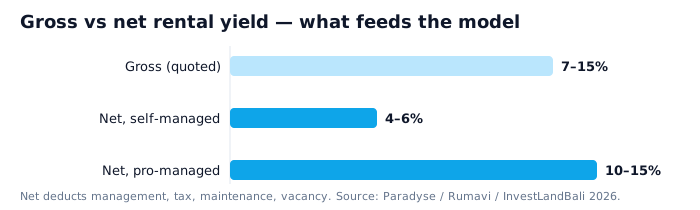
- Net ≠ gross: quoted gross is 7-15%; net is ~4-6% self-managed or ~10-15% professionally managed, that gap is operations.
- Appreciation does the heavy lifting: at 7-15%/yr, the resale value can roughly double-plus over a decade.
- Illustrative base case: a $400k villa at 11% net + 10% appreciation, ~$1.08M total 10-year profit, ~18% IRR (before tax/exit costs).
- Scenarios matter: bear (~8% IRR), base (~18%), bull (~21%), model all three, treat the bull as a bonus.
- It’s a 5-10-year business: the long frame dilutes currency, regulation and tourism shocks. All figures here are illustrative, not a forecast.

"Transparency: Magnum Estate develops property in Bali, so we have a commercial interest. This guide is educational, not investment, tax or legal advice. Every multi-year number below is an illustrative model output, not a promise of returns. Verify figures independently and consult a certified Indonesian notary (PPAT) and tax advisor before buying."
Transparency
If you only remember one thing about 10 year roi bali villa 2026, make it this: the first-year yield tells you almost nothing about a ten-year outcome. A single year is dominated by noise, seasonality, a soft tourism quarter, a currency swing, a one-off renovation. Over a decade, the picture inverts: compounding appreciation and cumulative net rent dominate, and short-term shocks wash out. This guide builds the long-horizon model end to end, net rent, appreciation, exit, and stress-tests it with bear, base and bull scenarios. It is the long-horizon spoke of our ROI cluster: for ROI by area see the Bali villa investment 2026 ROI & locations guide, and for the single-year formula see the Bali villa ROI guide.
Why a 10-year frame for Bali
Property-price indexes and firm-level returns respond to GDP, interest rates, credit growth and exchange-rate cycles, drivers that rarely resolve in one or two years. For Bali specifically, demand shocks (the pandemic being the obvious one) only fully reveal themselves over a 5-10-year series, and appreciation plus rental-income growth smooth out seasonality. That is why serious investors model Bali as a 5-10-year business targeting roughly 10-15% total annual return (net yield plus price growth), accepting short-term volatility along the way. The long frame is not a marketing flourish, it is the only window in which the structural drivers (zoning, management quality, long-stay demand) outweigh the noise.
The three parts of a 10-year return
A decade-long return is the sum of three distinct streams. Keeping them separate is what stops a brochure “20-25% ROI” headline from becoming your assumption:
| Component | What it is | Realistic 2026 input |
|---|---|---|
| 1. Cumulative net rent | Net yield × invested capital, summed year by year | ~4-6%/yr self-managed; ~10-15%/yr professionally managed (net) |
| 2. Capital appreciation | Resale value grown over the hold | ~7-15%/yr like-for-like in strong micro-markets |
| 3. Exit (resale) | Sale proceeds at year 10, less selling & tax costs | Appreciated value − transaction/tax costs; lease term matters |
| Quoted GROSS yields (7-15%, up to 18% in Canggu/Berawa) are the headline; the model uses NET. Source: canonical dataset, ~IDR 16,000/USD. |
The single biggest modelling error is plugging a gross yield into the net-rent line. Quoted gross runs 7-15%; what you actually keep is ~4-6% self-managed or ~10-15% professionally managed, after management, the 10% rental tax, maintenance and vacancy. See exactly how that gap forms in the villa ROI mechanics guide and factor holding costs with the taxes & holding costs guide.
The 10-year projection (illustrative base case)
Here is a fully worked, illustrative base case for the 10 year roi bali villa 2026 horizon. Assumptions: USD 400,000 all-in invested capital, a professionally managed net yield of 11% (mid of the 10-15% band), like-for-like appreciation of 10%/yr (mid of the 7-15% band), and a sale at year 10. Rent is held flat in dollars for conservatism; appreciation compounds on the asset value.
| Year | Net rent (USD) | Cumulative net rent | Resale value (10%/yr) |
|---|---|---|---|
| 1 | 44,000 | 44,000 | 440,000 |
| 2 | 44,000 | 88,000 | 484,000 |
| 3 | 44,000 | 132,000 | 532,400 |
| 4 | 44,000 | 176,000 | 585,640 |
| 5 | 44,000 | 220,000 | 644,204 |
| 6 | 44,000 | 264,000 | 708,624 |
| 7 | 44,000 | 308,000 | 779,487 |
| 8 | 44,000 | 352,000 | 857,436 |
| 9 | 44,000 | 396,000 | 943,179 |
| 10 | 44,000 | 440,000 | 1,037,497 |
| ILLUSTRATIVE model, not a forecast. Invested $400k; net 11%; appreciation 10%/yr; flat USD rent; ~IDR 16,000/USD. Before exit and tax costs. |
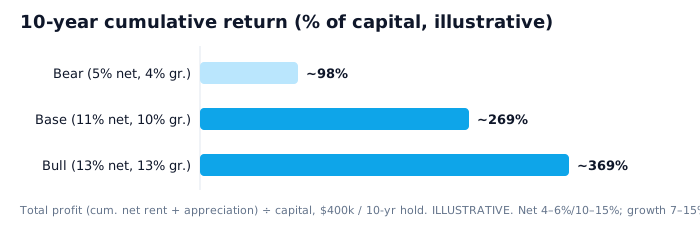
Over ten years this base case produces about USD 440,000 in cumulative net rent and an appreciation gain of roughly USD 637,000 (resale ≈ USD 1.04M against USD 400k invested), a total 10-year profit near USD 1.08M, or about 269% of the capital invested, before selling and tax costs. The rent alone returns your capital in roughly nine years; appreciation is what turns a steady income asset into a wealth-building one.
Total return & IRR illustration
Total return and IRR are two ways to read the same cash flows. Total return answers “how much did my capital grow?”; IRR (internal rate of return) answers “what annualised rate did that imply, accounting for when the cash arrived?”. For the base case, capital out at year 0, net rent each year, and the appreciated value realised at exit, the IRR lands near 18% (illustrative).
A few honest caveats on the IRR line. It is computed before transaction and income tax, before exit selling costs, and it assumes the asset can be sold at the modelled value, which depends heavily on the remaining lease term (a leasehold with few years left does not fetch the freehold-style price). Read these as the shape of a 10-year outcome, not a quote.
Bear, base & bull scenarios
No serious 10-year model is a single number. The discipline is to run three: a bear case that still has to clear positive total return, a base case you actually underwrite to, and a bull case you treat strictly as upside, never as justification for the entry price. All three below use the same USD 400,000 entry and 10-year hold:
| Scenario | Net yield | Appreciation/yr | Cum. net rent | Resale value | Total 10-yr profit | Illustrative IRR |
|---|---|---|---|---|---|---|
| Bear (stress) | 5% | 4% | $200,000 | $592,000 | ~$392,000 (~98%) | ~8% |
| Base (underwrite) | 11% | 10% | $440,000 | $1,037,000 | ~$1,077,000 (~269%) | ~18% |
| Bull (upside) | 13% | 13% | $520,000 | $1,358,000 | ~$1,478,000 (~369%) | ~21% |
| ILLUSTRATIVE scenarios, not forecasts. Bear adds a soft-occupancy, slow-growth stress; the test is that it still clears positive total return. Net yields per canonical 4-6%/10-15%; growth 7-15%/yr. |
The takeaway: even the bear case roughly doubles capital over a decade in this illustration, but only because both the net yield and the appreciation rate stay positive. The real downside protection is location plus operations: pick where 10-year demand is structural, then run it professionally. Compare the long-run profile of the two coasts in Canggu vs Uluwatu and the wider market in our 2026 market forecast.
Model your own 10-year hold on a real asset
See transparent pricing and projected net yields across Magnum Estate’s Berawa, Sanur and Uluwatu developments, then run the decade yourself.
View Magnum projects
Book a free consultation
What moves the number over a decade
Across a 10-year hold, four levers explain almost all of the variance between a bear and a bull outcome:
- Management quality. Weak operations can drag the same villa from a 10-15% net yield down toward 4-6%, the difference between the base and bear net-rent columns above is mostly this. Locking in developer-run rental management from day one is the simplest way to keep this lever at the top of the band.
- Location & structural demand. Core-yield zones (Canggu/Berawa, Uluwatu, Seminyak) carry the deepest year-round demand; defensive zones (Sanur, Ubud) trade headline yield for stability over the decade.
- Appreciation regime. A 7% vs a 13% growth assumption is the single largest swing in the resale column, and it is the hardest to control, so model it conservatively.
- Lease/title & exit. A leasehold’s remaining term at year 10 directly sets the resale price; pairing a proven hotspot with an emerging-zone position can balance growth and entry cost.
For the area-by-area version of these levers, which zones deliver which gross yields and why, use the ROI & locations hub; this page deliberately stays on the long-horizon math rather than repeating the by-area table.
Limitations & suitability
This long-horizon model is not for you if you need liquidity inside 2-3 years, can’t tolerate currency or occupancy volatility, or are relying on the bull case to make the entry price work. A 10-year Bali hold suits investors who can leave capital deployed, accept that year-one cash flow is the least important number, and verify lease term and title before buying. Foreigners cannot hold freehold (Hak Milik) directly, most structure via leasehold (Hak Sewa) or a PT PMA (HGB), which shapes the exit. Read the foreigner ownership legal guide before modelling an exit value.
Methodology & sources
All multi-year figures are illustrative model outputs, not forecasts. Inputs are the canonical 2026 ranges: net yield 4-6% self-managed / 10-15% professionally managed (area yields quoted elsewhere are gross, 7-15%, up to 18% in Canggu/Berawa); like-for-like appreciation ~7-15%/yr; land +15-30% over two years. Currency converted at ~IDR 16,000/USD. The projection uses a $400,000 entry, flat USD net rent, compounding appreciation on asset value, and a single exit at year 10, before transaction tax, income tax and selling costs. IRR is a bisection solve on the resulting cash-flow series. Real outcomes vary with lease term, occupancy, ADR and management; commission an independent appraisal and notary (PPAT) due diligence before purchase.
Conclusion
The 10 year roi bali villa 2026 answer is not a single headline percentage, it is a model. Stack cumulative net rent on appreciation on a clean exit, run it through bear, base and bull, and the decade reveals what one year hides: a well-located, professionally managed villa can target 10-15% total return a year and, illustratively, more than double the capital invested over ten years. The work is in the inputs, net not gross, conservative appreciation, an exit you can actually achieve.
Ready to underwrite a real 10-year case?
Explore Magnum Estate’s ocean-view residences in Uluwatu, Berawa and Sanur, transparent pricing and projected net yields you can drop straight into this model.
Uluwatu, Sky Stars
Berawa
Sanur
FAQ: 10 year roi bali villa 2026
What is a realistic 10-year ROI on a Bali villa in 2026?
Roughly 10-15% total return a year for a well-chosen, professionally managed villa, net yield (~10-15% pro-managed, or 4-6% self-managed) plus ~7-15%/yr appreciation. Illustratively that compounds to a total return well above 100% of capital over a decade, before tax and exit costs.
How do I model the 10-year horizon?
Sum cumulative net rent, capital appreciation and the exit over ten years; express it as total return and IRR; then stress-test with bear, base and bull. Treat every output as illustrative.
Why a 10-year frame instead of one year?
One year is noise, seasonality, currency, a one-off renovation. A decade lets appreciation compound and smooths occupancy cycles, which is why Bali is a 5-10-year business, not a flip.
What appreciation rate should I assume?
About 7-15%/yr like-for-like in strong micro-markets; land in prime belts rose ~15-30% over two years. Ignore “listings up 50%” headlines, that’s a stock-mix shift, not appreciation.
What’s the biggest risk to a 10-year hold?
Weak operations (which can pull net from 10-15% toward 4-6%) and a shortening leasehold eroding exit value. Model a bear case; if it still clears positive total return, the asset is robust.
Where do area-level ROI numbers live?
In the ROI & locations hub; the single-year formula is in the villa ROI mechanics guide. This page is the long-horizon model.
References & official sources
- BPS, Statistics Indonesia / Bali: 2025 foreign arrivals (6,948,754, +9.72%), occupancy, bali.bps.go.id
- Bank Indonesia, Residential Property Price Index: official price-growth & IDR/USD data, bi.go.id
- DJP / Ministry of Finance: rental-income, PBB & transaction taxes used in net-yield and exit costs, pajak.go.id
- ATR/BPN: land titles, leasehold/HGB terms affecting exit value, atrbpn.go.id
- World Bank: Indonesia GDP & macro context for the long-horizon view, data.worldbank.org
- Market data (2026): Bali Villa Realty price guide; Paradyse Homes price-per-are (AirDNA-benchmarked); Prestige Property Bali area/yield; InvestLandBali market report.
- Magnum Estate portfolio data (net yields by project).
About the author
Stanislav Sadovnikov is the founder of Magnum Estate (PT Magnum Estate International), an award-winning full-cycle Bali real estate developer with 8 projects and 575 units since 2019 (Berawa, Sanur, Umalas, Sky Stars, Sky Royal). He writes about Bali pricing, yields, ownership rules and regulation for international buyers.