





Written by Donny Yosua, Magnum Estate Analyst ·
Reviewed by Magnum Estate legal & investment desk ·
Last updated 3 June 2026
"~1,000 ha/yr Bali farmland lost to development · 4-6% / 10-15% Net yield: self- vs pro-managed · $250-1,900 Land per m² (emerging, Seminyak) · 6.95M 2025 foreign arrivals (+9.7%)"
Key figures (2026)
Bali sustainable real estate 2026: summary
Bali sustainable real estate 2026, the short answer: ESG is no longer a marketing label, it is a value driver. Eco-luxury villas that prove environmental compliance, energy and water efficiency, and climate-grade engineering tend to earn higher nightly rates, cost less to run and resell more easily, while non-compliant sprawl now carries real regulatory risk.
- Green protects the net, not the gross: efficiency cuts running costs, defending net yields of ~4-6% self-managed and ~10-15% professionally managed.
- Premium is real but estimate-level: credibly green, well-located villas can command a meaningful nightly-rate premium (industry estimate, verify per project).
- Certifications & approvals matter: AMDAL / UKL-UPL, zoning compliance and documented specs separate genuine projects from greenwashing.
- Where it works: Ubud, planned coastal zones (Sanur, Nusa Dua) and green corridors (Tabanan, Seseh, Sidemen), land under ~$250/m² in emerging areas leaves budget for build quality.
- Regulatory direction: stricter zoning, tourism levies, caps on large hotels, quality over quantity.

"Transparency: Magnum Estate develops property in Bali, so we have a commercial interest. This guide is educational, not investment, legal or environmental advice, verify figures and approvals independently and consult a certified Indonesian notary (PPAT), tax advisor and environmental consultant before buying."
Transparency
This Bali sustainable real estate 2026 guide reframes the island’s market through an eco-luxury and ESG lens. The 2026 market is no longer only about yield and location, it is about whether a villa fits Bali’s long-term environmental and social future. Investors, regulators and guests are all pushing toward eco-conscious, compliant, community-aligned projects. Below: what “sustainable” means in concrete terms, how green build quality protects returns, where it fits geographically, and which way regulation is heading.
Why sustainability now drives value in Bali property
The old model, build as many villas as fast as possible, is running out of road. Research on Bali land use estimates more than 1,000 hectares of agricultural land lost annually, much of it converted to villas and condotels, eroding green space and ecological buffers. Overtourism studies document water scarcity, waste pressure, reef damage and habitat loss as direct consequences of uncontrolled development. Against that backdrop, demand keeps climbing: Bali drew 6,948,754 foreign visitors in 2025, up 9.72% year-on-year, and prime-area occupancy runs 70-85% (island-wide average closer to ~65%). More arrivals on a finite, fragile island is exactly why low-impact, well-planned product is moving from “nice to have” to “value driver.”
The takeaway: scarcity plus scrutiny rewards quality. The same logic that makes location-sensitive pricing matter (see best areas to buy property in Bali 2026) now applies to sustainability, compliant, durable, efficient builds are the ones positioned to hold value as rules tighten.
What “sustainable real estate” actually means in Bali
In Bali, sustainability has concrete, measurable dimensions, not a buzzword. Local research applies the Balinese philosophy of Tri Hita Karana (harmony with the divine, people and nature) to score villas on environmental, social and spiritual criteria, often exposing gaps between branding and practice. Translated into practical buyer criteria, a genuinely sustainable Bali project shows:
| Dimension | What to verify | Why it matters |
|---|---|---|
| Legal & environmental | AMDAL / UKL-UPL approvals, zoning, setbacks, building-height limits | Foundation of long-term value and regulatory security |
| Energy | Efficient envelope, solar capacity, low-energy cooling | Lower running cost; protects net yield |
| Water | Water-saving fixtures, rainwater/greywater reuse, no aquifer overdraw | Bali water stress is a real and rising risk |
| Waste & materials | On-site/integrated waste plan, reduced single-use plastic, durable climate-grade materials | Less maintenance and waste over a 10-20 yr horizon |
| Community & culture | Local employment, cultural fit, fair benefit sharing | Reduces backlash; supports guest demand |
| Criteria synthesised from Tri Hita Karana villa assessments, sustainable-tourism research and Magnum Estate’s premium-construction guide. Documents beat claims. |
Greenwashing check: a sustainability “story” without AMDAL/UKL-UPL paperwork and spec sheets is marketing. Make environmental approvals and engineering documentation part of due diligence, see our Bali property due diligence checklist and zoning risk guide.
The economics of eco-luxury: ADR premium & cost savings
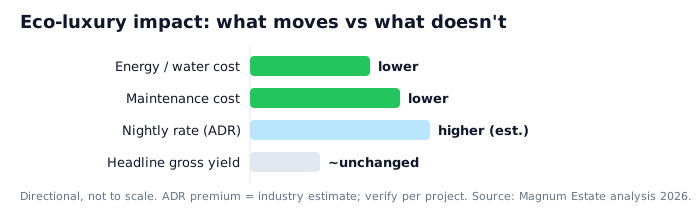
Here is the honest version of the “green pays” story. Eco features rarely move the headline gross yield much, that is set mostly by price and rent level. Where they pay is on the cost side and the rate side: efficient envelopes and solar cut energy bills, water reuse cuts utility and risk, and durable climate-grade materials cut maintenance over a 10-20 year hold. On the revenue side, credibly green, well-located villas can command a higher nightly rate (ADR) from the “nature-seeking” and wellness guest segments, but treat any specific premium figure as an industry estimate until validated against real booking data for a given property. The net effect is risk reduction and value protection, not a magic yield uplift.
Rental yields: gross vs net (where green actually pays)
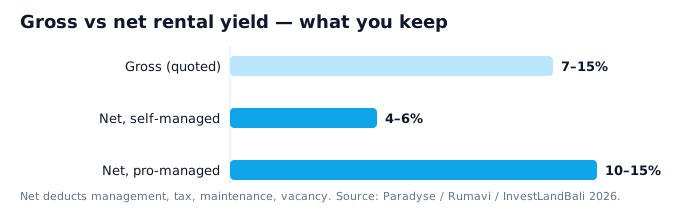
Most “8-15% yield” claims you’ll see are gross, annual rent ÷ price, before costs. In prime areas, gross yields run roughly 10-18% (Canggu/Berawa 12-18%, Uluwatu 10-16%, Ubud 10-15%, Seminyak 10-14%, North Bali 6-10%). What you keep is the net yield, after management, tax, maintenance and vacancy: about 4-6% self-managed or 10-15% professionally managed. Sustainability lives almost entirely on the net side, it is the lever that shrinks energy, water and maintenance lines and helps defend the upper half of the net range.
The gap between 4-6% and 10-15% net is operations + efficiency: data-driven pricing, OTA distribution, cost control and a building that is cheap to run. Model holding costs with our taxes & holding costs guide and see how management drives returns in our villa ROI guide.
Where eco-luxury fits: areas & land cost
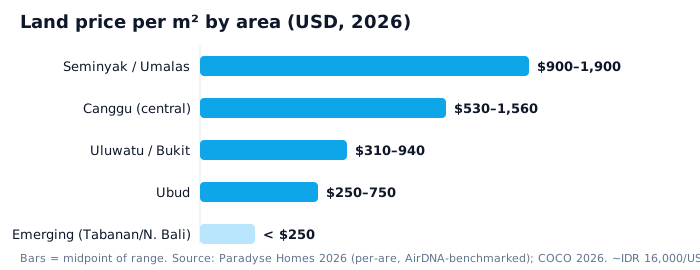
Eco-luxury tends to fit best where land is not at peak prime prices and where carrying capacity, culture and infrastructure are being actively managed. That points to Ubud (wellness, long-stay, lower volatility), planned coastal zones like Sanur and Nusa Dua, and emerging green corridors such as Tabanan, Seseh, Cemagi and Sidemen. The land-cost map explains why: at under ~$250/m² in emerging areas versus $900-1,900/m² in Seminyak, buying away from the prime south frees budget to spend on solar, water systems and durable materials rather than land alone.
| Area | Land price per m² | Gross yield | Eco-luxury fit |
|---|---|---|---|
| Ubud | ~$250-750 | 10-15% | Strong, wellness & long-stay, low density, jungle/rice-field setting |
| Sanur | part of southern range | 10-14% | Strong, planned, family/long-stay, calmer coast |
| Uluwatu / Bukit | ~$310-940 | 10-16% | Selective, cliff-top luxury; manage water carefully |
| Canggu / Berawa | ~$530-1,560 | 12-18% | High demand but dense; green build is a differentiator |
| Emerging (Tabanan, Seseh, Sidemen) | < $250 | 6-18% | Best value for green spend; longer horizon |
| Land per m² from Paradyse Homes 2026 (per-are, AirDNA-benchmarked) & COCO 2026; gross yields from Prestige Property Bali 2026. ~IDR 16,000/USD. Ranges are GROSS yields, before costs. |
The takeaway: for the same budget you secure far more land, and room for green features, in Ubud, Sanur or an emerging corridor than in Seminyak. Compare the coasts in Canggu vs Uluwatu and the long vs short-stay fit in our rental strategy guide.
See eco-luxury done to spec, not to slogan
Explore Magnum Estate’s Sanur development, planned, low-impact and built for a 10-20 year horizon.
Sanur, Sky Royal
Book a free consultation
Policy & the push to “build smarter, not more”
Policy research on Bali’s coastal zones warns that climate change, sea-level rise and poorly planned development threaten ecosystems and long-term investment value, and calls for integrated coastal-zone management. Spatial-planning studies show weak oversight has let more than 60% of productive land in some areas shift away from agriculture. The regulatory response points one way: limits on large new hotels, stronger zoning enforcement, tourism levies, and redistribution of revenue from high-tourism districts toward under-developed regions for infrastructure and flood prevention, with eco-residential and boutique projects favoured over mass capacity. For buyers, the read-across is simple: a compliant, low-impact villa is the one least exposed to future rule changes and community backlash.
Ownership & compliance: foreigners cannot hold freehold (Hak Milik) directly, use Leasehold (Hak Sewa) or a PT PMA (HGB). Pair the right structure with environmental approvals; see how foreigners own property in Bali 2026 and leasehold vs freehold vs PT PMA.
Sustainable investor playbook for 2026
- Start with legal & spatial compliance. Confirm zoning, height limits, setbacks and environmental approvals (AMDAL / UKL-UPL) before buying land or an off-plan unit.
- Demand verifiable build quality. Ask for engineering docs, material specs, solar and water-efficiency details and a real waste plan, credible practice, not claims.
- Choose locations aligned with long-term planning. Favour areas where carrying capacity, infrastructure and community involvement are managed (Ubud, Sanur, Nusa Dua; green corridors in Tabanan/Sidemen).
- Underwrite over 10-20 years, not 1-2 seasons. Use NPV/IRR and sensitivity analysis; treat ESG and build quality as risk-reduction and value-protection, not extra cost.
Build the model on real numbers, not hype, our invest with data, not hype guide and the 2026 market forecast show how to frame a long-horizon, quality-over-quantity thesis.
Limitations & suitability
Eco-luxury is not for everyone. Green build raises upfront cost, so it suits buyers underwriting a long hold who can wait for lower running costs and resale strength to compound, not those chasing a quick flip. It is a poor fit if you need maximum nightly volume in the densest party-belt micro-markets, where the green premium is hardest to capture, or if your budget is fully consumed by land in prime Seminyak/central Canggu with nothing left for efficiency systems. The ADR premium discussed here is an industry estimate; it is not guaranteed and varies by property, operator and segment.
Methodology & sources
Figures are indicative 2026 ranges, reconciled across multiple market datasets and converted at ~IDR 16,000/USD. Land prices are stated per m² (from per-are data; 1 are = 100 m²). Area yield percentages are GROSS (rent ÷ price, before costs); the net figures (~4-6% self-managed, ~10-15% professionally managed) deduct management, tax, maintenance and vacancy and are kept separate throughout. Any green nightly-rate (ADR) premium is an industry estimate, not a guaranteed figure. Always commission an independent appraisal, environmental review and notary (PPAT) due diligence before purchase.
Conclusion
In 2026, Bali rewards projects that are legal, durable, efficient and genuinely low-impact. For investors in Bali sustainable real estate 2026, the winning move is to treat ESG as underwriting: verify approvals, demand documented green specs, pick a location aligned with where policy is going, and model returns over a decade. Done that way, sustainability is not a cost, it is how you protect income and resale value as the island’s rules and guests both raise the bar.
Build on the right side of Bali’s future
Explore Magnum Estate’s planned, low-impact residences in Sanur, Berawa and Uluwatu, transparent pricing and projected net yields.
Sanur, Sky Royal
Berawa
Uluwatu, Sky Stars
FAQ: Bali sustainable real estate 2026
Why does sustainability matter for Bali property investors in 2026?
Uncontrolled development has cost Bali green space, water security and ecosystem health, while policy and buyers now reward compliant, low-impact, well-engineered projects. ESG-aligned villas tend to earn higher nightly rates, cost less to run and resell more easily, protecting income and value.
How can I tell if a project is genuinely sustainable, not greenwashed?
Ask for AMDAL/UKL-UPL approvals and zoning compliance, documented solar and water-efficiency specs, a real waste-management plan, climate-appropriate engineering and community engagement. Documents beat claims.
Does building green actually improve ROI?
It rarely moves the headline gross yield much, but it protects the net yield by lowering energy, water and maintenance costs and supporting premium nightly rates. Net yields run ~4-6% self-managed and ~10-15% professionally managed.
Which areas suit eco-luxury and sustainable projects?
Ubud and its surroundings, planned coastal zones (Sanur, Nusa Dua) and green corridors in Tabanan, Seseh and Sidemen. Land under ~$250/m² in emerging areas leaves budget for green build quality.
How is policy responding to environmental pressure?
The direction is stricter spatial oversight, tourism levies, limits on large new hotels, stronger zoning enforcement and revenue redistribution toward under-developed regions and flood prevention.
Is the nightly-rate “green premium” guaranteed?
No. A premium for credibly green, well-located villas is plausible and supported by guest-segment research, but specific figures are industry estimates, validate against real booking data per property.
What returns horizon should I use?
Underwrite over 10-20 years with NPV/IRR and sensitivity analysis, not a single season. Green build pays back through lower running costs and resale strength over time.
References & official sources
- BPS, Statistics Indonesia / Bali: 2025 foreign arrivals (6,948,754, +9.72%), occupancy, land-use change, bali.bps.go.id
- Bank Indonesia, Residential Property Price Index: official price-growth data & IDR/USD, bi.go.id
- ATR/BPN: land titles (Hak Milik / Hak Sewa / HGB) & zoning, atrbpn.go.id
- DJP / Ministry of Finance: PBB (~0.1%) & transaction taxes, pajak.go.id
- Kemenparekraf (Ministry of Tourism): sustainable-tourism strategy & carrying capacity, kemenparekraf.go.id
- Market & ESG data (2026): Paradyse Homes price-per-are study (AirDNA-benchmarked); Prestige Property Bali area/yield analysis; InvestLandBali market report; Tri Hita Karana villa-sustainability and Bali ecotourism research.
- Magnum Estate portfolio data (net yields & green ADR premium by project).
About the author
Donny Yosua is a market analyst at Magnum Estate, an award-winning Bali developer (Berawa, Sanur, Sky Stars, Sky Royal). He tracks Bali pricing, yields, regulation and sustainability for foreign investors.