





Written by Stanislav Sadovnikov, Founder, Magnum Estate ·
Reviewed by Magnum Estate legal & investment desk ·
Last updated 3 June 2026
"10-18% Gross yield, prime areas · 4-6% / 10-15% Net yield: self- vs pro-managed · ~$256-299k Median villa price (island) · 6.95M 2025 foreign arrivals (+9.7%)"
Key figures (2026)
Bali villa investment 2026: summary
Bali villa investment 2026, the honest answer: realistic ROI on Bali property is 10-15%+ total return a year — net rental yield plus capital growth — not the 20-25% brochure ROI. Quoted gross yields run 7-15% (up to 18% in prime Canggu/Berawa), but what you keep, the net yield, is about 4-6% self-managed or 10-15% professionally managed, after fees, tax, maintenance and vacancy. Add roughly 7-15% a year of capital growth in strong micro-markets and total returns of 10-15%+ are realistic. By area, Canggu/Berawa leads on gross yield at 12-18%, followed by Uluwatu at 10-16%, Ubud at 10-15% and Seminyak at 10-14%, while Uluwatu land appreciates fastest and Canggu/Berawa holds the deepest year-round demand. Most investor-grade villas trade between USD 300,000 and 600,000, close to the island median of USD 256,000-299,000. Demand underpins these returns: Bali drew 6.95M foreign visitors in 2025, up 9.7% year-on-year, keeping prime-area occupancy at 70-85%, but the gap between the low and high end of net yield is operations, not the headline rent.
- Highest gross yield: Canggu/Berawa 12-18%, then Uluwatu 10-16%, Ubud 10-15%, Seminyak 10-14%.
- Gross ≠ net: the gap between 4-6% and 10-15% net is operations, not the headline rent.
- Entry price: most investor-grade villas are USD 300,000-600,000; island median ≈ $256-299k.
- Fastest appreciation: Uluwatu land; deepest year-round demand: Canggu/Berawa.
- Demand base: Bali drew 6.95M foreign visitors in 2025 (+9.7% YoY); prime occupancy 70-85%.

"Transparency: Magnum Estate develops and manages property in Bali, so we have a commercial interest. This guide is educational, not investment or legal advice, verify figures independently and consult a certified Indonesian notary (PPAT) and tax advisor before buying."
Transparency
This Bali villa investment 2026 guide reconciles the latest market data into one realistic picture of returns, area by area. By 2026, Bali’s market has moved from its post-pandemic boom into a more selective, data-driven phase: the winners are not those who chase the highest advertised ROI but those who buy the right villa, in the right legal structure, and operate it like a business. Below are the real yields, the best locations, what your budget buys, and the simple maths to separate a genuine return from a brochure number.
The 2026 market in numbers
Bali drew 6,948,754 foreign visitors in 2025, up 9.72% year-on-year, pushing prime-area villa occupancy to 70-85% (island-wide average closer to ~65%). Land values across the island appreciated roughly 15-30% over the past two years, and like-for-like price growth is running near 7-15% a year in strong micro-markets. That demand base is what underpins villa returns, but as the next section shows, the rent a villa earns and the cash an investor keeps are two very different numbers.
ROI reality: gross vs net yield
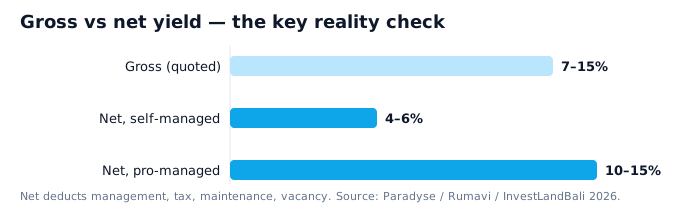
Most “8-15% yield” claims you’ll see for Bali villa investment are gross, annual rent ÷ price, before costs. What you actually keep is the net yield, after management, tax, maintenance and vacancy. This is the single biggest source of disappointed Bali investors, and the reason a “20% villa” can quietly become a 5% one:
| Metric | Typical range | What it means |
|---|---|---|
| Gross yield (quoted) | 7-15% | Annual rent ÷ purchase price, before any costs |
| Net yield, self-managed | 4-6% | After tax, maintenance, vacancy and owner time |
| Net yield, professionally managed | 10-15% | After fees, but with higher occupancy & ADR |
| Annual capital growth (strong areas) | ~7-15% | Like-for-like price appreciation, not stock-mix shift |
| Gross and net are kept strictly separate. Net is what reaches your account. Source: Paradyse / Rumavi / InvestLandBali 2026. |
The gap between 4-6% and 10-15% net is operations: data-driven pricing, OTA distribution and cost control. See how management drives returns in our Bali villa ROI guide, and factor holding costs with the taxes & holding costs guide.
Bali villa investment 2026: ROI by location
Bali villa rental yield 2026: gross vs net by area
Rental yield is the number that decides a Bali villa investment, so keep the gross figure and the net figure separate. Gross yield is annual rent divided by price. Net yield is what actually reaches you after management, staff, utilities, maintenance and rental-income tax, usually 30 to 50 percent below gross. Judge any Bali villa investment on the net number, not the gross headline.
Here are the projected net yields for Magnum’s current developments, modelled under in-house rental management at realistic Bali occupancy (island-wide villa occupancy has run around 65 percent in recent full-year data), not a marketing best case:
- The Umalas Signature (Umalas): from $225,000, projected 12.3% net yield
- Magnum Resort Berawa (Canggu): from $339,000, projected 12.1% net yield
- Magnum Resort Sanur (Sanur): from $531,000, projected 11.6% net yield
- Sky Stars Ocean View (Uluwatu): from $508,000, projected 10.8% net yield
- Darma Residence (Umalas): from $225,000, projected 9.5% net yield
So the honest answer on Bali villa investment returns: expect a projected 9.5 to 12.3 percent net rental yield by area and unit, plus capital appreciation as each project completes, not the 15 to 20 percent gross figures listing portals advertise. You can see the current developer-direct villas and apartments for sale or read how we calculate net yield below.
Every zone has a different risk/return profile. The gross-yield ranking below is consistent across 2026 market datasets; net depends on how the villa is run (see above):
| Area | Gross yield | Investor profile |
|---|---|---|
| Canggu / Berawa | 12-18% | Deepest year-round rental demand (digital-nomad, surf, lifestyle); sensitive to oversupply and management quality |
| Uluwatu / Bukit | 10-16% | View-driven luxury with strong ADRs; fastest land appreciation; ideal for branded/resort-integrated concepts |
| Ubud | 10-15% | Wellness & long-stay; low volatility; design-led, retreat-oriented homes |
| Seminyak | 10-14% | Most established; best exit liquidity; premium build & running costs |
| North Bali (Lovina) & emerging | 6-10% | “Next wave” west of Canggu and the north; more land per dollar, longer horizon |
| Gross yield only (before costs). Net yields land at ~4-6% self-managed or ~10-15% pro-managed in each area. Source: Prestige Property Bali 2026. |
The takeaway: the highest gross yield (Canggu/Berawa) is not automatically the best investment, it is the most management-intensive and the most exposed to new supply. Uluwatu trades some current yield for the fastest land appreciation. Compare the two coasts in Canggu vs Uluwatu and the wider map in best areas to buy in Bali 2026. You can also browse current villas for sale in Bali from the developer to see how each area prices in practice.
What an investment villa costs by area in 2026
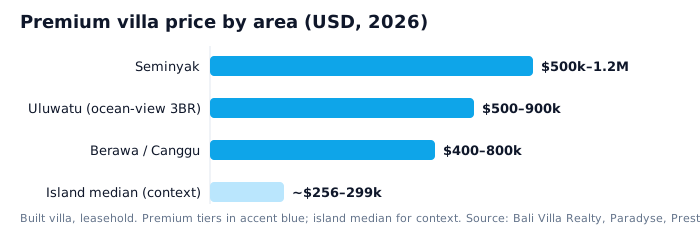
Whole-villa prices follow the yield logic but blur with product type (an ocean-view Uluwatu villa can exceed a Canggu entry villa). Typical built, leasehold ranges in 2026, most investor-grade villas sit between USD 300,000 and USD 600,000:
| Area | Typical villa price | Gross yield | Profile |
|---|---|---|---|
| Seminyak | $500k, 1.2M | 10-14% | Most established; best exit liquidity |
| Uluwatu / Bukit | $500-900k (3BR ocean view) | 10-16% | Luxury views; fastest land appreciation |
| Canggu / Berawa | $400-800k | 12-18% | Deepest rental demand, year-round |
| Ubud | $250-500k | 10-15% | Wellness & long-stay; low volatility |
| Emerging (Seseh, Cemagi, Tabanan) | $100-600k | 6-18% | More space per dollar; growth upside |
| Build cost adds ~USD 1,000-1,800/m² for an investment-grade villa. Island median ≈ $256-299k; full range $60k, $6M. Land runs from under $250/m² (emerging) to $900-1,900/m² (Seminyak), see our Bali property prices 2026 guide. |
See real 2026 villa numbers, not averages
Compare live pricing and projected net yields across Magnum Estate’s Berawa, Sanur and Uluwatu developments.
View Magnum projects
Book a free consultation
How to calculate Bali villa investment returns honestly
The maths is simple; the discipline is in subtracting every real cost. Two formulas cover most cases:
- Annual net ROI = (annual rent − annual costs) ÷ total cost in. Total cost in includes purchase price, taxes and legal fees, furnishings, renovation and start-up costs, not just the sticker price.
- Total annual return = net rental yield + annual capital appreciation. In strong micro-markets this is where the 10-15%+ headline comes from, with appreciation of ~7-15%/yr doing much of the work.
Costs you must subtract before quoting a net number:
- Management fees, staff, utilities, maintenance and marketing.
- Local hotel/restaurant tax (PHR), rental-income tax and insurance.
- Annual land & building tax (PBB, ~0.1% of assessed value) and loan servicing, if financed.
- Realistic vacancy, even prime occupancy tops out around 70-85%, not 100%.
Worked through properly, a headline “15-20% brochure ROI” typically settles into a 4-6% net yield self-managed or 10-15% professionally managed, still attractive, but a long way from a “guaranteed 25%”. For a full long-horizon model (NPV, IRR, payback over a 10-year hold), see our real 10-year ROI insights and the 10-year ROI investor guide.
Structure changes the number. Foreigners cannot hold freehold (Hak Milik) directly; investment villas are held via Leasehold (Hak Sewa) or a PT PMA company with HGB/Hak Pakai. The remaining lease term and licensing (PBG/SLF, rental permits) materially affect both yield and exit value, confirm them before you model returns. See buying property in Bali as a foreigner.
What actually makes a Bali villa investment succeed
Across area reports and Bali villa case studies, the same factors separate the 5% villas from the 12% villas:
- Legal structure and compliance. Correct land title (Leasehold, Hak Pakai, or PT PMA with HGB), clear zoning (ITR/KKPR), PBG/SLF permits and proper rental licensing. Compliant villas trade at a premium; grey-area assets carry discounts and exit risk.
- Design and build quality. Structure, waterproofing, acoustics and materials drive guest reviews, occupancy and ADR. See Magnum’s premium construction focus.
- Data-driven operations. Dynamic pricing, multi-channel (OTA) distribution, strong reviews and preventative maintenance are what keep a villa in the 10-15% net band year after year.
- Honest underwriting. Model net, not gross; price in vacancy and tax; treat 20%+ as an upside scenario, never the base case.
For many investors the most efficient route is to buy into a developer-managed villa or resort project, buying an operating product, not just a building shell, rather than assembling legal, construction and management pieces alone. That is the logic behind Bali property management for investors run by the developer itself.
Limitations & who this is not for
These are indicative 2026 ranges, not guarantees, and Bali villa investment is not for everyone:
- It is illiquid. Leasehold villas can take months to exit, and a depreciating lease term erodes value, plan a 5-10-year hold to smooth tourism cycles and recoup capex.
- It is operationally intensive. The high net yields assume active, professional management. A passive owner expecting brochure numbers will usually be disappointed.
- It is FX- and regulation-exposed. Returns are earned in IDR and reported here at ~IDR 16,000/USD; rupiah moves and zoning/licensing changes can shift the picture.
- It is not a fixed-income substitute. If you need predictable monthly cash with capital protection, a villa is the wrong instrument.
Methodology & sources
Figures are indicative 2026 ranges, reconciled across multiple market datasets and converted at ~IDR 16,000/USD. Prices are stated in USD; land (where referenced) is per m² (from per-are data, 1 are = 100 m²). Gross yields are rent ÷ price before costs; net yields deduct management, tax, maintenance and vacancy and are reported separately. Always commission an independent appraisal and notary (PPAT) due diligence before purchase.
Conclusion
In 2026, Bali villa investment rewards precision over averages: start from the area’s realistic net yield, not the quoted gross; add only defensible appreciation; subtract every real cost; and verify title, zoning and licensing first. The strongest plays pair a proven hotspot (Canggu, Uluwatu, Seminyak) with disciplined, professional management, that operations layer is the difference between a 4-6% villa and a 10-15% one.
Ready to see the real numbers?
Explore Magnum Estate’s ocean-view residences in Uluwatu, Berawa and Sanur, transparent pricing and projected net yields, or start with the shorter Bali property investment overview that puts each project’s entry price next to its projected net ROI.
Uluwatu, Sky Stars
Berawa
Sanur
FAQ: Bali villa investment 2026
Is Bali villa investment still worth it in 2026?
Yes, for well-chosen, professionally managed villas in strong locations. Realistic net yields are ~4-6% self-managed and ~10-15% professionally managed, plus ~7-15%/yr capital growth in strong micro-markets. Headline 20-25% returns are outliers, not base cases.
What ROI should I realistically target for a Bali villa?
Treat gross yield (7-15%) as the quoted headline and net yield as what you keep: ~4-6% self-managed or ~10-15% professionally managed. Combined with appreciation, total returns of 10-15%+ a year are achievable in prime areas.
Which areas are best for Bali villa investment right now?
On gross yield: Canggu/Berawa (12-18%), Uluwatu/Bukit (10-16%), Ubud (10-15%), Seminyak (10-14%); North Bali is lower (6-10%). Canggu has the deepest year-round demand; Uluwatu the fastest land appreciation.
What does an investment villa cost in 2026?
Most investor-grade villas sit between USD 300,000 and USD 600,000. The island median is ~USD 256,000-299,000; the full range runs ~USD 60,000 to USD 6 million. Build cost adds ~USD 1,000-1,800/m².
How long should I plan to hold a Bali villa?
Plan a 5-10-year hold to smooth tourism cycles and recoup capex; long-horizon feasibility studies model villas over 15-20 years. See our 10-year ROI investor guide.
What is the biggest mistake villa investors make in Bali?
Confusing gross with net yield and over-trusting brochure ROI. The gap between 4-6% and 10-15% net is operations and cost control, price everything in, and many flashy deals underperform while well-structured villas quietly compound.
References & official sources
- BPS, Statistics Indonesia / Bali: 2025 foreign arrivals (6,948,754, +9.72%), occupancy, bali.bps.go.id
- Bank Indonesia, Residential Property Price Index: official price-growth data & IDR/USD rate, bi.go.id
- DJP / Ministry of Finance: PBB, PHR & rental-income taxes, pajak.go.id
- ATR/BPN: land titles (Hak Milik / Hak Pakai / HGB) & zoning, atrbpn.go.id
- BKPM / Invest Indonesia: PT PMA & foreign-ownership rules, investindonesia.go.id
- Market data (2026): Prestige Property Bali area/yield analysis; Paradyse Homes price-per-are study (AirDNA-benchmarked); Bali Villa Realty price guide; InvestLandBali & Rumavi gross-vs-net reports.
- Magnum Estate portfolio data (net yields by project).
About the author
Stanislav Sadovnikov is the founder of Magnum Estate (PT Magnum Estate International), an award-winning full-cycle Bali real estate developer with 8 projects and 575 units since 2019 (Berawa, Sanur, Umalas, Sky Stars, Sky Royal). He writes about Bali pricing, yields, ownership rules and regulation for international buyers.
Related reading:
Bali villa ROI guide ·
Real 10-year ROI insights ·
10-year ROI investor guide ·
Bali property prices 2026 ·
Best areas to buy in Bali 2026