





Written by Stanislav Sadovnikov, Founder, Magnum Estate ·
Reviewed by Magnum Estate legal & investment desk ·
Last updated 3 June 2026
"7 steps Goal, area, structure, exit · 10-18% Gross yield, prime areas · 4-6% / 10-15% Net yield: self vs pro-managed · ~$256-299k Median villa price (island)"
Key figures (2026)
Bali real estate playbook 2026: summary
This Bali real estate playbook 2026 turns a confusing market into a seven-step plan you can actually follow: pick a goal, choose an area, set the ownership structure, run the finance, decide buy vs build, operate, plan the exit. By 2026 the island is a selective, data-driven market, quality, legally clean assets still perform; hype-priced stock corrects.
- Step 1, Goal: yield, growth or lifestyle. It dictates everything downstream.
- Step 2, Area: Canggu/Berawa for rental depth, Uluwatu for views & appreciation, Ubud/Sanur for stability, Tabanan/North Bali for value.
- Step 3, Structure: Leasehold (Hak Sewa) for simplicity; PT PMA + HGB for rental businesses.
- Step 4, Finance: headline yields are gross (10-18%); plan around net 4-6% self-managed or 10-15% pro-managed.
- Step 5, Buy vs build: build ~$1,000-1,800/m² + land; buy ready for instant cash flow.
- Steps 6-7, Operate & exit: professional management is the gap between 4-6% and 10-15% net; plan resale or lease assignment before you sign.

"Transparency: Magnum Estate develops property in Bali, so we have a commercial interest. This playbook is educational, not investment or legal advice, verify figures independently and consult a certified Indonesian notary (PPAT) and tax advisor before buying."
Transparency
The Bali real estate playbook 2026 is built for one thing: turning a noisy, hype-prone market into a sequence of decisions you can execute in order. By early 2026, Bali has shifted from its post-pandemic boom into a more mature, selective phase, prices keep rising in the best micro-locations, while mispriced or poorly located assets correct. This hub walks you step by step from goal to exit and links out to the deep guides on prices, areas, legal structures and yields, so every figure here is part of one coherent system rather than a stand-alone claim.
The 7-step Bali real estate playbook 2026 at a glance
Most investors lose money not on the purchase price but on skipping a step, buying before they set a goal, or modelling gross yield as if it were take-home cash. The table below is the spine of this Bali real estate playbook 2026; each step deepens in the section that follows.
| Step | Decision | The key question | Go deeper |
|---|---|---|---|
| 1. Goal | Yield, growth or lifestyle | What am I optimising for? | Villa ROI guide |
| 2. Area | Match goal to micro-market | Where does my goal live? | Best areas 2026 |
| 3. Structure | Leasehold vs PT PMA | How do I hold title legally? | Foreigner legal guide |
| 4. Finance | Gross vs net math | What do I actually keep? | Prices & yields 2026 |
| 5. Buy or build | Ready villa vs construction | Speed or customisation? | Build cost per m² |
| 6. Operate | Self vs professional management | Who runs the asset? | Rental strategy |
| 7. Exit | Resale or lease assignment | How do I get out? | Taxes & holding costs |
| The Bali real estate playbook 2026, seven decisions in order, each linked to a deep-dive spoke. |
2026 market conditions in numbers
Bali drew 6,948,754 foreign visitors in 2025, up 9.72% year-on-year, pushing prime-area villa occupancy to 70-85% (island-wide average closer to ~65%). Land values appreciated roughly 15-30% over the past two years, and the island median villa price now sits near
USD 256,000-299,000. Like-for-like price growth is closer to 7-15% a year
in strong micro-markets. The practical read for this playbook: demand is real and resilient, but the easy money is gone, returns in 2026 come from selection and operations, not from a rising tide.
Step 1, Pick your goal (yield, growth or lifestyle)
Every later decision flows from this one. Be honest about which of three return profiles you are buying:
- Yield first: maximise rental cash flow. Favours Canggu/Berawa and Uluwatu, short-stay operations, professional management.
- Growth first: maximise capital appreciation. Favours emerging belts (Tabanan, Seseh, North Bali) and land plays with a longer horizon.
- Lifestyle first: personal use plus some income. Favours defensive, long-stay markets such as Ubud, Sanur and Nusa Dua.
Many foreign buyers deliberately blend profiles, one high-yield villa in Canggu or Uluwatu paired with a defensive or growth-corridor asset. If you are unsure, model the cash-on-cash returns first in our Bali villa ROI guide before committing to an area.
Step 2, Choose your area
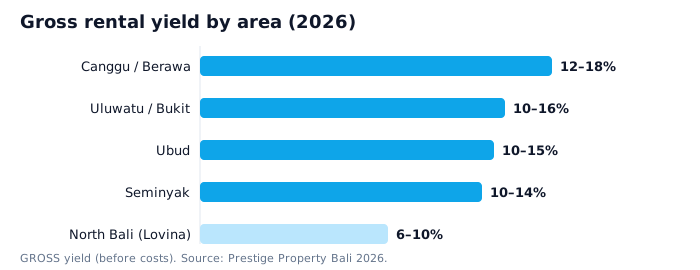
Location now drives both occupancy and exit value more than interior decor. Match your Step 1 goal to the area’s gross-yield band and character:
| Area | Typical villa price | Gross yield | Best for (goal) |
|---|---|---|---|
| Canggu / Berawa | $400-800k | 12-18% | Yield, deepest year-round rental demand |
| Uluwatu / Bukit | $500-900k (3BR ocean view) | 10-16% | Yield + growth, views & fastest land appreciation |
| Ubud | $250-500k | 10-15% | Lifestyle, wellness & long-stay, low volatility |
| Seminyak | $500k, 1.2M | 10-14% | Lifestyle + exit, most established, best liquidity |
| Emerging (Tabanan, Seseh, N. Bali) | $100-600k | 6-18% | Growth, more land per dollar, longer horizon |
| Area % values are GROSS yield (before costs). Villa prices are built, leasehold. Source: Prestige Property, Bali Villa Realty, Paradyse 2026. ~IDR 16,000/USD. |
The takeaway: for the same budget you secure far more land in Uluwatu, Ubud or the emerging belt than in Seminyak or central Canggu, the trade-off is short-term rental depth, not just scenery. Compare the coasts in Canggu vs Uluwatu and the full ranking in best areas to buy in Bali 2026.
Step 3, Set the ownership structure
Foreigners cannot hold Hak Milik (freehold) directly in Indonesia. Two routes dominate, and your Step 1 goal usually points to one:
| Structure | How it works | Best fit |
|---|---|---|
| Leasehold (Hak Sewa) | Long lease (often 25-30 yrs + extension) over the land/villa | Simplicity, lifestyle and single-asset buyers |
| PT PMA + HGB | Foreign-owned company holds Right to Build (Hak Guna Bangunan) | Rental businesses, multi-asset and longer-horizon control |
| Always confirm the specific structure, lease term and extension rights with a certified notary (PPAT). Source: ATR/BPN; BKPM Positive Investment List. |
Legal: the choice between leasehold and a PT PMA changes your tax position, exit options and financing. Read the full decision tree in our buying property in Bali as a foreigner legal guide before you put down a deposit.
Step 4, Run the finance (gross vs net)
This is where most Bali playbooks quietly mislead. The headline 10-18% figures by area are gross, annual rent ÷ price, before costs. What you keep is the net yield, after management, tax, maintenance and vacancy. Conflating the two is the single biggest source of disappointed investors.
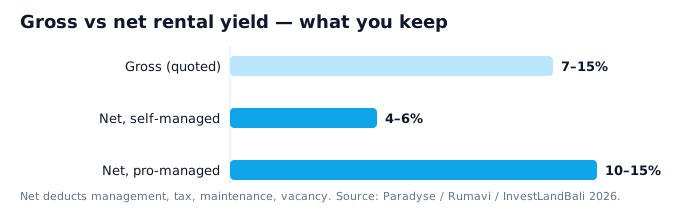
| Metric | Range | What it means |
|---|---|---|
| Gross yield (quoted) | 7-15% (up to 18% prime) | Annual rent ÷ price, before any costs |
| Net yield, self-managed | 4-6% | After costs, running it yourself |
| Net yield, professionally managed | 10-15% | After costs, with strong operations |
| GROSS and NET are kept separate. Source: Paradyse / Rumavi / InvestLandBali 2026. ~IDR 16,000/USD. |
The gap between 4-6% and 10-15% net is operations: data-driven pricing, OTA distribution and cost control. Build your model with our villa ROI guide and factor the holding side with the
taxes & holding costs guide
(annual PBB is low, ~0.1% of assessed value, but transaction and rental-income taxes apply).
See real 2026 numbers, not averages
Compare live pricing and projected net yields across Magnum Estate’s Berawa, Sanur and Uluwatu developments.
View Magnum projects
Book a free consultation
Step 5, Buy or build
Both work; the choice is speed vs customisation. Buying a completed villa gives immediate rental cash flow and visible quality. Building can be cheaper per m² and fully bespoke, but adds time, project-management risk and permitting complexity.
| Path | Indicative cost | Trade-off |
|---|---|---|
| Buy completed villa | $60k (emerging), $300-600k (core), $1-6M (luxury) | Instant cash flow; pay for someone else’s margin |
| Build (standard) | ~$1,000-1,400/m² + land | Lower per-m² cost; you carry build & permit risk |
| Build (luxury) | ~$1,400-1,800/m² + land | Full customisation; longer timeline |
| Build cost is for an investment-grade villa, excluding land. Land prices by area: Seminyak/Umalas $900-1,900/m² > Canggu $530-1,560 > Uluwatu $310-940 > Ubud $250-750 > emerging <$250. Source: Paradyse Homes / COCO 2026. ~IDR 16,000/USD. |
Build math: a typical 150 m² villa with a pool runs roughly $150,000-270,000 in construction before land, so total all-in cost is driven by the land price per m² in your chosen area. See the full per-area land map in our Bali property prices 2026 guide.
Steps 6-7, Operate, then plan the exit
Operate
The number that turns a 4-6% asset into a 10-15% one is management. The digital-nomad and long-stay wave has reshaped demand: 1-3 month bookings stabilise occupancy, and villas with dedicated workspaces and fast Wi-Fi rent faster and command higher monthly rates. Decide early between self-management (cheaper, hands-on) and professional management (higher net, hands-off), and choose a short-stay or long-stay strategy per the long-term vs short-term rental strategy guide.
Exit
Plan the exit before you sign. On leasehold, your exit is a lease assignment with a shrinking remaining term, so a 25-30 year lease bought with 5 years already gone is worth materially less on resale. On a PT PMA + HGB structure, you can sell the asset or the company. Seminyak and central Canggu offer the deepest resale liquidity; emerging belts trade slower but on growth. Holding-cost and transfer-tax detail is in the taxes & holding costs guide.
Pre-purchase checklist
| Before you sign | Why it matters |
|---|---|
| Goal defined (yield / growth / lifestyle) | Filters area, structure and operation choices |
| Area matched to goal & gross-yield band | Location drives occupancy and exit value |
| Structure confirmed with a PPAT notary | Leasehold vs PT PMA changes tax and exit |
| Net yield modelled (not gross) | 4-6% self / 10-15% pro is what you keep |
| Lease term & extension rights verified | Remaining years drive resale value |
| Zoning, title & permits (IMB/PBG) checked | 2026 market penalises non-compliant stock |
| Management plan chosen (self vs pro) | Determines whether you hit net 10-15% |
| Exit route & transfer taxes mapped | Liquidity differs sharply by area & structure |
| Use this as the operational core of your Bali real estate playbook 2026. |
Limitations & suitability
This playbook is not for everyone. Bali real estate suits buyers who can hold for at least 5-10 years, accept currency risk (IDR/USD moves materially), and treat the asset as an operating business rather than a passive flip. It is a poor fit if you need quick liquidity, expect freehold security, or model returns on gross yield. Leasehold assets depreciate as the term runs down; non-compliant or saturated-zone stock can correct sharply. Always commission independent legal, technical and financial due diligence, the 2026 market rewards precision and punishes shortcuts.
Methodology & sources
Figures are indicative 2026 ranges, reconciled across multiple market datasets and converted at ~IDR 16,000/USD. Land prices are stated per m² (from per-are data, 1 are = 100 m²). Area-level percentages are gross yields (rent ÷ price before costs); net yields deduct management, tax, maintenance and vacancy and are reported separately as ~4-6% (self-managed) or ~10-15% (professionally managed). Build cost is ~USD 1,000-1,800/m² for an investment-grade villa, excluding land. Individual parcels and villas vary by road access, zoning, view and lease term. Always commission an independent appraisal and notary (PPAT) due diligence before purchase.
Conclusion
The Bali real estate playbook 2026 is deliberately boring in the best way: define the goal, pick the area that serves it, lock the legal structure, model net not gross, choose buy or build, operate professionally, and know your exit before you sign. Do those seven things in order and Bali remains one of the strongest income-and-growth real estate markets in Asia for foreign buyers.
Ready to run the playbook on a real asset?
Explore Magnum Estate’s ocean-view residences in Uluwatu, Berawa and Sanur, transparent pricing and projected net yields.
Uluwatu, Sky Stars
Berawa
Sanur
FAQ: Bali real estate playbook 2026
What is the Bali real estate playbook 2026 in one sentence?
Pick a clear goal (yield, growth or lifestyle), match it to an area, choose the right ownership structure (Leasehold or PT PMA), run the net-yield math, decide buy vs build, operate professionally, and plan the exit before you sign.
Is Bali still a good place to invest in 2026?
Yes, but selectively. Well-located, legally clean villas still perform while mispriced stock corrects. Gross yields run ~10-18% in prime areas; net is ~4-6% self-managed or ~10-15% professionally managed.
Which areas offer the best returns in 2026?
Canggu/Berawa lead on gross yield (12-18%); Uluwatu is 10-16% plus fastest land appreciation; Ubud 10-15% and defensive; Seminyak 10-14% with best exit liquidity; North Bali/Tabanan 6-10% growth plays.
How much does it cost to buy or build a villa in Bali in 2026?
Built villas range from ~USD 60,000 (emerging) to USD 6 million (luxury), with most investor-grade villas at USD 300,000-600,000. Building costs ~USD 1,000-1,800/m², plus land.
What ownership structure should foreigners use?
Foreigners cannot hold Hak Milik directly. Use Leasehold (Hak Sewa) for simplicity, or a PT PMA holding HGB for rental businesses and longer control. Confirm with a PPAT notary.
What net yield can I realistically expect?
After all costs, ~4-6% self-managed or ~10-15% professionally managed. Headline 10-18% figures are gross, before costs.
Should I build or buy a ready villa?
Building is cheaper per m² and fully customisable but adds time and risk; buying ready costs more but gives immediate cash flow and visible quality.
How important is due diligence in 2026?
Critical. The 2026 market penalises non-compliant or low-quality stock, verify zoning, title, permits, lease term and realistic net projections before committing.
References & official sources
- BPS, Statistics Indonesia / Bali: 2025 foreign arrivals (6,948,754, +9.72%), occupancy, bali.bps.go.id
- Bank Indonesia, Residential Property Price Index: official price-growth & IDR/USD, bi.go.id
- BKPM / Invest Indonesia: PT PMA & foreign-ownership rules (Positive Investment List), investindonesia.go.id
- ATR/BPN: land titles (Hak Milik / Hak Pakai / HGB) & zoning, atrbpn.go.id
- DJP / Ministry of Finance: PBB & transaction taxes, pajak.go.id
- Market data (2026): Bali Villa Realty price guide; Paradyse Homes price-per-are study (AirDNA-benchmarked); Prestige Property Bali area/yield analysis; InvestLandBali market report.
- Magnum Estate portfolio data (net yields by project).
About the author
Stanislav Sadovnikov is the founder of Magnum Estate (PT Magnum Estate International), an award-winning full-cycle Bali real estate developer with 8 projects and 575 units since 2019 (Berawa, Sanur, Umalas, Sky Stars, Sky Royal). He writes about Bali pricing, yields, ownership rules and regulation for international buyers.