






Written by Stanislav Sadovnikov, Founder, Magnum Estate ·
Reviewed by Magnum Estate legal & investment desk ·
Last updated 3 June 2026
"4-6% / 10-15% Net yield (self vs pro-managed) · ~7-15%/yr Like-for-like appreciation · 6-12 mo Typical villa sale timeline · ~0.1% Annual holding tax (PBB)"
Key figures (2026)
Buy sell or hold Bali villa 2026: summary
Buy sell or hold Bali villa 2026, the short answer: it depends on your villa’s net yield, its area, its legal quality and your own goals, not on a market-wide verdict. Hold a clean, well-located villa that still earns a healthy net yield and let it compound; sell an underperforming, legally weak or short-lease asset (or when you need liquidity into strength); buy more only when a stress-tested deal clears your net-yield hurdle over 5-10 years.
- Hold if: net yield is healthy (~4-6% self-managed, ~10-15% pro-managed), area is strengthening, title is clean.
- Sell if: chronic underperformance with no fix, flawed legal structure, short lease, or you need capital.
- Buy more if: a deal still hits your net hurdle after a conservative stress-test.
- Appreciation: ~7-15%/yr like-for-like in strong micro-markets; land +15-30% over two years.
- Exit reality: plan a 6-12 month sale; liquidity is best in Seminyak, Canggu/Berawa, Uluwatu.

"Transparency: Magnum Estate develops property in Bali, so we have a commercial interest. This guide is educational, not investment or legal advice, verify figures independently and consult a certified Indonesian notary (PPAT) and tax advisor before buying, holding or selling."
Transparency
This buy sell or hold Bali villa 2026 guide is written for existing owners, not first-time buyers. The market has moved past the “buy anything and it rents” phase into a more selective, fundamentals-driven cycle, so the right move is no longer the same for every villa. Below is a decision framework that scores your asset on three axes, net yield, area strength and legal quality, and weighs it against the cost of exiting, so you can decide whether to hold for appreciation, sell into liquidity, or accumulate more.
Where the Bali villa market stands in 2026
Demand fundamentals are intact: Bali drew 6,948,754 foreign visitors in 2025, up 9.72% year-on-year, keeping prime-area villa occupancy at 70-85% (island-wide average closer to ~65%). Land values appreciated roughly 15-30% over the past two years, and like-for-like price growth in strong micro-markets runs around 7-15% a year. This is a normalising market, not a crash, not a frenzy, which is exactly why a one-size verdict is wrong and a per-villa decision is right. For the underlying numbers, see our Bali property prices 2026 guide and the broader Bali property investment 2026 outlook.
The buy / sell / hold framework
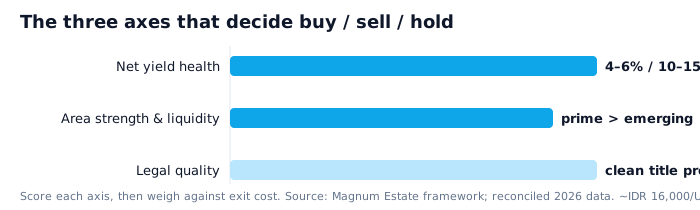
Score your villa on three axes. A villa that is strong on all three is a clear hold; weak on two or more, with no economic fix, leans sell; and a new opportunity that clears the same bar on a 5-10 year horizon is a buy.
| Your situation | Decision | Why |
|---|---|---|
| Healthy net yield, strengthening area, clean title | Hold | Compound rent + ~7-15%/yr appreciation |
| Weak occupancy/yield, no economic fix | Sell | Reallocate to a better asset |
| Flawed legality or short remaining lease | Sell / fix first | Discount and regulatory risk grow over time |
| Need liquidity, comparables selling well | Sell | Exit into strength, not weakness |
| New deal clears net hurdle on 5-10yr horizon | Buy / accumulate | Selective entry still rewarded in 2026 |
| A practical scoring of the buy sell or hold Bali villa 2026 question. Net yields per reconciled 2026 data. |
When to hold your Bali villa
Real-estate returns make the most sense on multi-year horizons, and Bali is no exception: serious owners treat villas as 5-10 year businesses. Hold is usually right when your villa is still earning a healthy net yield, occupancy is stable, the title and zoning are clean, and it sits in a strengthening area. The key distinction owners miss is gross vs net: most quoted “8-15%” figures are gross, before costs. What you actually keep is the net yield.
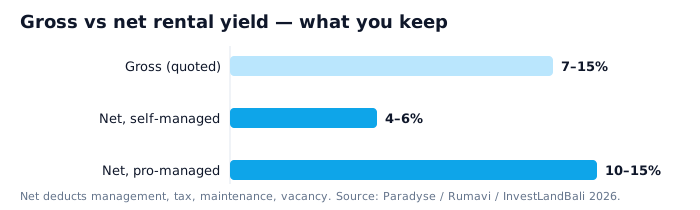
If your villa is delivering close to a strong net yield and sits in Canggu/Berawa, Uluwatu/Bukit or Sanur, selling just because prices rose can mean giving up years of cash flow plus appreciation. Holding through 2026-2028 lets both compound.
The gap between 4-6% and 10-15% net is operations: data-driven pricing, OTA distribution and cost control. Before you judge a villa a “sell”, confirm whether better management closes the gap, see how returns are built in our Bali villa ROI guide.
When to sell, and how area liquidity matters
2026 rewards quality and “weeds out” generic or legally weak villas, which are increasingly discounted. Sell when: the villa underperforms (location, layout, noise) with no economic fix; its net yield stays materially below market even after management changes; the legal structure is flawed (unclear zoning, missing PBG/SLF, nominee risk); a leasehold is running short; or you simply need liquidity while comparable villas are selling well.
Where you own changes how fast and how cleanly you can exit. Liquidity is deepest in the established prime belt and thinnest in emerging corridors:
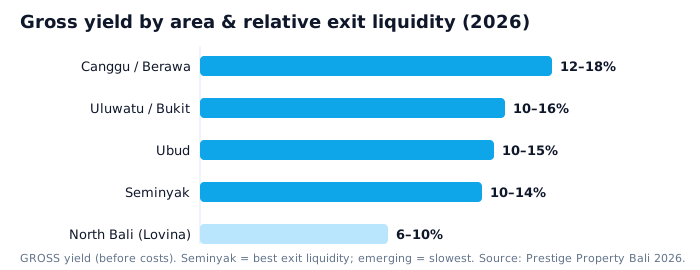
| Area | Gross yield | Exit liquidity | Sell signal |
|---|---|---|---|
| Seminyak | 10-14% | Best, most established buyer pool | Sell into strong comparables |
| Canggu / Berawa | 12-18% | High, deepest year-round demand | Watch local oversupply pockets |
| Uluwatu / Bukit | 10-16% | Strong, ocean-view premium | Lease term & access matter |
| Ubud | 10-15% | Moderate, niche wellness buyers | Long-stay vs nightly mix |
| North Bali / emerging | 6-10% | Slowest, thin buyer pool | Allow longer marketing time |
| Gross yield by area: Prestige Property Bali 2026. Liquidity is a qualitative ranking of buyer-pool depth, not a yield figure. |
Legal & lease check: a flawed structure or a short remaining lease destroys exit value faster than a soft market. Fix zoning/PBG/SLF gaps or extend a short lease before marketing. Foreigners hold via leasehold (Hak Sewa) or PT PMA (HGB), never Hak Milik directly, see buying property in Bali as a foreigner.
When to buy more
2026 is still a good year to accumulate, but selectively, with a 5-10 year horizon. Buy more when, after modelling conservative occupancy and realistic costs, a villa still clears your net hurdle, sits in an area matching 2026 demand (compact 1-3BR in prime or well-planned emerging zones), and is legally and structurally clean. Paying a premium for clean title and engineering usually beats chasing “cheap” but risky stock, because the legality premium is widening.
The takeaway: the same capital that exits a tired, short-lease villa can often re-enter a stronger area at a better net yield. Compare the coasts in Canggu vs Uluwatu before you redeploy.
Not sure whether to hold or trade up?
Compare live pricing and projected net yields across Magnum Estate’s Berawa, Sanur and Uluwatu developments.
View Magnum projects
Book a free consultation
Exit taxes & selling costs
The decision is incomplete without the cost of leaving. Holding is cheap, annual PBB is about 0.1% of assessed value, but exiting is not free, and these costs should be netted against any expected appreciation before you sell.
| Item | Indicative level | Notes |
|---|---|---|
| Annual holding tax (PBB) | ~0.1% of assessed value | Low; rarely a reason to sell |
| Seller income tax on disposal | Applies to gain / sale value | Confirm current rate with a tax advisor |
| Agency commission | ~5% (typical) | Negotiable; varies by agent/exclusivity |
| Notary / PPAT & documents | Transaction-based | Clean docs speed the sale |
| Lease assignment / extension | Varies (leasehold) | Short lease cuts value sharply |
| Indicative 2026 cost items; not tax advice. Holding cost (PBB ~0.1%) per DJP/pajak.go.id. Confirm all rates before transacting. |
Model the full picture before deciding: net rental income, expected appreciation, and these exit costs. Our taxes & holding costs guide breaks down the holding side so you can compare it against a sale.
Limitations & suitability
This framework is a starting point, not a verdict on your specific villa. It assumes a 5-10 year horizon; it is less useful if you need to exit within 12 months for reasons unrelated to the asset. Figures are indicative 2026 ranges, and individual outcomes vary widely by micro-location, lease term, build quality and management. Owners with legally grey structures, very short leases, or financing pressure should take tailored legal and tax advice rather than rely on ranges. If your goal is capital preservation with minimal involvement, a low-net-yield self-managed villa may not suit you regardless of the headline gross figure.
Methodology & sources
Figures are indicative 2026 ranges, reconciled across multiple market datasets and converted at ~IDR 16,000/USD. Gross yields are rent ÷ price before costs; net yields deduct management, tax, maintenance and vacancy (~4-6% self-managed, ~10-15% professionally managed). Like-for-like appreciation (~7-15%/yr) and land growth (+15-30% over two years) describe strong micro-markets, not every villa. Exit-cost items are indicative and not tax advice. Always commission an independent appraisal and notary (PPAT) due diligence before transacting.
Conclusion
In 2026, the buy / sell / hold answer is a calculation, not a slogan: score your villa on net yield, area strength and legal quality, then net any expected appreciation against the real cost of exiting. Clean, well-located, healthy-yielding villas usually reward patience; tired, legally weak or short-lease assets are better sold into strength and redeployed. The strongest owners keep proven hotspots and trade out of what no longer earns its place.
Ready to pressure-test your villa decision?
Explore Magnum Estate’s ocean-view residences in Uluwatu, Berawa and Sanur, transparent pricing and projected net yields to benchmark your current asset against.
Uluwatu, Sky Stars
Berawa
Sanur
FAQ: buy sell or hold Bali villa 2026
Buy sell or hold Bali villa 2026, what is the short answer?
Hold a clean, well-located villa with healthy net yield (~4-6% self-managed, ~10-15% pro-managed) and let it compound with ~7-15%/yr appreciation. Sell if it underperforms with no fix, has a flawed structure or short lease, or you need liquidity. Buy more only if a stress-tested deal clears your net hurdle over 5-10 years.
When should I hold my Bali villa in 2026?
When net yield is healthy, occupancy stable, title clean, and the area is strengthening (Canggu/Berawa, Uluwatu/Bukit, Sanur). Holding compounds rent plus ~7-15%/yr like-for-like growth.
When should I sell my Bali villa in 2026?
When it underperforms with no economic fix, net yield stays below market after management changes, the legal structure is flawed, the lease is short, or you need capital and comparables are selling well. Plan a 6-12 month sale.
What exit costs apply when I sell?
Seller income tax on the disposal, agency commission (~5%), notary/PPAT and documentation, plus lease considerations on leasehold. Annual PBB is low (~0.1%). Confirm current rates with a tax advisor.
Does leasehold decay change the decision?
Yes. Sale value falls as remaining years drop, especially below ~15-20 years left. If extension is uncertain or costly, selling earlier or extending before marketing usually preserves more value.
Which areas sell fastest if I need to exit?
Seminyak has the best exit liquidity; Canggu/Berawa the deepest year-round demand; Uluwatu strong ocean-view appeal. Emerging zones are cheaper to enter but slower to exit.
References & official sources
- BPS, Statistics Indonesia / Bali: 2025 foreign arrivals (6,948,754, +9.72%), occupancy, bali.bps.go.id
- Bank Indonesia, Residential Property Price Index: official price-growth data & IDR/USD, bi.go.id
- DJP / Ministry of Finance: PBB, transaction & rental-income taxes, pajak.go.id
- ATR/BPN: land titles, leasehold (Hak Sewa) & zoning, atrbpn.go.id
- Market data (2026): Bali Villa Realty price & ROI guide; Prestige Property Bali area/yield analysis; Paradyse Homes price-per-are study; InvestLandBali market report.
- Magnum Estate portfolio data (net yields by project).
About the author
Stanislav Sadovnikov is the founder of Magnum Estate (PT Magnum Estate International), an award-winning full-cycle Bali real estate developer with 8 projects and 575 units since 2019 (Berawa, Sanur, Umalas, Sky Stars, Sky Royal). He writes about Bali pricing, yields, ownership rules and regulation for international buyers.