





Written by Donny Yosua, Magnum Estate Analyst ·
Reviewed by Magnum Estate legal & investment desk ·
Last updated 3 June 2026
"$60k+ Entry capital (off-plan / land) · 7-15% Gross yield, prime areas · 4-6% / 10-15% Net yield: self vs pro-managed · 6.95M 2025 foreign arrivals (+9.7%)"
Key figures (2026)
Bali property investment 2026: the investor answer first
Bali property investment 2026 is still worth it, but only if you buy as an investor, not a speculator. The right move depends entirely on who you are: your goal (yield, growth or lifestyle income), your capital tier and your time horizon. Match those three to the right area and entry route, and Bali remains one of Asia’s strongest lifestyle-plus-return plays.
- Yield-seekers: Canggu/Berawa carry the deepest year-round rental demand (12-18% gross).
- Growth-seekers: Uluwatu and emerging belts (Tabanan, Seseh, North Bali) for land appreciation.
- Lifestyle + income: Sanur and Ubud, stable long-stay occupancy, lower volatility.
- Capital tiers: $60-150k off-plan/land, $300-600k investor villa, $500k, 1.2M+ prime.
- Gross ≠ net: net is ~4-6% self-managed, ~10-15% professionally managed, operations decide.
- Entry route: foreigners use Leasehold (Hak Sewa) or PT PMA (HGB), never a nominee.

"Transparency: Magnum Estate develops property in Bali, so we have a commercial interest. This guide is educational, not investment or legal advice, verify figures independently and consult a certified Indonesian notary (PPAT) and tax advisor before buying."
Transparency
This Bali property investment 2026 guide is built as a decision tool, not a market recap. Rather than re-listing every price, it answers the question serious buyers actually ask: given my goal, my capital and my time horizon, what should I buy and how should I hold it? For the full price map by area, see our Bali property prices 2026 guide; for return mechanics, the villa ROI guide. Here, the lens is you.
Why Bali property investment 2026 rewards investors, not speculators
By 2026, the market has matured. Bali drew 6,948,754 foreign visitors in 2025, up 9.72% year-on-year, pushing prime-area villa occupancy to 70-85% (island-wide closer to ~65%). Land appreciated roughly 15-30% over the past two years, and like-for-like price growth runs about 7-15% a year in strong micro-markets. But the easy money is gone: listings are more rational, sellers more serious, and returns now reward location, design, operations and compliance over hype. That is good news for disciplined buyers, the field is less crowded with speculators.
Investor profiles: which one are you?
The single most useful thing you can do before looking at listings is to name your profile. Each one maps to a different area, product and holding pattern. Most disappointed Bali investors simply bought the wrong profile’s asset, chasing party-tourism yields in quiet Sanur, or expecting Canggu occupancy in Lovina.
| Profile | Primary goal | Best-fit areas | Typical horizon |
|---|---|---|---|
| Yield-seeker | Maximise rental cash flow | Canggu / Berawa, Uluwatu | 3-7 years |
| Growth-seeker | Capital appreciation on land | Uluwatu, Tabanan, Seseh, North Bali | 5-10 years |
| Lifestyle + income | Personal use plus stable rent | Sanur, Ubud | 5-10+ years |
| Value-add operator | Reposition underperforming stock | Prime areas with old stock | 2-5 years |
| Profiles map to strategy, not to a single “best” area. Areas reference the canonical Bali 2026 dataset (see Methodology). |
The takeaway: decide your profile before your area. A yield-seeker and a growth-seeker can stand on the same Uluwatu clifftop and reach opposite buying decisions. Compare the two coasts in Canggu vs Uluwatu and the full area shortlist in best areas to buy in Bali 2026.
Capital tiers: what each budget buys in 2026
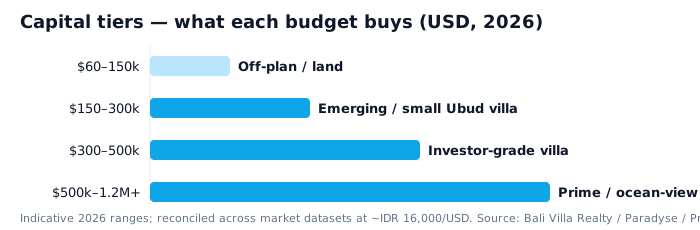
Capital tier is the second filter. The same canonical price data, read as an entry ladder, tells you exactly which rung you are buying on:
| Budget (USD) | What you can realistically get | Best-fit profile |
|---|---|---|
| 60k, 150k | Off-plan / co-ownership unit, or land in an emerging area | Growth-seeker (patient) |
| 150k, 300k | Villa in an emerging zone (Tabanan, Seseh) or a small Ubud villa | Lifestyle + income |
| 300k, 500k | Investor-grade villa in Canggu, Ubud, or second-row Uluwatu | Yield-seeker |
| 500k, 1.2M+ | Ocean-view Uluwatu or prime Seminyak / central Canggu villa | Yield + exit liquidity |
| Build cost adds ~USD 1,000-1,800/m² for an investment-grade villa. Island median villa ≈ $256-299k; full range $60k, $6M. |
What to buy for which goal
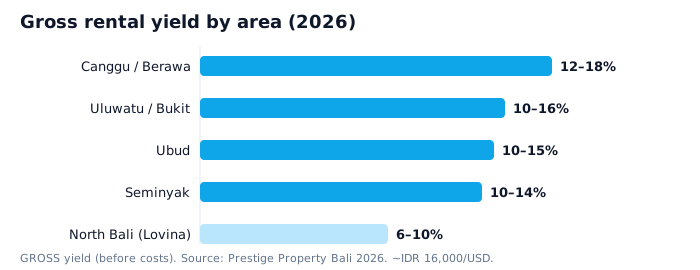
With profile and tier set, the area choice becomes mechanical. The chart below shows gross yield by area, the headline figure each profile weighs against price and growth (net comes next, and it is a different number entirely):
| If your goal is… | Buy in | Typical villa price | Gross yield | Why it fits |
|---|---|---|---|---|
| Maximum rental cash flow | Canggu / Berawa | $400-800k | 12-18% | Deepest year-round demand |
| Views + appreciation | Uluwatu / Bukit | $500-900k (3BR ocean view) | 10-16% | Fastest land appreciation |
| Exit liquidity / prestige | Seminyak | $500k, 1.2M | 10-14% | Most established resale market |
| Stability + long-stay | Ubud | $250-500k | 10-15% | Wellness, low volatility |
| Lowest entry / patient growth | Emerging (Tabanan, Seseh, N. Bali) | $100-600k | 6-18% | Most land per dollar |
| Yields are GROSS, before costs. Land per m² ranges from <$250 (emerging) to $900-1,900 (Seminyak). Source: Bali Villa Realty / Paradyse / Prestige 2026. |
Sanur note for lifestyle buyers: Sanur is quietly emerging as a family and retiree hub with long-stay demand and beachfront infrastructure, ideal for capital preservation rather than peak yield. See how it compares in our best areas guide.
See real 2026 prices, not averages
Compare live pricing and projected net yields across Magnum Estate’s Berawa, Sanur and Uluwatu developments.
View Magnum projects
Book a free consultation
The number that decides it: gross vs net yield
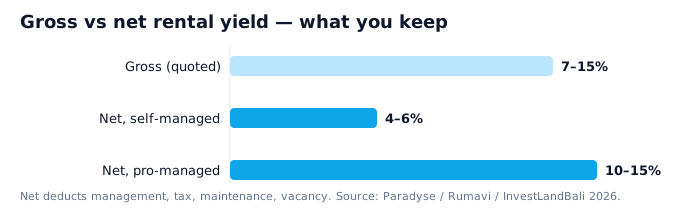
Every profile lives or dies on one distinction. The “8-15% yield” you see advertised is almost always gross, annual rent ÷ price, before costs. What an investor actually keeps is the net yield, after management, tax, maintenance and vacancy. This single gap separates the investors who hit their model from the ones who don’t:
| Measure | Range | What it reflects |
|---|---|---|
| Gross yield (quoted) | 7-15% | Annual rent ÷ price, before any costs |
| Net yield, self-managed | 4-6% | After fees, tax, maintenance, vacancy, DIY |
| Net yield, professionally managed | 10-15% | Data-driven pricing, OTA distribution, cost control |
| GROSS and NET are different measures and never interchangeable. Source: Paradyse / Rumavi / InvestLandBali 2026. |
The gap between 4-6% and 10-15% net is operations, not luck. Treat “guaranteed yield” offers with caution, they are a marketing tool, not a return. Factor holding costs with our taxes & holding costs guide and see how management drives returns in the villa ROI guide.
Entry routes & legal structure for Bali property investment 2026
Profile and area decide what you buy; structure decides whether you keep it. Foreigners cannot hold Hak Milik (freehold) directly. The two compliant routes are a Leasehold (Hak Sewa), simplest, fixed term, value decays as the lease shortens, or a PT PMA foreign-owned company holding Hak Guna Bangunan (HGB), which suits rental businesses and longer horizons. Nominee arrangements (putting title in an Indonesian’s name) are illegal and the most common way investors lose everything.
| Route | Best for | Watch-outs |
|---|---|---|
| Leasehold (Hak Sewa) | Simpler entry, lifestyle + income, fixed horizon | Lease decay; model the renewal/extension terms |
| PT PMA + HGB | Rental business, value-add, longer hold | Setup & compliance cost; minimum investment rules |
| Off-plan purchase | Lower entry capital, growth-seekers | Developer track record; staged-payment risk |
| Nominee (Indonesian name) | Never, illegal | Title is unenforceable; total-loss risk |
| Structures are indicative, confirm with a certified notary (PPAT). See our foreigner legal guide for full detail. |
Structure before signing: the leasehold-vs-company decision changes your tax, exit and renewal economics. Read buying property in Bali as a foreigner before you commit, and have a PPAT verify title and zoning.
Who Bali property investment 2026 is not for
Honest suitability check. Bali is the wrong call if you need a guaranteed, hands-off 12%, that number exists only on paper. It is also wrong if you cannot tolerate currency risk (rents and rupiah move against the dollar), if you want true freehold ownership, or if your horizon is under three years and you expect to exit cleanly. Some villa segments are genuinely oversupplied; a generic large villa aimed at big groups now underperforms a smaller, well-designed 1-3 bedroom property in the same area. If you want passive and liquid, listed REITs may fit you better than a Bali villa.
Conclusion
In 2026, Bali property investment rewards precision over averages. Name your profile, fix your capital tier, choose the area that serves that goal, and lock in a compliant structure, in that order. The strongest plays pair a proven hotspot (Canggu, Seminyak, Uluwatu) with a clear operating plan, and treat the asset as a 5-10 year business rather than a holiday home with magical returns.
Ready to match a profile to a project?
Explore Magnum Estate’s ocean-view residences in Uluwatu, Berawa and Sanur, transparent pricing and projected net yields.
Uluwatu, Sky Stars
Berawa
Sanur
Methodology & sources
Figures are indicative 2026 ranges, reconciled across multiple market datasets and converted at ~IDR 16,000/USD. Land prices are stated per m² (from per-are data, 1 are = 100 m²). Gross yields are rent ÷ price before costs; net yields deduct management, tax, maintenance and vacancy and are reported only as a self-managed (4-6%) or professionally managed (10-15%) band, never as an area-specific figure. Individual deals vary by road access, zoning, view and lease term. Always commission an independent appraisal and notary (PPAT) due diligence before purchase.
FAQ: Bali property investment 2026
Is Bali property investment 2026 still worth it for serious investors?
Yes, for investors who buy on fundamentals. The market has shifted from speculation to a selective, data-driven phase; returns reward location, legal structure and professional operations.
How much capital do I need?
Entry starts at ~USD 60,000-150,000 (off-plan or emerging-area land). USD 300,000-600,000 buys an investor-grade villa; USD 500,000-1.2M+ buys ocean-view Uluwatu or prime Seminyak/central Canggu.
What net yield can I realistically expect?
Gross yields run ~7-15% in prime areas. Net is lower: ~4-6% self-managed or ~10-15% professionally managed, after fees, tax, maintenance and vacancy.
Which investor profile suits Bali in 2026?
Yield-seekers favour Canggu/Berawa; growth-seekers favour Uluwatu and emerging belts (Tabanan, North Bali); lifestyle-plus-income buyers favour Sanur and Ubud. Match the area to your goal.
How should foreigners legally hold a Bali investment?
Foreigners cannot hold Hak Milik directly. Use a Leasehold (Hak Sewa) or a PT PMA holding HGB. Avoid nominee arrangements, they violate Indonesian law.
Can I rely on “guaranteed yield” offers from developers?
Be cautious. Many 10-15% “guaranteed” returns are marketing tools. Insist on performance-based projections tied to real occupancy, nightly rates and operating costs.
How long should I plan to hold?
Model a 5-10 year horizon. Payback on well-structured projects is often 6-9 years, with meaningful value realised over 10+ years.
Is appreciation still happening in 2026?
Yes, like-for-like growth ~7-15%/yr in strong micro-markets; land appreciated ~15-30% over two years, underpinned by 6.95M foreign arrivals in 2025 (+9.7%).
References & official sources
- BPS, Statistics Indonesia / Bali: 2025 foreign arrivals (6,948,754, +9.72%), occupancy, bali.bps.go.id
- Bank Indonesia, Residential Property Price Index: official price-growth & FX data, bi.go.id
- BKPM / Invest Indonesia: PT PMA & foreign-ownership rules, investindonesia.go.id
- DJP / Ministry of Finance: PBB & transaction taxes, pajak.go.id
- ATR/BPN: land titles (Hak Milik / Hak Pakai / HGB) & zoning, atrbpn.go.id
- Market data (2026): Bali Villa Realty price guide; Paradyse Homes price-per-are study; Prestige Property Bali area/yield analysis; InvestLandBali market report.
- Magnum Estate portfolio data (net yields by project).
About the author
Donny Yosua is a market analyst at Magnum Estate, an award-winning Bali developer (Berawa, Sanur, Sky Stars, Sky Royal). He tracks Bali pricing, yields and regulation for foreign investors.