






Written by Stanislav Sadovnikov, Founder, Magnum Estate ·
Reviewed by Magnum Estate legal & investment desk ·
Last updated 3 June 2026
"~$20k/yr Short-term income (~65% occ., ~$98 ADR)* · $12-18k/yr Long-term income (predictable)* · 4-15% Net yield (self vs pro-managed) · 31 Mar 2026 Short-let licensing deadline*"
Key figures (2026)
Bali long-term vs short-term rental strategy 2026: summary
The Bali long-term vs short-term rental strategy 2026 decision is no longer “Airbnb always wins.” Short-term still earns more on paper, roughly USD 20,000/year at ~65% occupancy and ~USD 98 ADR, but after full compliance, management, tax and vacancy, net returns often land close to a simple long-term lease (USD 12,000-18,000/year). The right answer depends on your zone, product and capacity, not theory. Short-term suits a photo-ready 2-3BR in a tourism or mixed-use zone run at 60-70% occupancy under professional management; long or mid-term suits a residential-zone villa, an absentee owner, or anyone who wants low-touch, bond-like income. Many owners run a hybrid, leasing long or mid-term through low season (February, June) and switching to nightly stays across peak months (July, August, December, January). One deadline changes the calculus for everyone: from 31 March 2026, only listings that are properly licensed, zoned and taxed can stay live on Airbnb or Booking, unlicensed short-term income is no longer a realistic option.
- Short-term wins when: tourism/mixed-use zone, photo-ready 2-3BR, ~60-70% occupancy and pro management.
- Long/mid-term wins when: residential zone, absentee owner, or you want low-touch, “bond-like” income.
- Hybrid: long/mid-term in low season (Feb, Jun), short-term in peaks (Jul, Aug, Dec, Jan).
- Gross ≠ net: gross 7-15%; net ~4-6% self-managed, ~10-15% professionally managed.
- New rule: from 31 March 2026, only licensed, zoned & taxed listings stay on Airbnb/Booking.*

"Transparency: Magnum Estate develops and manages property in Bali, so we have a commercial interest. This guide is educational, not investment, legal or tax advice, verify figures independently and consult a certified Indonesian notary (PPAT) and tax advisor before buying or letting. Figures marked * are third-party market estimates (see References); net-yield bands are reconciled Magnum/market ranges."
Transparency
Picking the right Bali long-term vs short-term rental strategy 2026 now decides whether your villa is a high-effort hospitality business or a low-touch income asset. New licensing rules, higher compliance costs and a more mature guest market have narrowed the gap between nightly stays and annual leases. Below we compare real ADR, occupancy and net yields, lay out the new legal requirements, and give you a simple framework to choose short-term, long-term or hybrid, built around your villa’s location, design and legal setup.
What changed in 2026: regulation and real numbers
Short-term rentals still earn more on paper than long-term leases, but the gap narrows sharply once you load in full compliance and operating costs. Third-party 2026 data (BaliPropertyScout*) indicates:
- Average short-term rentals across Bali generate around USD 20,000 per year at ~65% occupancy and ~USD 98 ADR, with professionally managed units doing better (~USD 226 ADR).*
- Long-term rentals generate lower but more predictable income, often USD 12,000-18,000 per year for similar villas, with far less operational complexity.*
The rules tightened too. Third-party reporting (LegalIndonesia*) states that from 31 March 2026 all housing listed on platforms such as Airbnb and Booking must be properly licensed, zoned and taxed or risk de-listing and fines. In practice that means:
| Requirement | What it covers |
|---|---|
| KBLI + NIB (via OSS) | Correct business classification & business identity number |
| Tourism/hosting license | e.g. Pondok Wisata or Sertifikat Standar |
| PBG + SLF | Building approval & occupancy/safety certificate |
| KKPR / ITR zoning | Land use must permit tourist accommodation |
| PHR tax + income tax | Local hotel-restaurant tax registration & correct income-tax treatment |
| Source: third-party reporting (LegalIndonesia, 2026)*, verify against DJP (pajak.go.id), BKPM/OSS and ATR/BPN before relying on it. |
Legal: compliant, well-managed villas will likely perform better as weaker players exit, but zoning and licensing now decide which strategies are even legal for your property. Run the checks in our
legal guide for foreign buyers
before you commit to a rental model.
Short vs long: the income comparison (2026)
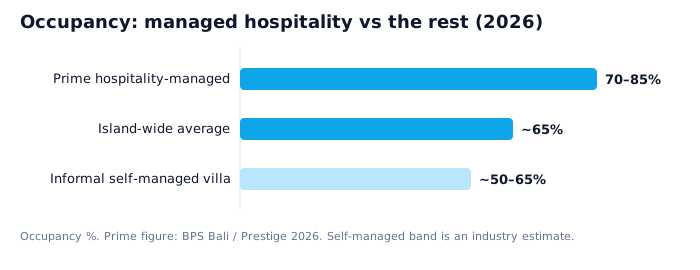
On a per-month basis, the same gap appears: a two-bedroom villa that might earn USD 1,200/month on a long-term lease could reach USD 3,000+/month equivalent via nightly bookings.* But once you add full taxes, management, utilities, maintenance and compliance, net returns between short- and long-term can end up surprisingly close.
| Factor | Short-term (nightly) | Long / mid-term |
|---|---|---|
| Top-line income* | ~$20k/yr (≈$3,000+/mo for 2BR) | $12-18k/yr (≈$1,200/mo for 2BR) |
| Occupancy target | ~60-70% (pro-managed) | Near-continuous lease |
| Operating effort | High (cleaning, OTAs, guest comms) | Low (one tenant, fewer turns) |
| Compliance load | Full hospitality licensing (see above) | Lighter, if structured correctly |
| Income stability | Seasonal, variable | Predictable, “bond-like” |
| Absentee-owner add-on | +20-30% management cost* | Minimal |
| *Income/occupancy/ADR figures are third-party 2026 estimates (BaliPropertyScout); confirm against a named, dated source before relying on them. |
Gross vs net yield, what you actually keep
Most “yield” numbers you see for Bali are gross, annual rent ÷ price, before costs. What you keep is the net yield, after management, tax, maintenance and vacancy. This is the biggest reason short- and long-term net returns converge once the spreadsheet is honest:
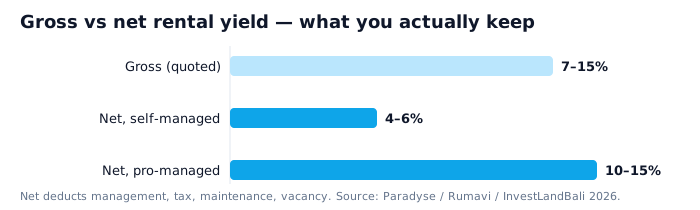
Well-located, compliant, professionally run short-term villas can land in the 10-15% net-yield band, with stronger upside in top micro-locations such as Canggu/Berawa and Uluwatu. The same operational discipline, data-driven pricing, OTA distribution, cost control, is what separates a 4-6% self-managed result from a 10-15% professionally managed one.
The gap between 4-6% and 10-15% net is operations, not luck. See how management drives returns in our Bali villa ROI guide and the day-to-day mechanics in our villa management & operations guide.
Short-term rental: when nightly stays still win
Short-term (Airbnb-style) rental remains powerful when three conditions are met: location, product, compliance. It makes the most sense when:
- Your villa sits in a tourism or mixed-use zone in a high-demand hub, Canggu/Berawa, Uluwatu/Bukit, Seminyak or parts of Ubud.
- Design is optimised for photos, comfort and flexibility (2-3 bedrooms, good living-pool-garden flow, work-friendly spaces).
- You can achieve ~60-70% occupancy with professional management and dynamic pricing.
- You can absorb high effort and high compliance complexity in exchange for higher top-line revenue.
The takeaway: short-term is a business, not passive income. If you can’t actively run it, the management fee eats most of the premium. Match the area to the demand first, compare hotspots in our Bali property prices 2026 guide.
Long & mid-term rental: when simpler is smarter
Long-term (12+ months) and mid-term (1-6 months) rentals appeal to expats, digital nomads, families and remote workers who want stability, fewer moves and less day-to-day service. They offer:
- Stable, predictable income with fewer gaps and lower vacancy risk.
- Lower operating overheads, no daily cleaning, less guest communication, reduced marketing.
- Simpler regulatory exposure than running a full hospitality operation, when structured correctly.
For investors who are not in Bali full-time, long- or mid-term strategies in family-friendly, infrastructure-strong areas such as Sanur, Nusa Dua and Ubud can balance yield and simplicity, often delivering net results similar to mid-range short-term lets, with a fraction of the workload.
Not sure which strategy fits your villa?
Magnum Estate’s team models short, long and hybrid scenarios on real Berawa, Sanur and Uluwatu units.
View Magnum projects
Book a free consultation
The hybrid strategy: best of both seasons
A hybrid model lets you optimise for Bali’s seasonality instead of betting on one mode all year:
- Lease long-term or mid-term during low season (roughly February, June) for guaranteed base income.
- Switch to short-term for peak months (July, August, December, January) to capture premium nightly rates.*
Hybrid suits owners with flexible management set-ups and properties in tourist-friendly zones. It is more optimisation work than a single mode, but it matches 2026’s seasonal realities and smooths the variable income that scares off pure short-term investors. Seasonal switching is also exactly the kind of workload that full-service rental management in Bali is built to absorb.
Choosing your 2026 strategy: the decision framework
| Question | If yes / strong | If no / weak |
|---|---|---|
| Tourism/mixed-use zone + full licenses & SLF? | Short-term or hybrid can work | Stay long/mid-term to remain compliant |
| Do you live in Bali or have strong management? | Short-term viable | Add 20-30% management cost*; long-term may win |
| Can your villa truly compete for daily guests? | Push short-term | Long-term/hybrid avoids effort for little extra profit |
| Risk tolerance & time horizon? | Short = upside; hybrid = balance | Long = calm, “bond-like” income |
| Whichever path you choose, model it over 5-10 years, not a single season. *Absentee-owner management add-on is a third-party estimate. |
Don’t chase advertised “20% ROI” without proper cost and compliance assumptions. Stress-test cash flow over a real holding period with our 10-year ROI insights and the operating-cost breakdown in our villa ROI guide.
Methodology & sources
Figures are indicative 2026 ranges. Income, occupancy and ADR figures marked * are third-party market estimates (BaliPropertyScout, LegalIndonesia) carried over from the prior version of this page, they are not Magnum data and should be re-confirmed against a named, dated source before publication. Net-yield bands (gross 7-15%; net 4-6% self-managed, 10-15% professionally managed) are reconciled Magnum/market ranges, monetary values in USD at ~IDR 16,000/USD. Gross yields are rent ÷ price before costs; net yields deduct management, tax, maintenance and vacancy. Licensing requirements change frequently, verify with DJP (pajak.go.id), BKPM/OSS and ATR/BPN, and commission independent notary (PPAT) due diligence before letting.
Conclusion
In 2026, the Bali long-term vs short-term rental strategy question is settled case by case, not by slogan. Short-term still wins on top-line revenue, but only when zone, product and management line up, and only after the new licensing regime is satisfied. Long- and mid-term offer calmer, simpler income that, on a net basis, can match mid-range short-term lets. For many owners the smartest answer is hybrid: base income in low season, premium nights in peak. Match the model to your villa and your bandwidth, then prove it over 5-10 years.
See the numbers on a real Bali villa
Explore Magnum Estate’s residences in Sanur, Berawa and Uluwatu, with transparent pricing and projected net yields by strategy, starting from the current Bali villas and apartments for sale.
Sanur
Berawa
Uluwatu, Sky Stars
FAQ: Bali long-term vs short-term rental strategy 2026
Does short-term rental still earn more than long-term in Bali in 2026?
Headline short-term revenue is still higher (~USD 20,000/yr at ~65% occupancy and ~USD 98 ADR*), but after full compliance, management, utilities, cleaning, marketing and tax, net returns on mid-range villas can land close to a simple long-term lease (USD 12,000-18,000/yr*). Strategy now depends on location, product and your capacity, not theory.
What new rules affect short-term rentals in 2026?
Third-party reporting* states that by 31 March 2026 only properly licensed, zoned and taxed properties may stay on Airbnb and Booking, requirements include KBLI and NIB via OSS, a tourism license (Pondok Wisata / Sertifikat Standar), PBG, SLF, KKPR/ITR-aligned zoning and PHR tax registration.
When is long-term rental the better choice?
When you want low-touch, predictable income, hold a villa in residential or family-oriented areas, cannot easily secure full hospitality licensing, or live abroad. Sanur, Nusa Dua and Ubud are strong long/mid-term fits.
What is a hybrid rental strategy and who should use it?
Lease 6-12 months in low season for base income, then switch to short-term in peak months to capture high nightly rates.* It suits owners with flexible management and properties in tourist-friendly zones.
What net yield can a Bali villa realistically achieve?
Gross yields run ~7-15%. Net is lower: ~4-6% self-managed or ~10-15% professionally managed, after fees, tax, maintenance and vacancy. Absentee owners should add 20-30% management cost to short-term projections.*
Where can I learn the legal checks before choosing a strategy?
Our legal guide for foreign buyers explains how zoning (KKPR/ITR), PBG, SLF and tourism licensing determine which rental strategies are legally available for a given property.
References & official sources
- DJP / Ministry of Finance: PHR, PBB & rental-income tax treatment, pajak.go.id
- BKPM / Invest Indonesia (OSS): KBLI, NIB & PT PMA / foreign-ownership rules, investindonesia.go.id
- ATR/BPN: land titles & KKPR/ITR zoning that govern tourist accommodation, atrbpn.go.id
- BPS, Statistics Indonesia / Bali: 2025 foreign arrivals (6,948,754, +9.72%) & occupancy context, bali.bps.go.id
- Market data (2026)*: BaliPropertyScout short- vs long-term income/ADR/occupancy comparison; LegalIndonesia short-let licensing summary (31 March 2026). Third-party estimates, re-confirm before publish.
- Net-yield ranges: Paradyse Homes / Rumavi / InvestLandBali 2026 (gross vs net), reconciled with Magnum portfolio data, to be labelled with sample size & period.
About the author
Stanislav Sadovnikov is the founder of Magnum Estate (PT Magnum Estate International), an award-winning full-cycle Bali real estate developer with 8 projects and 575 units since 2019 (Berawa, Sanur, Umalas, Sky Stars, Sky Royal). He writes about Bali pricing, yields, ownership rules and regulation for international buyers.