






Written by Stanislav Sadovnikov, Founder, Magnum Estate ·
Reviewed by Magnum Estate legal & immigration desk ·
Last updated 3 June 2026
"~$33 e-VOA fee (30 days) · 5-60 yrs Stay range (e-VOA, KITAP) · ~$130k Second-home visa deposit · IDR 1M/day Overstay penalty"
Key figures (2026)
Bali visa application guide 2026: summary
This Bali visa application guide 2026 answers the question directly: you do not need a residence permit to buy property in Bali, a tourist VOA/e-VOA or B211 visitor visa is enough to inspect and notarise a deal, but to live here and run a rental you need a residence visa (investor KITAS, second-home/golden visa or KITAP). Crucially, a KITAS/KITAP also unlocks a stronger ownership route: Hak Pakai (Right of Use) title in your own name. For due diligence, the e-VOA covers 30+30 days for about USD 33, and a B211 extends to 60 or 180 days for occasional oversight trips. Relocating to actively manage a rental calls for an investor KITAS, valid 6 months to 5 years with work and banking rights; retirees more often choose the second-home visa, valid 5 or 10 years with no employer sponsor. Long-term settlers can progress to KITAP, permanent residence after qualifying KITAS years. No visa, including these, grants freehold (Hak Milik), which stays closed to foreigners regardless of immigration status.
- Just visiting / due diligence: e-VOA (30+30 days, ~USD 33) or B211 (60, 180 days).
- Frequent oversight trips: multiple-entry visa (1-5 years, 60-180 days per visit).
- Relocating & managing a rental: investor KITAS (6 months, 5 years), work & banking rights.
- Retirees / passive investors: second-home (golden) visa, 5/10 years, no employer sponsor.
- Permanent settlement: KITAP, permanent residence after qualifying KITAS years.
- Ownership link: no visa grants freehold (Hak Milik); KITAS/KITAP enables Hak Pakai.

"Transparency: Magnum Estate develops property in Bali, so we have a commercial interest. This guide is educational, not immigration or legal advice. Government fees and rules change, verify current figures at the Directorate General of Immigration and consult a licensed visa agent and a certified Indonesian notary (PPAT) before applying or buying."
Transparency
This Bali visa application guide 2026 maps every visa a foreign buyer realistically uses, from a 30-day tourist e-VOA to a permanent KITAP, against three profiles: tourists doing due diligence, investors managing a rental, and retirees settling down. For each we cover eligibility, real 2026 costs, the step-by-step application, and the part most guides skip: which visa actually strengthens how you can own property in Bali as a foreigner. All government fees are quoted in Indonesian rupiah (the statutory currency) with a USD conversion at ~IDR 16,000/USD.
Which Bali visa fits your situation
Start from your goal, not the visa name. The single most common mistake is over-buying a residence permit when a visitor visa would do, or under-buying a tourist visa when you actually intend to live here and operate a rental, which requires work rights you only get on a KITAS.
| If you are… | Recommended visa | Why |
|---|---|---|
| Inspecting property, 1-2 weeks | e-VOA (Type B) | Fastest and cheapest; apply online before departure |
| Closing a deal / construction visits, 2-6 months | B211 visitor visa (Type C) | Extendable to 180 days; no work permitted |
| Quarterly oversight trips for years | Multiple-entry visa (Type D) | Re-enter freely; valid 1-5 years |
| Relocating & managing a rental business | Investor KITAS (Type E) | Residence + work & banking rights; enables Hak Pakai |
| Retiree / financially independent, passive | Second-home (golden) visa | 5-10 years, no employer sponsor; proof of funds |
| Settling permanently | KITAP | Permanent residence after qualifying KITAS years |
| Profiles map to Indonesia’s visitor (B/C/D) and residence (KITAS/second-home/KITAP) categories. Source: Directorate General of Immigration (imigrasi.go.id). |
Bali visa types compared: cost, duration & property ownership
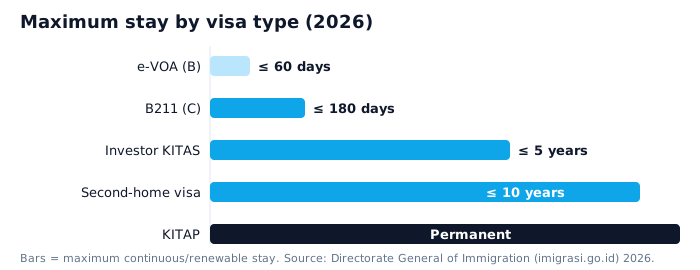
The table below is the core of this guide, purpose, duration, real cost, work rights, and the column most buyers care about: whether the visa lets you hold property title in your own name.
| Visa | Best for | Max duration | Indicative cost | Work rights | Can own property? |
|---|---|---|---|---|---|
| VOA / e-VOA (Type B) | Inspections, due diligence | 30 + 30 = 60 days | IDR 500,000 (~USD 33) | No | Can buy via leasehold / PT PMA; no title in own name |
| B211 visitor (Type C) | Closing, construction visits | 60, 180 days | IDR 2-3M (~USD 130-200) | No | Can buy via leasehold / PT PMA |
| Multiple-entry (Type D) | Frequent oversight trips | 1-5 yrs (60-180 days/visit) | IDR 5-12M (~USD 330-800) | No | Can buy via leasehold / PT PMA |
| Investor KITAS (Type E) | Relocating, running a rental | 6 months, 5 years | IDR 3-15M (~USD 200-1,000) | Yes (investor) | Yes, Hak Pakai in own name |
| Second-home (golden) visa | Retirees, passive investors | 5 or 10 years | Deposit ~IDR 2B (~USD 130,000) | Limited | Hak Pakai (as residence permit holder) |
| KITAP | Permanent settlers | Permanent (5-yr card) | Varies (after KITAS years) | Yes | Yes, Hak Pakai in own name |
| Government fees in IDR with USD at ~IDR 16,000/USD; B211/multiple-entry/KITAS ranges vary by validity, sponsor and agent. Second-home deposit is a proof-of-funds balance, not a fee. Foreigners cannot hold Hak Milik (freehold). Sources: imigrasi.go.id; Magnum Estate desk estimates for agent-dependent figures (marked indicative). |
Read costs carefully: the e-VOA/B211/KITAS figures are government + typical agent ranges and move with PMK fee schedules, confirm live numbers before you pay. The second-home visa’s “~USD 130,000” is a refundable proof-of-funds deposit held in an Indonesian state bank, not money spent. See how holding costs and taxes fit the bigger picture in our Bali property taxes & holding costs guide.
VOA / e-VOA (Type B): short visits & due diligence
Best for: short property-inspection trips and initial due diligence. Duration: 30 days, extendable once for another 30 (60 days maximum). Cost: IDR 500,000 (~USD 33) per application. Citizens of around 97 countries, most Western passports, are eligible.
The recommended route is the electronic VOA (e-VOA): apply at evisa.imigrasi.go.id no earlier than 14 days before travel, upload your passport bio page and a 35 × 45 mm photo, pay by foreign card, and receive an approval letter in 3-5 working days. You can also buy a VOA on arrival at Ngurah Rai Airport, but expect longer queues. Extending the e-VOA (IDR 850,000, ~USD 55) now requires a one-time biometric visit at a local immigration office, a rule effective 1 June 2025.
Hard limit: the e-VOA extends only once. After 60 days you must leave Indonesia or switch to a B211, multiple-entry or KITAS before expiry. Overstay is fined IDR 1,000,000 per day. If you’re moving from visiting to buying, read buying property in Bali as a foreigner: legal guide 2026.
B211 visitor visa (Type C): 60 to 180 days
Best for: medium-term projects (2-6 months), closing, meeting architects and lawyers, monitoring construction. The B211 (the single-entry visitor/social visa, often called “Type C”) grants 60 days and extends twice by 60 days each, for up to 180 days. Indicative cost is IDR 2-3 million (~USD 130-200), depending on nationality and agent.
The B211 requires an Indonesian sponsor, an Indonesian citizen, a registered company (PT), or in practice your developer or agent. You’ll also show a passport valid 6+ months, a recent photo, a bank statement (typically ~USD 2,000 for 60 days) and proof of onward travel. Each in-country extension costs roughly IDR 600,000-800,000 and takes 3-7 working days. The B211 carries no work rights: it covers buying and overseeing, not operating a rental business for income.
Not sure which visa your purchase needs?
Magnum Estate’s desk can sponsor site visits and connect you with licensed visa agents while you evaluate Berawa, Sanur and Uluwatu developments.
View Magnum projects
Book a free consultation
Investor KITAS (Type E): relocating & managing a rental
Best for: living in Bali while running rental operations, overseeing ownership and acquiring more property. KITAS (Kartu Izin Tinggal Terbatas) is a temporary residence permit valid for 6 months to 5 years. Indicative cost is IDR 3-15 million (~USD 200-1,000) depending on duration and sponsor type. The investor KITAS is sponsored by a PT PMA (foreign-owned company) in which you hold qualifying shares, rather than by an employer.
KITAS unlocks the rights visitor visas don’t: legal work and business activity, an Indonesian bank account, tax-resident filing, multiple entries, and the ability to hold Hak Pakai title in your own name (see below). Requirements include a valid passport, sponsor authorisation, proof of funds, a health certificate, and a home-country police clearance. Processing typically takes 2-4 weeks. If you already hold a B211, in-country conversion to KITAS is possible in many cases.
Second-home (golden) visa: retirees & passive investors
Best for: financially independent foreigners and retirees who want long-term residency without a company sponsor. Indonesia’s second-home visa (part of the broader “golden visa” framework) grants 5 or 10 years of residence. The headline requirement is proof of funds: a deposit of about IDR 2 billion (~USD 130,000) in an Indonesian state bank, or an equivalent qualifying asset such as Indonesian property or government bonds. The deposit is a balance you hold, not a fee you spend.
Because it needs no employer or PT sponsor, the second-home visa suits retirees and passive investors who don’t intend to actively work but want a stable, multi-year base to oversee a villa. If that is your plan, see how the visa, the title and the income fit together in retire in Bali and buy property. As a residence permit holder you can also hold Hak Pakai. For higher investment thresholds, the golden-visa track offers longer validity, confirm current tiers at the immigration directorate before applying.
KITAP: permanent residence
Best for: long-term settlers. KITAP (Kartu Izin Tinggal Tetap) is a permanent residence permit, generally available after holding a qualifying KITAS for a set number of consecutive years (commonly tied to investor or family routes). It is issued on a 5-year card that renews, with the strongest bundle of rights: stable residence, work, banking and, like KITAS, the ability to hold Hak Pakai title in your own name. For a foreign investor planning to make Bali a permanent home, KITAP is the end-state of the residence ladder that starts with KITAS.
Visas & property ownership: how KITAS enables Hak Pakai
This is the link generic visa guides miss. Your visa does not let you buy freehold: under Indonesia’s Agrarian Law, foreigners cannot hold Hak Milik (freehold) directly, on any visa. What changes with your immigration status is the strength of the ownership route open to you:
| Your status | Ownership route available | Notes |
|---|---|---|
| Visitor (VOA/e-VOA, B211, multiple-entry) | Leasehold (Hak Sewa) or PT PMA (HGB) | You can buy and notarise; no title in your personal name |
| Investor KITAS / KITAP / second-home holder | Hak Pakai (Right of Use), plus leasehold / PT PMA | Hak Pakai can be held in your own name for residential use |
| Foreigners cannot hold Hak Milik (freehold) on any visa. Source: Agrarian Law No. 5/1960; ATR/BPN (atrbpn.go.id). |
The takeaway: if you intend to hold residential title in your own name rather than through a lease or company, a residence permit (KITAS/KITAP/second-home) is what makes Hak Pakai possible. Get the structure right first: see how foreigners own property in Bali and freehold vs leasehold for Bali property investors.
How to apply: documents & steps
Whatever the visa, the core documents and sequence are similar. Apply 2-3 weeks ahead, use official channels (evisa.imigrasi.go.id or your nearest Indonesian embassy/consulate), and use only licensed agents.
| Requirement | Detail |
|---|---|
| Passport | Valid at least 6 months from intended entry |
| Proof of funds | ~USD 1,000-2,000 (30 days); ~USD 2,000-3,000 (60 days); USD 5,000+ (180 days) |
| Onward travel | Proof of exit from Indonesia (not necessarily a return home) |
| Accommodation | Hotel booking or sponsor/property address in Bali |
| Photo | Recent passport-sized (typically 4×6 cm), plain background |
| Sponsor (C/D/KITAS) | Indonesian citizen, PT, or PT PMA; biometric step for extensions since 1 Jun 2025 |
| Indicative requirements; KITAS/KITAP and second-home visas add health, police-clearance and proof-of-funds/deposit steps. Source: imigrasi.go.id. |
- Match the visa to your timeline using the table in Which visa fits your situation.
- Secure a sponsor if needed (B211, multiple-entry, KITAS), your developer or agent can often help.
- Prepare documents from the checklist above; scan clearly.
- Submit online (e-VOA) or via embassy/licensed agent; pay the government fee.
- Complete biometrics at a local immigration office for extensions and residence permits.
- Track expiry and extend or switch before the deadline to avoid the IDR 1M/day overstay fine.
Limitations & who this isn’t for
This guide is for foreign buyers and investors; it is not a substitute for a licensed visa agent or immigration lawyer. A few honest caveats:
- Fees move. Immigration fees follow PMK schedules and can change between budget cycles, treat every figure as indicative and confirm before paying.
- Work needs a KITAS. Operating a rental for income on a tourist visa is prohibited; if you’ll actively manage, budget for an investor KITAS, not a B211.
- Eligibility varies by nationality. VOA eligibility, embassy requirements and proof-of-funds expectations differ by passport, check your own case.
- The second-home deposit ties up capital. ~USD 130,000 sitting in a state bank is real opportunity cost; weigh it against your investment plan.
Methodology & sources
Figures are indicative 2026 ranges. Government fees are stated in IDR (the statutory currency) with USD converted at ~IDR 16,000/USD; agent and service surcharges are market estimates and labelled as such. Visa categories follow Indonesia’s Directorate General of Immigration; ownership rules follow the Agrarian Law and ATR/BPN. Rules, especially fees and the biometric-extension requirement (effective 1 June 2025), change; verify current requirements at official sources and with a licensed agent before applying.
Conclusion
In 2026, matching your Bali visa to your timeline is the cheapest risk you can remove. Visit and do due diligence on an e-VOA or B211; relocate and operate on an investor KITAS; settle for the long term with a second-home visa or KITAP, and remember that residence permits, not visitor visas, are what unlock Hak Pakai title in your own name. Get the legal foundation right from day one.
Planning a move to Bali?
Explore Magnum Estate’s ocean-view residences in Uluwatu, Berawa and Sanur, and we’ll help align the right visa and ownership structure with your purchase.
Uluwatu, Sky Stars
Berawa
Sanur
FAQ: Bali visa application guide 2026
Do I need a visa for Bali in 2026?
Yes, there is no visa-free entry for tourists. Citizens of roughly 97 countries can use the VOA or e-VOA: IDR 500,000 (~USD 33), 30 days with a single 30-day extension. Staying longer than 60 days, look at the B211 (60-180 days), the investor KITAS or the second-home visa covered above in this guide.
What are the main Bali visa types?
Five in practice: VOA/e-VOA for up to 60 days, the B211 visitor visa for 60-180 days, the investor KITAS (a temporary stay permit), the second-home visa for 5 or 10 years, and KITAP for permanent residence. The right one depends on whether you are visiting, inspecting property, relocating or holding passively.
What is the Bali tourist levy and how do I pay it?
Separate from any visa, Bali charges a one-off tourist levy of IDR 150,000 (~USD 10) per foreign visitor. Pay in advance via the official Love Bali portal (lovebali.baliprov.go.id) or on arrival, and keep the receipt, it may be checked.
Do I need a visa to buy property in Bali in 2026?
You need legal status to be in Indonesia while viewing, signing and notarising, but buying does not itself require a residence permit. A VOA/e-VOA or B211 is enough to complete a deal. To live here and run a rental, you need a KITAS, second-home visa or KITAP.
Which Bali visa lets a foreigner own or hold property?
No visa grants freehold (Hak Milik). But an investor KITAS or KITAP holder can hold Hak Pakai (Right of Use) in their own name, and any visa holder can buy via leasehold (Hak Sewa) or a PT PMA company.
How much does a Bali visa cost in 2026?
e-VOA ~IDR 500,000 (~USD 33) for 30 days; B211 ~IDR 2-3M (~USD 130-200); multiple-entry ~IDR 5-12M (~USD 330-800); investor KITAS ~IDR 3-15M (~USD 200-1,000). The second-home visa needs a deposit of ~IDR 2B (~USD 130,000).
What is the second-home (golden) visa?
A 5- or 10-year residence permit for financially independent foreigners and retirees. It needs proof of funds (~IDR 2B / ~USD 130,000 deposit or equivalent asset) and no company sponsor.
Can I work on a B211 or multiple-entry visa?
No. Visitor visas prohibit paid work or running a business. To actively manage a rental, you need an investor KITAS.
What is the overstay penalty?
IDR 1,000,000 per day, charged at immigration before departure and strictly enforced; longer overstays risk deportation and re-entry bans.
Is biometric registration mandatory for extensions?
Yes, since 1 June 2025, visa extensions and new applications require fingerprints and a photo submitted at a local immigration office.
References & official sources
- Directorate General of Immigration (Ditjen Imigrasi): visa categories, e-VOA, extensions, fees, overstay, imigrasi.go.id and evisa.imigrasi.go.id
- Kemenparekraf (Ministry of Tourism & Creative Economy): tourism & second-home visa context, kemenparekraf.go.id
- ATR/BPN (Land Agency): Hak Milik / Hak Pakai / HGB titles and foreign ownership, atrbpn.go.id
- DJP / Ministry of Finance: tax residency & property taxes, pajak.go.id
- Legal basis: Agrarian Law No. 5/1960; Omnibus Law No. 11/2020, via faolex.fao.org
- Market estimates (2026): agent-dependent B211/KITAS/second-home service ranges reflect Magnum Estate desk observations and licensed-agent quotes; labelled indicative.
About the author
Stanislav Sadovnikov is the founder of Magnum Estate (PT Magnum Estate International), an award-winning full-cycle Bali real estate developer with 8 projects and 575 units since 2019 (Berawa, Sanur, Umalas, Sky Stars, Sky Royal). He writes about Bali pricing, yields, ownership rules and regulation for international buyers.