






Written by Stanislav Sadovnikov, Founder, Magnum Estate ·
Reviewed by Magnum Estate legal & investment desk (PPAT review pending) ·
Last updated 3 June 2026
"25-30 yr Typical leasehold (Hak Sewa) term · ~70-80 yr PT PMA + HGB control when renewed · 30-50% Leasehold land discount vs freehold · 0% Direct Hak Milik open to foreigners"
Key figures (2026)
Leasehold vs freehold vs PT PMA: summary
Leasehold vs freehold in Bali is settled by one legal fact: foreigners cannot hold freehold (Hak Milik) land directly, so “freehold for foreigners” is never truly on the table. That makes leasehold vs freehold vs PT PMA the structural choice every foreign buyer has to make first, and the real decision is between leasehold (Hak Sewa) for simpler, mid-term holdings and a PT PMA holding HGB or Hak Pakai for long-term, business-grade control. Leasehold typically runs 25-30 years, costs 30-50% less than equivalent freehold land, and needs no company, best for a single villa held 10-25 years. A PT PMA holding HGB or Hak Pakai stretches control to roughly 70-80 years across renewals, costs a few thousand USD to set up plus ongoing compliance, and can legally run a rental business, best for portfolios and long horizons with an exit via property or share sale. Foreigners can also hold strata title (HMSRS) on qualifying apartments; nominee freehold arrangements should be avoided, as they conflict with agrarian law and can be ruled void.
- Freehold (Hak Milik): reserved for Indonesian citizens, off the table for foreigners.
- Leasehold (Hak Sewa): 25-30 years, ~30-50% cheaper, no company needed, best for single-asset / lifestyle buyers.
- PT PMA + HGB/Hak Pakai: ~70-80 years of control, can run rentals, exit via share sale, best for portfolios.
- Apartments: foreigners can hold strata title (HMSRS) on qualifying units.
- Nominee freehold: avoid, it conflicts with agrarian law and can be void.

"Transparency: Magnum Estate develops property in Bali, so we have a commercial interest. This guide is educational, not investment or legal advice, verify every figure independently and consult a certified Indonesian notary (PPAT) and tax advisor before structuring any purchase."
Transparency
This leasehold vs freehold vs PT PMA reference explains how each Bali ownership structure actually works, the legal right behind it, how long it lasts, what it costs, and who it suits, so you can match the structure to your holding horizon and exit plan. If you want the higher-level “which one should I pick” verdict, read it alongside our freehold vs leasehold decision guide for investors; for the full legal pathway, see the how foreigners can own property in Bali pillar.
What foreigners can and cannot legally own in Bali
Indonesian agrarian law reserves Hak Milik (freehold) over land for Indonesian citizens and certain local entities; a foreigner cannot hold Hak Milik land in their personal name. This is set out in the Basic Agrarian Law No. 5/1960. The practical effect is that the whole leasehold vs freehold vs PT PMA question, for a foreign buyer, is really a choice between the lawful alternatives below, freehold is simply not a personal option:
| Legal right | What it is | Open to foreigners? |
|---|---|---|
| Hak Milik (Freehold) | Absolute, perpetual land ownership | No, Indonesian citizens only |
| Hak Sewa (Leasehold) | Contractual long-term lease of land/building | Yes, in personal name |
| Hak Pakai (Right to Use) | Usufruct / use right over land, often residential | Yes, foreigners / foreign-controlled entities |
| HGB (Right to Build) | Right to build and own buildings on land | Via a PT PMA company |
| HMSRS (Strata title) | Ownership of a unit in a flat/apartment block | Yes, qualifying units |
| Source: Basic Agrarian Law No. 5/1960; ATR/BPN land-title framework; BKPM foreign-investment rules. |
Leasehold vs freehold vs PT PMA at a glance
Here is the three-way comparison of the structures most foreign buyers actually weigh, leasehold, the freehold-equivalent control a PT PMA provides, and the freehold title itself (shown to make the contrast explicit, even though it is closed to foreigners):
| Dimension | Leasehold (Hak Sewa) | PT PMA + HGB/Hak Pakai | Freehold (Hak Milik) |
|---|---|---|---|
| Open to foreigners | Yes, personal name | Yes, via company | No |
| Typical term | 25-30 yr, extendable | 30 yr, ~70-80 yr total | Perpetual |
| Entry cost | Lowest (~30-50% below freehold land) | Higher, company setup + compliance | n/a for foreigners |
| Can run a rental business | Personal/limited | Yes, licensed scope | n/a |
| Exit | Assign the lease (value tied to term left) | Sell property or PT PMA shares | n/a |
| Best for | Single asset, lifestyle + yield, 10-25 yr | Portfolios, long hold, business use | , |
| Indicative 2026 structuring. Terms and costs vary by parcel, zoning and contract quality. ~IDR 16,000/USD. |
Leasehold (Hak Sewa): mechanics, term & cost
Leasehold (Hak Sewa) is the most common structure used by foreign individuals buying villas in Bali. It is a contractual long-term lease of land and/or buildings, typically 25-30 years with extensions negotiated up front. Properly drafted and registered, it is widely recognised and straightforward, and it can be signed in a foreigner’s personal name without forming a company.
Why buyers choose it:
- Lowest entry cost. Leasehold land is typically 30-50% cheaper than equivalent freehold in the same area, attractive for budgets under ~USD 300-400k.
- No company overhead. No PT PMA to set up, file or audit.
- Flexible horizon. Fits 10-25 year holds focused on rental yield plus partial personal use.
The catch is time and contract quality. Your right ends when the lease expires unless extensions are formally agreed and documented; and a villa with under 15-20 years left commands a lower resale price and a smaller buyer pool. Protection depends entirely on the lease wording and on land and zoning checks, run the
legal due-diligence checklist for foreign buyers
before you sign.
Freehold (Hak Milik): why foreigners can’t hold it directly
Freehold (Hak Milik) is the strongest land right in Indonesia, absolute and perpetual. It is also the one a foreigner cannot personally hold. The Basic Agrarian Law No. 5/1960 restricts Hak Milik to Indonesian citizens, and Articles 21 and 26 are the basis on which courts have treated foreign attempts to control freehold, most often through an Indonesian “nominee”, as inconsistent with the law and potentially null and void.
That is why, in the leasehold vs freehold vs PT PMA framing, freehold functions as the benchmark you measure the lawful structures against rather than a route you can take. The closest a foreigner gets to freehold-like, long-term control is a PT PMA holding HGB or Hak Pakai, covered next. For the full legal pathway and paperwork, see the buying property in Bali as a foreigner legal guide.
PT PMA + HGB/Hak Pakai: mechanics & cost
A PT PMA is a foreign-owned Indonesian company. It cannot hold Hak Milik either, but it can legally acquire land under HGB (Hak Guna Bangunan, Right to Build) or Hak Pakai, and construct and own the buildings on it for residential and commercial use.
How the term works: HGB through a PT PMA is generally granted for an initial 30 years, extendable by 20 and then a further 30, roughly 70-80 years of control when each renewal is handled correctly. That is close enough to perpetual ownership for most investment horizons.
Why investors choose it:
- Long-term control. ~70-80 years via HGB/Hak Pakai when renewed.
- Business rights. A PT PMA can legally run villa rentals, hotels or restaurants within its licensed scope.
- Cleaner exit. You can sell the asset or sell the company shares that hold it, often preferred by professional buyers of multi-villa or resort assets.
- Scalable. One consistent legal and tax wrapper for multiple properties.
Cost reality: a PT PMA generally costs a few thousand USD in legal and notary fees to establish, plus ongoing accounting, tax filing and corporate-governance obligations, and must meet foreign-investment and minimum-capital rules. Budget those holding costs alongside property tax in our Bali property taxes 2026 for foreigners guide.
Not sure which structure fits your plan?
Magnum Estate structures every sale around a clean, lawful title and a clear exit. Talk it through with our team.
View Magnum projects
Book a free consultation
Ownership term length compared
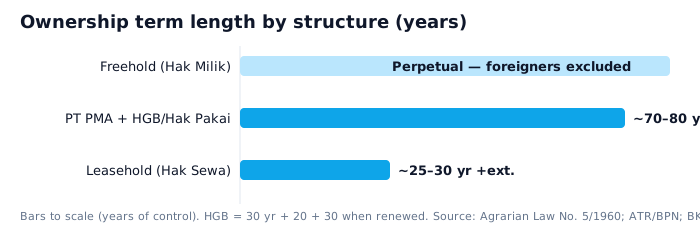
The term gap is the heart of the leasehold vs freehold vs PT PMA trade-off: leasehold is the cheapest way in but the shortest clock, the PT PMA route stretches control to multi-decade horizons, and true freehold, perpetual, is the benchmark foreigners can only approximate.
When to use which structure
Two questions settle most cases: how long do I want to hold? and
who is my likely buyer at exit?
- Leasehold fits a single villa, a lifestyle-plus-rental holding, and a 10-25 year horizon with retail buyers at exit. Keep an eye on the remaining term, sell or extend well before it dips under ~20 years.
- PT PMA + HGB/Hak Pakai fits longer horizons, multiple properties, licensed rental/hospitality use, and professional buyers who may acquire the company itself.
- Strata (HMSRS) fits foreign buyers of qualifying apartments who want a titled unit without land complexity.
The takeaway: structure follows strategy, not the other way round. Decide the hold period and exit buyer first, then pick the right-of-land that matches. For the area and yield context behind those decisions, see our
Bali real estate investment 2026: best areas, ROI & strategy
and the best areas to buy property in Bali 2026.
Methodology & sources
Terms, costs and discounts here are indicative 2026 ranges drawn from Indonesian land law and market practice, with monetary figures stated in USD at ~IDR 16,000/USD. Lease terms, HGB renewal periods and PT PMA costs vary by parcel, zoning, contract quality and current regulation. Land-right definitions follow the Basic Agrarian Law No. 5/1960 and the ATR/BPN framework; foreign-investment and PT PMA rules follow BKPM. This is general information, not legal advice, always commission an independent notary (PPAT) and an Indonesian property lawyer for your specific structure.
Limitations & who this is not for
This reference explains how the structures work; it does not replace tailored legal and tax advice, and it is not for anyone hoping to find a shortcut to personal freehold.
Nominee structures, do not use them. Holding Hak Milik through an Indonesian “nominee” who signs a private side agreement is a well-documented trap: socio-legal studies and court cases find such arrangements inconsistent with Articles 21 and 26 of the Basic Agrarian Law and liable to be declared null and void, leaving the foreign funder with little enforceable right because formal ownership stays with the Indonesian title holder. The lawful path is leasehold, Hak Pakai or a PT PMA, confirm the route for your case with a PPAT notary and follow the due-diligence checklist.
Conclusion
In 2026, the leasehold vs freehold vs PT PMA decision comes down to matching a lawful structure to your horizon and exit: leasehold for simple, mid-term, single-asset holds; a PT PMA over HGB/Hak Pakai for long-term, business-grade, scalable control; and freehold as the benchmark foreigners approximate but cannot hold. Get the structure right at entry and the rest of the investment, financing, tax, exit, becomes far easier to plan.
See how Magnum structures clean, lawful ownership
Explore our Uluwatu, Berawa and Sanur developments, each sold with transparent titles and a defined exit path, and see what full-cycle means for a Bali real estate developer that holds the land, builds and then manages the units.
Uluwatu, Sky Stars
Berawa
Sanur
FAQ: Leasehold vs freehold vs PT PMA in Bali 2026
Can foreigners own freehold (Hak Milik) land in Bali?
No. The Basic Agrarian Law No. 5/1960 reserves Hak Milik for Indonesian citizens. Foreigners use leasehold (Hak Sewa), Hak Pakai, HGB via a PT PMA, or strata title (HMSRS) for apartments.
How long does a leasehold last in Bali?
Hak Sewa is typically 25-30 years, with extensions negotiated and ideally written into the original contract. Resale value drops once under 15-20 years remain.
How long can a PT PMA hold land via HGB?
HGB is usually granted for an initial 30 years, extendable by 20 then 30 more, about 70-80 years of control when renewed correctly.
Is leasehold or PT PMA cheaper?
Leasehold has the lowest entry cost, land is often ~30-50% cheaper than freehold and needs no company. A PT PMA adds a few thousand USD of setup plus ongoing accounting, tax and reporting.
Are nominee freehold agreements legal?
No. They conflict with Articles 21 and 26 of the Basic Agrarian Law and can be deemed null and void. Use leasehold, Hak Pakai or PT PMA instead.
Which is better for me, leasehold or PT PMA?
Leasehold suits single-asset, lifestyle-plus-rental holds over 10-25 years; PT PMA suits longer horizons, portfolios and business use, at higher cost. See our freehold vs leasehold decision guide.
How does structure affect my exit?
Leasehold exit value depends heavily on the remaining term and extension options; a PT PMA can exit via property sale or share sale, often preferred by professional buyers.
References & official sources
- Basic Agrarian Law No. 5/1960 (Art. 21 & 26): Hak Milik restricted to Indonesian citizens, via faolex.fao.org / UNCTAD Investment Policy Hub
- ATR/BPN (National Land Agency): Hak Milik, Hak Pakai, HGB & strata title framework, atrbpn.go.id
- BKPM / Invest Indonesia: PT PMA rules, foreign-investment list, minimum capital, investindonesia.go.id
- DJP / Ministry of Finance: property & transaction taxes (PBB, transfer), pajak.go.id
- Market & legal practice (2026): Bali leasehold/PT PMA structuring guides; socio-legal studies on nominee agreements and Bali land tenure.
- Magnum Estate transaction data (structures used across recent sales).
About the author
Stanislav Sadovnikov is the founder of Magnum Estate (PT Magnum Estate International), an award-winning full-cycle Bali real estate developer with 8 projects and 575 units since 2019 (Berawa, Sanur, Umalas, Sky Stars, Sky Royal). He writes about Bali pricing, yields, ownership rules and regulation for international buyers.