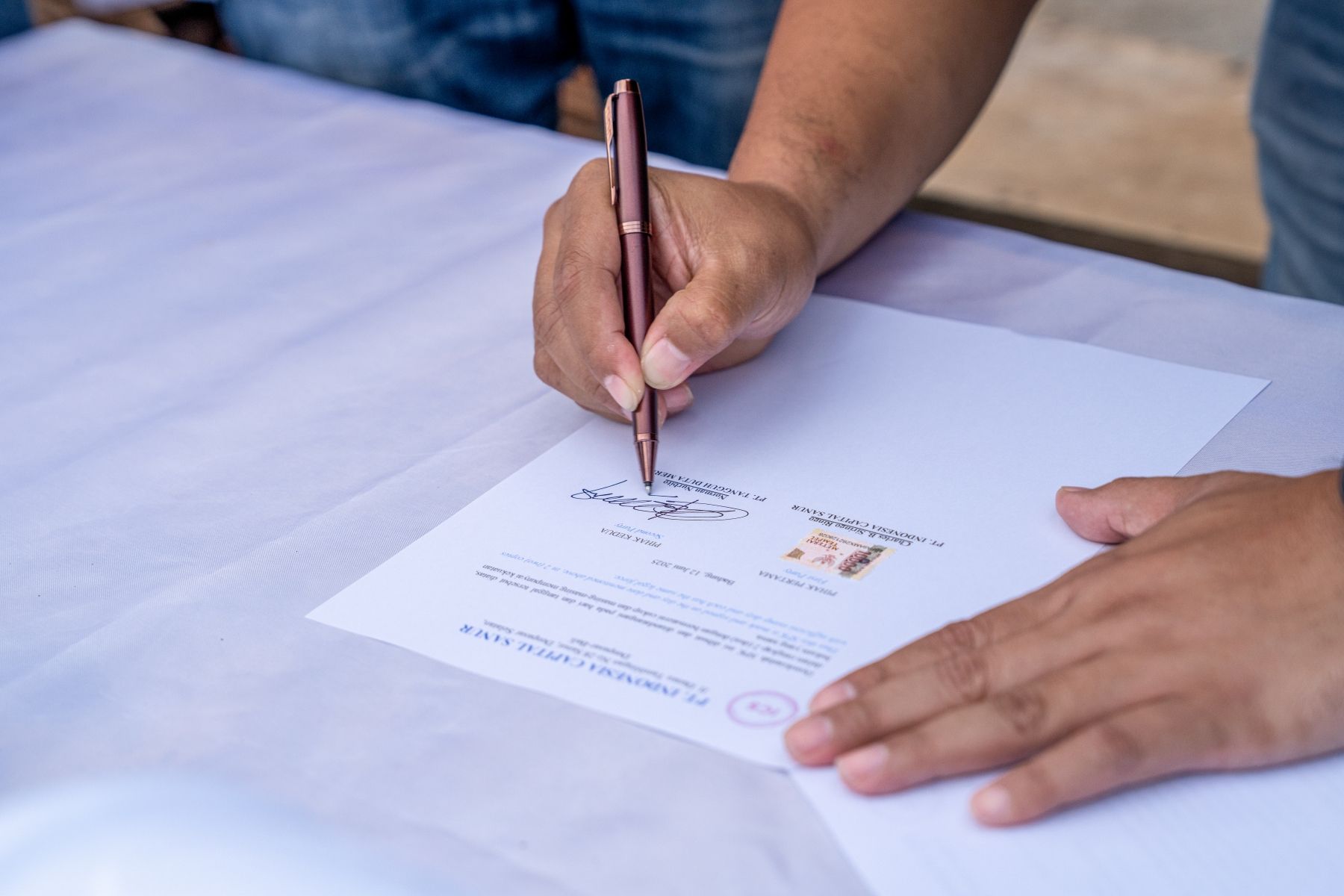







You are selling a contract, not land. What transfers is your right to occupy and use the property for whatever term remains, passed to a new lessee by notarial deed. The landowner is notified so the record is clean, but the landowner does not vote on it and cannot block a transfer your lease permits.
Last updated 1 September 2026. This is a process guide for someone who already holds a Bali leasehold and has decided to exit it. If you are still deciding, our buy, sell or hold guide covers that question, and freehold vs leasehold covers how structure affects resale value.
Almost everything written about Bali leasehold is written for the incoming buyer. This is the other side: the sequence you go through to get your capital back out, in order, and where it genuinely slows down.
Step 1. Understand what you are actually transferring
A Hak Sewa gives you the right to use the property for a defined term. Selling it means passing that right to someone else who continues it for the balance. You are not selling land, and you are not asking anyone’s permission to sell something you already hold.
That is worth stating plainly because a lot of Bali commentary implies the landowner holds a veto over your exit. As a matter of ordinary practice they do not. Your right runs for the term, and the right to pass it on runs with it.
What can change this is your own contract. A lease is a private agreement, so if someone drafted an unusual restriction into yours, that restriction binds you. Read the transfer clause once, early, and confirm there is nothing non-standard in it. That is a five-minute check, not a negotiation.
Step 2. Notify the landowner
The landowner needs to know who the new lessee is. Notification keeps the record clean, means rent or any periodic obligation is directed correctly, and avoids a dispute later about who holds the right.
Do it in writing and keep the acknowledgement with your file. Where the original signatory has died or the freehold has changed hands, establish who currently holds the title so the notification reaches the right party and the buyer’s notary can trace the chain. That is an administrative exercise rather than an approval process, but leaving it until completion week is how it becomes a delay.
Step 3. Assemble the document pack
A notary will not move without paperwork, and a serious buyer’s lawyer will ask for the same set. Gathering it before listing shortens the transaction and signals a clean asset.
- The original notarised lease agreement and every addendum or extension
- Evidence of the landowner’s title, and their identity documents
- Your written notification to the landowner, and their acknowledgement of it
- The building approval, PBG, and the certificate of function, SLF
- Zoning confirmation for the parcel and the use the buyer intends
- Any operating licence held over the property, and in whose name it sits
- Proof that land and building tax, PBB, is paid up to date
- Utility accounts, service charge statements and any estate or IPL arrears
- For an operating villa, twelve months of rental statements, occupancy and rate data
Step 4. Fix what devalues the asset, before you list
A short remaining term and missing paperwork destroy exit value faster than a soft market does. Both are fixable, and both are far cheaper to fix before marketing than to negotiate against afterwards.
If the term is short, price an extension first. Each extension is a fresh agreement requiring a new notarial deed and the consent of both parties, so it takes time; but selling a lease with a longer runway reaches a wider buyer pool. If PBG or SLF is missing, or the zoning does not support how the property is being used, resolve it or disclose it plainly. A buyer’s notary will find it, and finding it late converts a discount into a collapsed deal.
The same applies to licensing. If the villa operates under an accommodation licence held in someone else’s name, the buyer needs to know whether that arrangement transfers, and whether it is lawful in the first place. Nominee structures are prohibited under Bali’s Perda No. 4 of 2026, and the rules on who may hold an operating licence changed in 2026, which we covered in Bali is restructuring foreign investment.

Step 5. Price against the remaining term, not the purchase price
The value of a lease decays as the clock runs down, and it does not decay in a straight line. Above roughly 30 years remaining, resale and rental confidence stays strong. Below roughly 15 to 20 years, the buyer pool narrows sharply and discounting steepens, because the next buyer is underwriting a shorter earning window and a nearer expiry.
What you paid is not the reference point. The reference point is what a buyer can earn over the years that are left, plus whatever certainty exists about extension. Two otherwise identical villas with a decade of difference in remaining term are not comparable assets.
Area matters too. Liquidity is deepest in the established belt and thinnest in emerging corridors; our buy, sell or hold guide carries an area-by-area liquidity comparison worth reading alongside this.
Step 6. Execute the transfer through a notary
The transfer is done by notarial deed, passing the lease rights for the balance of the term to the incoming lessee. In Indonesian practice this is a deed of transfer of lease rights, and the landowner is commonly brought in to acknowledge it so that the chain of documents is complete on the face of the record.
Use a notary or PPAT operating in the region where the land sits, and expect the buyer to run their own diligence on the document chain from step three. Payment and the handover of originals should be structured against execution of the deed, not before it.
Step 7. Settle the tax: 10% with an NPWP, 20% without
Transferring a leasehold is taxed at 10% of the transfer value where the seller holds an Indonesian tax number, the NPWP, and 20% where the seller does not. This is a tax on the transfer of the lease right and is separate from the tax on ongoing rental income, and separate again from the 2.5% final rate that applies to a freehold transfer of land and building rights.
The NPWP differential is the part worth acting on early. The gap between the two rates is the whole of a second 10%, applied to the transfer value rather than to your profit, so on a substantial villa it runs to tens of thousands of dollars. A foreign seller who has never registered for Indonesian tax is exposed to the higher rate by default. If you do not hold an NPWP and you are planning an exit, raise it with your tax adviser before you market the property, not at the notary’s table.
Two practical points. Agree in the contract who bears the tax and how it is withheld, so the figure you shake hands on is the figure you actually receive. And confirm the treatment against your own documents with an Indonesian tax adviser, because the transfer value the tax is computed on should be established before you commit to a price.
Two things to check against your own documents
Registration. Some sources describe Hak Sewa as purely contractual and not registered at the land office, others state that leases are notarised and then registered at BPN. The practical answer depends on how your lease was drafted and recorded, so have your notary confirm the position on your deed. Landowner approval. Be wary of the widely repeated claim that a landowner must consent to your sale before it is valid. That is a contractual proposition, not the ordinary position; read your own transfer clause rather than a general article, this one included.
How long it takes, and what actually drives it
We are not going to publish a days-on-market figure, because no reliable Bali dataset exists and any number quoted is someone’s impression. What we can say is what governs the timeline.
The legal path is usually not the slow part. The length of the remaining term and the completeness of the document pack do most of the work: a lease with a long runway and a clean file moves through a buyer’s diligence quickly, while a short term with a missing SLF invites a renegotiation at the end of it. Where the freehold title has changed hands or passed to heirs, tracing the current owner so the chain is clean can add time.
Sell into strength where you can. A property with current occupancy data, a paid-up tax record and a licence that plainly transfers is a different proposition from the same building marketed cold with gaps in the file.
Limitations and sources
This is a general description of process, not legal or tax advice, and it has not been reviewed by Indonesian counsel. Every leasehold in Bali is governed by its own contract, and the terms of your agreement override any general account of how these transactions work.
A note on one widely repeated claim. Many Bali property and advisory websites state that a landowner’s written consent is required before a lease may be assigned. That is a contractual proposition rather than a statutory one, it is not the ordinary position, and we do not repeat it here. Leases in Indonesia are governed by Articles 1548 to 1600 of the Civil Code, and Indonesian legal scholarship on pengalihan hak sewa records lessees transferring leased land without the owner’s approval in practice. Where a specific lease contains a genuine restriction on transfer, that restriction binds the parties to it; that is a reason to read your own deed, not a general rule.
On tax: a leasehold transfer is taxed at 10% where the seller holds an NPWP and 20% where they do not. Note that public sources on this are inconsistent, with some describing the charge as falling on profit rather than on the transfer value, and others applying the 2.5% final rate that in fact governs transfers of land and building rights under Government Regulation 34 of 2016. The 10% and 20% rates stated here are the applicable ones. Our own taxes guide currently notes only that leasehold “differs” from the freehold rate and is due an update to carry these figures.
The remaining-term thresholds of approximately 30 years and 15 to 20 years are the bands published in our own freehold versus leasehold guide and reflect market convention rather than a measured dataset. We hold no secondary-transaction data and publish no discount curve by remaining term, because we do not have one.
Get your own notary and tax adviser onto your actual documents before you market the property.