





Written by Stanislav Sadovnikov, Founder, Magnum Estate ·
Reviewed by Magnum Estate investment desk ·
Last updated 21 August 2026
Bali hotel market 2026: summary
Bali’s hospitality market entered 2026 in consolidation, not expansion. Island-wide hotel occupancy eased 2.5 points to 73.2% in 2025, USD ADR fell 2%, and RevPAR was flat in rupiah terms, while 5,641 rooms across 45 hotels stay in the active pipeline and global brands keep breaking ground. Demand has plateaued. Development has not. That shifts the decisive question from price to operator, licence, and whether a site can still be replicated at all.
The 2025 scoreboard: strong, but past the peak
2025 was a record year on arrivals and a softer one on operations. Bali took 6.95 million foreign arrivals, up 10% year-on-year, a second consecutive all-time high above the 2019 peak, plus 9.6 million domestic arrivals. Australia led at 1.63 million, India came second, and China rebounded 20% to 537,000.
Operations tell the other half. Occupancy of 73.2% was down 2.5 points from 2024’s elevated base. ADR rose 2.4% in rupiah to IDR 2.4 million (about USD 150) but slipped 2% in USD on currency. RevPAR was broadly flat at IDR 1.7 million (about USD 106). July peaked at 85.9%.
Read together: more visitors, spread across more rooms, paying about the same in dollar terms. A maturing market, not a stalling one, but no longer the 2024 seller’s market.
Bali hotel submarket performance, 2025
| Submarket | Standout metric | Figure | What it signals |
|---|---|---|---|
| Nusa Dua | Highest occupancy | 79.2% | MICE plus leisure base |
| Jimbaran / Uluwatu | Highest ADR | IDR 4.8m (~USD 300) | View-driven premium holds |
| Ubud | Best RevPAR growth | +5.6% | ADR +11% despite softer occupancy |
| Luxury (Rate A, >USD 501) | Strongest ADR growth | +8.0% to IDR 13.1m (~USD 819) | Top end keeps pricing power |
| Island-wide | Occupancy | 73.2% (-2.5 pts) | Supply absorbing demand growth |
The top of the market kept its pricing power while the middle absorbed new supply. And Ubud grew RevPAR by raising rates, not occupancy, which is what a market does when it has a differentiated product rather than a volume one.
The number nobody quotes: 2026 arrivals have flattened
Almost every Bali market piece still runs on the 2025 growth figure. The 2026 data reads differently. BPS Bali recorded 1,466,546 foreign arrivals in Q1 2026, up just 1.04% year-on-year. Through May, cumulative arrivals of 2,598,143 were 1.77% below the same period of 2025. Momentum returned into mid-year, with June at 605,013, up 4.63% on May, but the half-year trend is flat to slightly negative, not double-digit growth.
Underwriting a unit on 2025’s +10% while 2026 runs near zero builds an occupancy assumption the market may not deliver. Horwath HTL’s own read is that 2026 is a year of consolidation rather than expansion.
What to do with this
Underwrite flat, not rising. If a projection needs arrivals growth to clear its target yield, it is a bet on the market rather than on the asset. Run the same unit at 2025-flat occupancy and see whether it still works. Our [cash flow stress test](/blog/bali-villa-cash-flow-roi-stress-test) walks through the downside cases.
What is actually being built right now
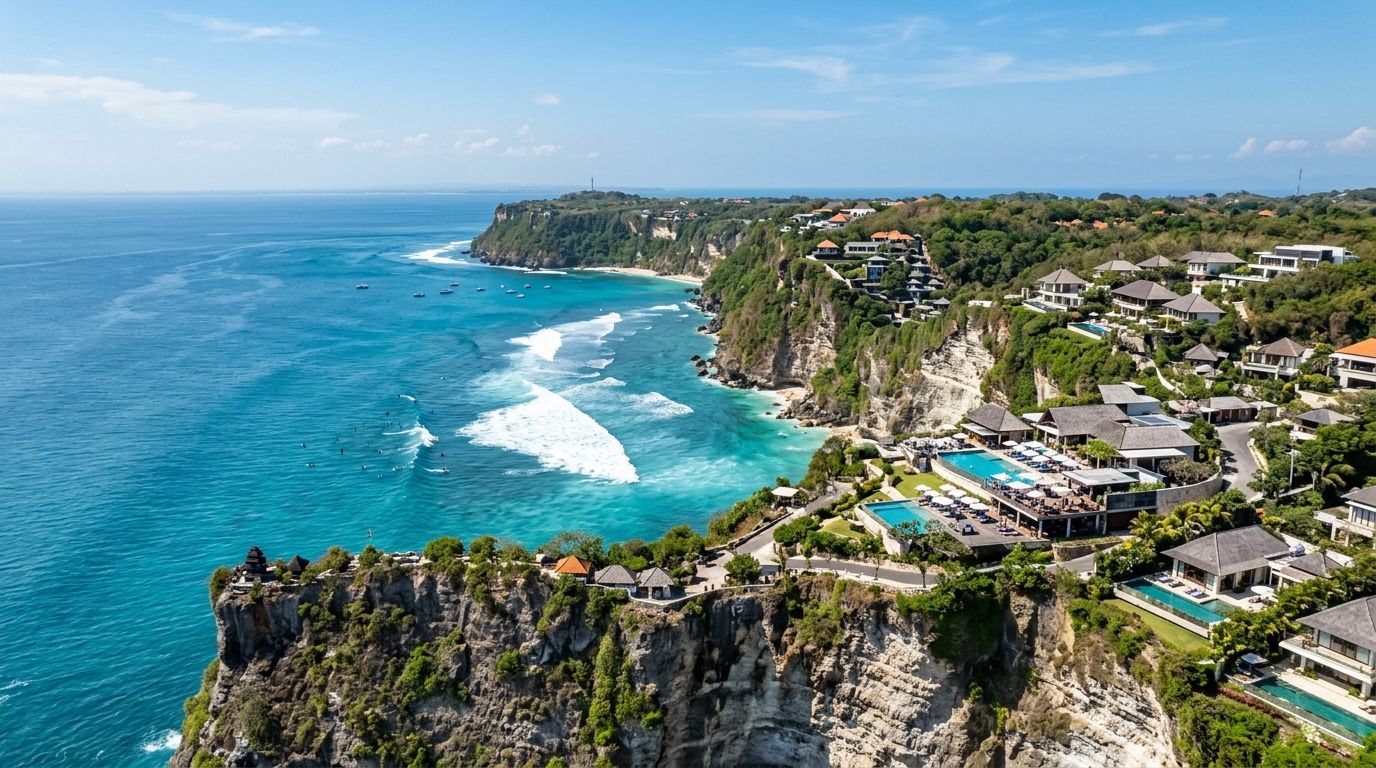
Softer operating numbers have not slowed construction. 5,641 rooms across 45 hotels sit in the active pipeline, and Rate A and Rate B properties account for more than half of pipeline rooms, meaning the new supply is weighted to the upper-upscale and luxury tiers rather than mid-market. Alongside it, more than 70 hospitality-managed developments are actively on sale.
The named projects show where the capital is going. Raffles Residences Bali, a joint Accor and Kajima Development project, brings 28 ultra-luxury homes from 502 m2 on a 5.3-hectare oceanfront estate beside Raffles Bali in Jimbaran, with a Q2 2026 opening. Paradisus Bali opened at Nusa Dua as Melia’s first Southeast Asian property. Anantara Dragon Seseh Bali Residences lands squarely in the northwest frontier. Aman Villas at Nusa Dua, The Residences at Mandarin Oriental, Bali, plus Banyan Tree, Bvlgari and Karma schemes complete a roster that confirms branded, hospitality-run residences are now mainstream in Bali rather than niche.
One structural detail matters more than any single launch: 41% of branded projects have fewer than 30 units, and only 5% exceed 200 units. Bali’s development is overwhelmingly small-scale. Large, consolidated schemes are the exception across the whole island.
Selected Bali hospitality developments in progress, 2026
| Project | Location | Detail |
|---|---|---|
| Raffles Residences Bali | Jimbaran | Accor + Kajima, 28 homes from 502 m2, 5.3-ha oceanfront, Q2 2026 |
| Paradisus Bali | Nusa Dua | Melia's first Southeast Asia property, now open |
| Anantara Dragon Seseh Residences | Seseh | Branded scheme on the northwest frontier |
| Aman Villas | Nusa Dua | Ultra-luxury branded villas |
| The Residences at Mandarin Oriental | Bali | Branded residence component |
| Banyan Tree / Bvlgari / Karma | Various | Established luxury operators expanding |
Where new supply is moving, and the permit backdrop
Canggu and Berawa hold roughly 40% of branded-residence supply, and the wider Canggu corridor including Pererenan and Umalas accounts for about 39% of all branded projects. Uluwatu follows at 20%, then Nusa Dua and Tabanan at 7% each and Seminyak at 6%.
But land constraints in the Canggu core are pushing new launches northwest into Seseh, Pererenan and Nyanyi, a cluster now at roughly 17% of total supply. Congestion is part of the story: Canggu’s traffic is cited directly as a limit on the corridor’s long-term sustainability.
The permit backdrop tightened as well. Following the September 2025 floods, Governor Wayan Koster reinstated a moratorium on new construction permits for hotels, restaurants and tourism accommodation on agricultural-zoned land. Two caveats matter. It operates through governor’s directives to regents rather than codified regulation, and Badung regency, which contains Canggu, Berawa, Pererenan, Seminyak and Uluwatu, is not subject to the formal moratorium. Read it as tighter scrutiny of agricultural-land conversion island-wide, not a building ban in the core.
Tenure is shifting too. Freehold offerings nearly doubled from 12% to 23% of supply, widening the buyer pool to domestic Indonesians. Canggu and Berawa remain predominantly leasehold, and the Bali standard is a 25 to 35 year lease.
Branded-residence supply and direction of travel, 2026
| Area | Share of supply | Direction |
|---|---|---|
| Canggu / Berawa (+ Pererenan, Umalas) | ~40% of supply, ~39% of projects | Core hub, land-constrained, new launches moving out |
| Seseh / Pererenan / Nyanyi | ~17% | New-launch frontier, fastest growth |
| Uluwatu / Jimbaran | ~20% | Highest ADR, luxury pipeline lead |
| Nusa Dua | ~7% | Highest occupancy, MICE anchored |
| Tabanan | ~7% | Emerging, low base |
| Seminyak | ~6% | Mature, little new land |
Why the Canggu and Berawa core is getting harder to replicate
This is where precision matters, because the popular version of this argument is wrong.
Property in Canggu and Berawa is not scarce. The corridor is the single largest cluster of branded supply on the island at around 40%, it carries about a third of all Bali property transactions, and well over a thousand land plots are listed for sale in Canggu at any given time. Median Canggu land pricing has also been broadly flat over the past year, which is not what a supply squeeze looks like on a price chart.
What is scarce is a developable site at project scale inside the core. Those are different things. A thousand small plots for sale does not produce one contiguous, correctly zoned, permitted parcel large enough for a full resort scheme with amenities and parking. The evidence for that constraint is behavioural rather than promotional: Horwath HTL reports that new launches are moving northwest specifically because of land constraints, and developers do not leave the highest-demand corridor on the island for a frontier area by preference. Add that only 5% of branded projects island-wide exceed 200 units, and the scale constraint is visible in the data.
So the honest reading for a buyer is narrow. An existing, permitted, hospitality-grade scheme in the Canggu and Berawa core sits on a site that is genuinely difficult to reproduce today, and future competing supply is more likely to appear in Seseh, Pererenan or Nyanyi than next door. That is a supply argument about replacement cost, not a forecast of price growth. Flat land pricing and 2026’s soft arrivals both argue against assuming automatic appreciation, and the lease term and licensing still decide whether any of it is worth owning.

Compliance stopped being a deadline and became a filter
This is the genuine 2026 change, and most content still describes it in the future tense.
Every short-term accommodation provider needed a Business Identification Number (NIB) through the OSS licensing system by 31 March 2026, with a final extension to 31 May 2026. Both dates have passed. Enforcement is live and mechanical: the OSS database is linked to the OTA platforms, so when Airbnb or Booking.com checks a listing it verifies against government records in real time. Non-compliant listings get hidden or removed, and local officers are checking zoning and business licences on site.
For a foreign owner the requirement stack is specific: an NIB, a villa accommodation licence (KBLI 55193, held through a PT PMA), correct zoning, PBG and SLF building certificates, and tax registration. Pondok Wisata (KBLI 55130) is available to Indonesian citizens only, and an individual foreigner cannot hold these licences personally.
This is also why branded, managed product is gaining share. Compliance is built into a professional operation; for an informal villa it is an afterthought that now decides whether guests can find the listing at all.
Legal note
Foreign ownership runs through leasehold (Hak Sewa), typically 25-35 years in Bali, or a PT PMA holding Hak Guna Bangunan (HGB). Both are legal and compliant; neither is freehold in a foreign individual's name. A managed operator handling licensing does not transfer your duty to verify title, zoning and lease term with a notary (PPAT). See our [legal guide for foreign buyers](/blog/buying-property-in-bali-as-a-foreigner-legal-guide-2026).
How the buying question changed
What this means if you are buying in 2026
Operator and licence now carry more of the return than the address does. With occupancy easing and new rooms still arriving, the spread between a well-run compliant asset and an informally run one widens. That is the case for hospitality-grade product, covered in our hospitality real estate guide, and for hotel-style unit management by the developer, where the operator and the licence are part of what you buy.
Judge a core location on replacement cost, not on a growth story. An already-permitted scheme in Canggu or Berawa is hard to reproduce, and that has real value; the permits behind our own schemes are set out on the Bali real estate developer page. It is not a promise that prices rise, and flat land pricing says as much.
Check the tenure and the term. Freehold rising from 12% to 23% of supply does not make Canggu freehold; that corridor is still predominantly leasehold on 25 to 35 year terms. Confirm what you are buying and how many years remain, then pressure-test the returns with our villa ROI guide and compare area costs in our Bali property prices 2026 guide.
Expect the frontier to compete with you. If you buy for yield in the core, your future competing supply is being permitted in Seseh, Pererenan and Nyanyi right now, at lower land cost. That is a margin question for the next decade, not a reason to avoid the core.
Limitations and sources
Hotel performance, pipeline composition, branded-residence supply, tenure split and area distribution are from Horwath HTL’s “Bali Hotel & Branded Residences 2026”, produced with the Bali Hotels Association and C9 Hotelworks, published 24 March 2026 and reporting full-year 2025. Project-scale and per-m2 pricing figures are corroborated by published analysis of the same research series. Arrivals for 2026 are from BPS Bali monthly releases through June 2026. The moratorium position reflects reporting on the Governor’s September 2025 directives. Compliance requirements are drawn from published Indonesian OSS and Ministry of Tourism guidance.
Rupiah figures are converted at approximately IDR 16,000/USD and rounded; currency moves change the USD view materially, which is why USD ADR fell while rupiah ADR rose. Hotel ADR and RevPAR describe hotels, not private villas, and should not be read as villa rates. The northwest-cluster share and the 12% to 23% tenure shift rest on published summaries of the 2026 report rather than the full document. Land-listing counts and median land pricing are agency-portal data and move with listing inventory, not transactions. Nothing here is a projection for any specific unit. Commission independent appraisal and notary (PPAT) due diligence before purchase.