






Written by Stanislav Sadovnikov, Founder, Magnum Estate ·
Reviewed by Magnum Estate legal & investment desk ·
Last updated 3 June 2026
"15-25% Typical full-management fee · 30-50% Opex as % of gross income · 4-6%, 10-15% Net yield: self vs pro-managed · 70-85% Prime-area occupancy"
Key figures (2026)
Bali property management 2026: summary
Bali property management 2026, the short answer: a professional manager typically charges 15-25% of gross rental revenue, and that fee is usually worth paying. The reason is the gross-to-net gap: a self-managed villa nets roughly 4-6%, while the same villa under professional operations nets 10-15%, because dynamic pricing, multi-channel distribution and preventive maintenance recover far more than they cost.
- What a manager does: distribution, pricing, guest journey, housekeeping, maintenance, reporting and compliance.
- Fees: full management ~15-25% (commission-only ~18%); marketing-only ~9%.
- Cost drag: total operating costs run ~30-50% of gross rental income.
- Gross ≠ net: quoted yields are gross (7-15%); what you keep is net, 4-6% self-managed, 10-15% pro-managed.
- Demand: Bali drew 6.95M foreign visitors in 2025 (+9.7% YoY); prime occupancy 70-85%.

"Transparency: Magnum Estate develops and operates property in Bali, so we have a commercial interest. This guide is educational, not investment or legal advice, verify figures independently and consult a certified Indonesian notary (PPAT) and tax advisor before buying."
Transparency
This Bali property management 2026 guide is about the one factor that now separates a good Bali villa from a disappointing one: operations. By 2026 the market has matured past the post-pandemic boom, and the headline yields you see in listings are almost always gross. What you actually keep, your net yield, is decided after the villa is built, by how it is run. Below we break down what a manager does, what it costs (typically 15-25% of revenue), and why that spend turns a 4-6% self-managed return into 10-15%.
Why operations, not location, decide 2026 returns
Location still sets the ceiling, Bali drew 6,948,754 foreign visitors in 2025, up 9.72% year-on-year, and prime-area occupancy runs 70-85% (island-wide average closer to ~65%). But two villas on the same street can return wildly different net yields. The difference is operations: one is priced dynamically and booked across every major channel; the other sits half-empty with stale pricing and deferred maintenance. In 2026, serious investors treat a villa as a 5-10-year business with a real operating budget, not a holiday house that occasionally earns. For the underlying purchase math, pair this guide with our Bali villa ROI guide and the wider Bali villa investment hub.
What a Bali property manager actually does
“Management” is often imagined as cleaning and key handover. In practice, a professional manager runs the full operating system that converts an asset into income:
- Distribution & OTA management: listing and syncing the villa across Airbnb, Booking.com, Agoda, Expedia and direct-booking channels, with a channel manager to prevent double-bookings and to push the right inventory to the right platform.
- Revenue & dynamic pricing: adjusting nightly rates by season, day-of-week, lead time and local events using occupancy and channel analytics, the single biggest revenue lever.
- Guest journey: pre-arrival communication, smooth check-in, responsive support and review management, which drive the repeat business that keeps occupancy high.
- Housekeeping & turnover: reliable cleaning and quality control between stays.
- Preventive maintenance & engineering: scheduled inspections and replacements that avoid costly emergency repairs and protect asset life.
- Staffing, security & landscaping: rostering teams against actual bookings.
- Financial reporting & compliance: transparent statements plus coordination of rental-income tax and annual levies.
The takeaway: distribution and pricing are where most self-managed owners lose the most money, not in the cleaning bill. A manager who fills the shoulder season at the right price routinely out-earns a cheaper one who simply lists on a single platform. See how this plays out across areas in our best areas to buy in Bali 2026. For a developer-run example of this operating model, see Magnum’s Bali property management service.
Management fees & cost structure in Bali property management 2026
Bali operators have become far more transparent about pricing. Most full-service models are commission-based, charged as a percentage of gross or published revenue, so the manager only earns when the villa earns. Marketing-only packages are cheaper but leave the operational heavy lifting to you:
| Package | Typical fee | What it covers |
|---|---|---|
| Full management (commission) | ~15-25% of gross revenue (often ~18%) | Distribution, pricing, guest journey, housekeeping, maintenance coordination, reporting |
| Marketing / listing only | ~9% of gross revenue | OTA listing & marketing; owner handles operations on the ground |
| Preventive maintenance reserve | ~2-5% of property value / yr | Scheduled upkeep, system tune-ups, capex on multi-year cycles |
| Annual property tax (PBB) | ~0.1% of assessed value | Statutory land-and-building tax (rental-income tax is separate) |
| Indicative 2026 ranges. Full-management fee is the headline number; the maintenance reserve and PBB sit on top. ~IDR 16,000/USD. |
The gross-to-net gap: where management earns its fee
Almost every “8-15% yield” headline you’ll see in Bali is a gross figure, annual rent divided by price, before a single cost is deducted. What you actually keep is the net yield, after management, tax, maintenance and vacancy. This is the single biggest source of disappointed Bali investors, and it is also where professional operations prove their value:
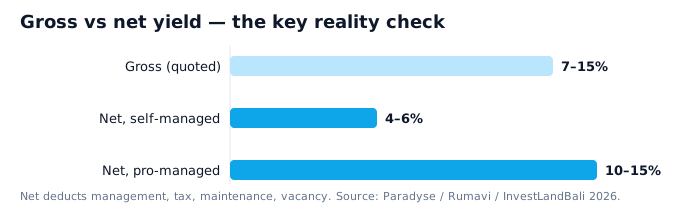
The counter-intuitive part: paying a manager 15-25% of revenue usually raises your net yield rather than lowering it. A self-managed owner overseas typically lands at 4-6% net, stale pricing, single-channel listing, gaps in the calendar and reactive maintenance all eat the return. A professionally run villa lands at 10-15% net because higher occupancy, smarter pricing and asset protection add more revenue than the fee removes. The fee is the price of capturing the upper band, not a deadweight cost.
The gap between 4-6% and 10-15% net is operations: data-driven pricing, OTA distribution and cost control. Model the full picture with our taxes & holding-costs guide and the area-level yields in our Bali property prices 2026 map.
Note these are net bands and apply island-wide. They are not the same as the gross yields quoted by area (Canggu/Berawa 12-18%, Uluwatu 10-16%, Ubud 10-15%, Seminyak 10-14%, North Bali 6-10%), those are pre-cost figures. The chart below shows the gross starting point that operations then convert into the net bands above.
See net yields, not gross headlines
Magnum Estate’s villas are built and operated for long-term performance, compare transparent pricing and projected net yields across our Berawa, Sanur and Uluwatu developments.
View Magnum projects
Book a free consultation
Where the money goes: operating-cost drag by line
Total operating costs typically consume 30-50% of gross rental income, before the management fee in some models and inclusive of it in others, always confirm which in the contract. The rough split for an investment-grade villa:
| Cost line | Typical share of gross income | Notes |
|---|---|---|
| Management fee | 15-25% | Commission-only on gross/published revenue |
| Staff (housekeeping, security, garden) | 8-15% | Scaled to villa size & occupancy |
| Utilities & consumables | 5-10% | Electricity, water, internet, supplies |
| Maintenance & repairs | 5-10% | Plus a 2-5%-of-value annual reserve for capex |
| OTA / channel commissions | 3-8% | Airbnb, Booking.com, Agoda fees |
| Taxes & insurance | 3-6% | Rental-income tax, PBB ~0.1% of value, cover |
| Indicative shares; total opex ≈ 30-50% of gross rental income. Lines overlap depending on whether OTA fees and tax are billed gross or net. Source: Magnum Estate ROI & holding-cost guides; Bali operators 2026. |
Compliance counts: “premium” in 2026 starts with correct zoning, PBG, SLF and environmental approvals, and continues with management keeping those standards current. Get the legal foundation right in our
foreign-buyer legal guide
before you sign an operating contract.
Methodology & sources
Figures are indicative 2026 ranges, reconciled across multiple market datasets and converted at ~IDR 16,000/USD. Management fees are stated as a percentage of gross/published revenue; operating-cost shares are of gross rental income. Gross yields are rent ÷ price before costs; net yields deduct management, tax, maintenance and vacancy, and are stated only as 4-6% (self-managed) and 10-15% (professionally managed). Individual villas vary by size, location, service level and contract terms. Always commission independent due diligence and a notary (PPAT) review before purchase or signing a management agreement.
Conclusion
In 2026, Bali rewards operators, not just owners. The asset gets you to the gross yield; management gets you to the net. A 15-25% fee looks expensive until you compare a 4-6% self-managed net yield with the 10-15% a well-run villa delivers, at which point professional operations are the cheapest way to protect both your ROI and your sanity. The strongest position is to buy a villa that was designed to be operated, not retro-fitted into a management system afterwards.
Buy a villa built to be run, not just sold
Explore Magnum Estate’s ocean-view residences in Uluwatu, Berawa and Sanur, engineered for long-term operations with transparent, projected net yields.
Uluwatu, Sky Stars
Berawa
Sanur
FAQ: Bali property management 2026
How much does Bali property management cost in 2026?
Full villa management typically costs 15-25% of gross or published revenue (commission-only models often ~18%); marketing-only packages are closer to 9%. Total operating costs, including staff, utilities, maintenance and taxes, usually reach 30-50% of gross rental income.
What is the difference between gross and net yield?
Gross yield is rent ÷ price before costs (typically 7-15%). Net deducts management, tax, maintenance and vacancy, about 4-6% self-managed or 10-15% professionally managed.
Can professional management really improve ROI?
Yes. The jump from 4-6% to 10-15% net is driven by dynamic pricing, multi-channel OTA distribution, preventive maintenance and cost control, which add more revenue and protection than the fee costs.
What does a Bali property manager actually do?
Distribution and pricing, guest communication and check-in, housekeeping, preventive maintenance, security, staffing, financial reporting and tax/compliance coordination, the full operating system behind the villa.
Why can’t I self-manage from overseas?
Without on-the-ground teams, occupancy and reviews fall, emergencies cost more and compliance slips, which is why self-managed villas usually net only 4-6%.
What should a management contract include?
Clear scope of services, fee structure, maintenance responsibilities, reporting standards, insurance and compliance obligations, and measurable performance metrics.
How do I budget for maintenance and staffing?
Reserve roughly 2-5% of property value per year for preventive maintenance and capex, with separate line items for housekeeping, security, landscaping, utilities, insurance and contingency, scaled to occupancy.
References & official sources
- BPS, Statistics Indonesia / Bali: 2025 foreign arrivals (6,948,754, +9.72%), occupancy, bali.bps.go.id
- Bank Indonesia, Residential Property Price Index: price-growth data & IDR/USD rate, bi.go.id
- DJP / Ministry of Finance: PBB & rental-income taxes, pajak.go.id
- ATR/BPN: land titles, zoning & building permits (PBG/SLF), atrbpn.go.id
- Market & operations data (2026): Paradyse Homes price-per-are study; Prestige Property Bali area/yield analysis; Rumavi & InvestLandBali management cost/yield reports; Bali management-operator fee schedules.
- Magnum Estate portfolio data (net yields & opex ratios by project).
About the author
Stanislav Sadovnikov is the founder of Magnum Estate (PT Magnum Estate International), an award-winning full-cycle Bali real estate developer with 8 projects and 575 units since 2019 (Berawa, Sanur, Umalas, Sky Stars, Sky Royal). He writes about Bali pricing, yields, ownership rules and regulation for international buyers.