






Written by Stanislav Sadovnikov, Founder, Magnum Estate ·
Reviewed by Magnum Estate legal & investment desk ·
Last updated 3 June 2026
"20-30% Full-service management fee (of rental income) · 4-6%, 10-15% Net yield: poorly run vs run as a business · 70-85% Prime occupancy (island ~65%) · 6.95M 2025 foreign arrivals (+9.7%)"
Key figures (2026)
Bali villa management 2026: summary
Bali villa management 2026 is no longer a side task, it is a full hospitality business. The short answer: owning the villa is half the game; the other half is licensing it, staffing it, systemising it and branding it so guests pay a premium and come back. The difference between a 4-6% net yield and a 10-15% net yield is almost entirely how you operate.
- Licence first: short-stay rentals need a tourism accommodation licence, most often Pondok Wisata, held through a PT PMA, registered on OSS with an NIB.
- Build a team: operations manager, housekeeping, maintenance and guest relations, in-house or via a management company at 20-30% of rental income.
- Run on systems: a PMS/channel manager, dynamic pricing, digital maintenance logs and guest-service SOPs.
- Brand it: a named villa with a story, consistent photography and a direct-booking funnel earns more than an anonymous Airbnb listing.
- Guest experience is the product: reviews drive occupancy and pricing power on Airbnb and Booking.com.

"Transparency: Magnum Estate develops and operates property in Bali, so we have a commercial interest. This guide is educational, not investment, tax or legal advice, verify figures independently and consult a certified Indonesian notary (PPAT), a tax advisor and a licensing consultant before you start renting."
Transparency
This Bali villa management 2026 guide is about a different question from “what does a manager do day-to-day?”, it is about how to turn a villa into a real hospitality business. In 2026, owning the property is only half the game; with thousands of villas chasing the same guests, the winners are the ones run with a licence, a team, proper systems and a brand. Below is the operating blueprint, licensing through Pondok Wisata, staffing, the software stack, branding and the guest experience, plus the gross-vs-net economics that decide whether the business is worth running at all. For the day-to-day operational checklist and ROI math, see our companion guide on Bali property management and ROI.
From asset to business: the 2026 mindset
Bali’s market has matured. Guests now expect hotel-level service, online reviews decide occupancy, and the rules around tourism rentals are stricter and more visible. Demand is strong, 6,948,754 foreign visitors arrived in 2025, up 9.72% year-on-year, pushing prime-area villa occupancy to 70-85% (island-wide closer to ~65%), but that same audience punishes weak service and poor maintenance instantly in reviews. The island’s climate (heat, humidity, heavy rain, sea air) means a villa deteriorates fast without a structured maintenance and inspection schedule, directly hitting ratings and returns.
The practical conclusion: treat the villa as a mini-hotel with a P&L, not as a holiday home that occasionally earns. That reframing, from asset to business, is what the rest of this guide builds out.
The takeaway: the same building can return 4-6% or 10-15% net depending only on how it is run. Before you buy, sanity-check the area’s realistic demand in best areas to buy in Bali 2026 and the underlying price you are paying in Bali property prices 2026.
Licensing: Pondok Wisata and the legal base
A villa rental business cannot run legally on a residential title alone. Short-stay accommodation in Bali requires a tourism accommodation licence on top of a valid property structure. The most common categories:
| Licence / structure | Typical use | Notes |
|---|---|---|
| Pondok Wisata | Smaller guesthouses / individual villas (commonly up to ~5 rooms) | Most common route for a single rented villa; held through the property’s structure |
| Hotel / serviced-accommodation licence | Larger or multi-unit, branded operations | More reporting; suits a portfolio or villa complex |
| PT PMA (HGB) + OSS / NIB | Foreign-owned operating company | Foreigners can’t hold Hak Milik directly; a PT PMA holds HGB and registers the business on OSS for an NIB |
| CHSE / standards registration | Cleanliness, health, safety & environment signalling | Optional but increasingly expected by guests and OTAs |
| Indicative categories only, confirm the exact licence with a licensing consultant and notary (PPAT). Foreign ownership routes per ATR/BPN & BKPM 2026. |
Legal note: foreigners cannot hold freehold (Hak Milik) directly, a villa business is typically operated through Leasehold (Hak Sewa) or a PT PMA holding HGB. The ownership wrapper you choose also shapes how rental income is taxed. Get the structure right before you take your first booking; start with our legal guide to buying property in Bali as a foreigner.
Building the team
A hospitality business runs on people. Whether you hire directly or delegate to a management company, these roles have to be covered every single day:
- Operations / property manager, the “GM” of your mini-hotel; owns occupancy, the schedule and vendor relationships.
- Housekeeping, turnover cleaning to a documented standard; the single biggest driver of cleanliness reviews.
- Maintenance / handyman, pool and garden care, AC, plumbing and a 24/7 fault response, on a preventive schedule (not reactive).
- Guest relations, inquiries, check-ins, concierge and complaint resolution across Airbnb, Booking.com and direct channels.
- Revenue & finance, dynamic pricing, monthly statements, payroll, tax filing and capex budgeting.
Most foreign owners do not hire all of this directly. They appoint a management company that bundles the roles for a fee, typically 20-30% of rental income for full-service management. Treat that selection like hiring a CEO for the business: judge it on proven occupancy, ADR and review data for similar villas, not on a 5-10% fee difference.
Systems that run the business
Process maturity is what separates a hobby listing from a business. The 2026 operating stack:
| System | What it does | Why it matters |
|---|---|---|
| PMS + channel manager | Syncs availability & bookings across Airbnb, Booking.com and direct | Stops double-bookings; one source of truth |
| Dynamic pricing tool | Adjusts nightly & monthly rates by season, demand, events & competition | Flat year-round pricing routinely underperforms |
| Digital maintenance log | Tracks inspections, faults and vetted contractors | Catches leaks, mold and AC faults before reviews do |
| Guest-service SOPs | Documented check-in, cleaning and complaint procedures | Consistency regardless of which staff member is on shift |
| Accounting / reporting | Transparent monthly P&L, payments and tax reporting | Lets you manage the business by numbers, not vibes |
| A management company should already run this stack. If it can’t show you the dashboards, it is not running a business. |
Data point: dynamic pricing and disciplined cost control are exactly where the net yield is won or lost. The same operational levers are quantified in our Bali property management & ROI guide and in the long-vs-short-stay trade-off in our rental strategy guide.
Branding and direct bookings
An anonymous “3BR villa near Berawa” competes only on price. A named villa with a story, consistent professional photography, a simple website and a direct-booking funnel competes on brand, and keeps the 15-18% commission it would otherwise pay the OTAs. Branding for a villa business in 2026 means:
- A name and identity, a memorable villa name, logo and consistent visual style across every listing.
- Photography that sells the experience, not just rooms, but mornings by the pool, the workspace, the neighbourhood.
- A direct channel, a one-page site plus a WhatsApp/booking link, so repeat guests skip the OTA fee.
- A guest community, for the digital-nomad and long-stay segment: coworking partnerships, yoga, curated events that drive repeat and referral stays.
Guest experience as the product
In a review-driven market, the guest experience is the product. Digital nomads and remote workers are now a core segment, and they choose on specifics: fast, reliable internet, a real workspace, quiet, good lighting. Villas that deliver these rent faster and at higher monthly rates, and long-stay bookings (weeks to months) smooth out seasonality and cut changeover costs. The mechanics that protect reviews, and therefore occupancy and pricing power, are smooth check-ins, fast complaint resolution, spotless housekeeping and proactive maintenance so nothing breaks mid-stay.
Thinking of running your villa as a business?
Magnum Estate develops and operates branded, fully-managed residences in Berawa, Sanur and Uluwatu, designed for hospitality income from day one.
View Magnum projects
Book a free consultation
The economics: gross vs net (why operations decide the result)
Most “8-15% yield” claims you’ll see are gross, annual rent ÷ price, before costs. What a villa business actually keeps is the net yield, after management, tax, maintenance and vacancy. This single distinction explains why two identical villas can return wildly different amounts:
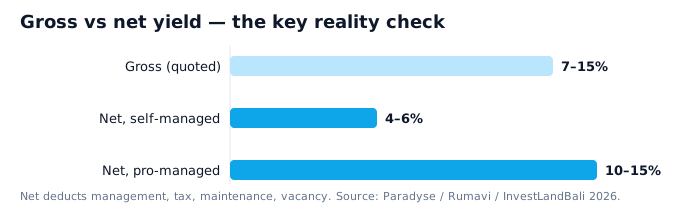
Gross yields are also strongly area-driven, the rental demand behind the business varies a lot by location:
| Area | Gross yield | Demand profile for an operator |
|---|---|---|
| Canggu / Berawa | 12-18% | Deepest, most year-round rental demand |
| Uluwatu / Bukit | 10-16% | Luxury / ocean-view; strong ADR, more seasonal |
| Ubud | 10-15% | Wellness & long-stay; lower volatility |
| Seminyak | 10-14% | Established; best exit liquidity |
| North Bali (Lovina) | 6-10% | Thinner demand; longer horizon |
| GROSS yield (before costs). Net is materially lower, see chart above. Source: Prestige Property Bali 2026. |
Annual property tax (PBB) is low at roughly 0.1% of assessed value, but transaction and rental-income taxes apply and belong in the P&L. Map the full holding cost with our taxes & holding costs guide.
Self-manage vs management company
| Factor | Self-managed | Professional management |
|---|---|---|
| Typical net yield | ~4-6% | ~10-15% |
| Cost | Your time + direct staff | 20-30% of rental income |
| Pricing | Often flat / under-optimised | Dynamic, tool-driven |
| Maintenance | Reactive; risk of neglect from abroad | Scheduled, preventive, logged |
| Licensing & tax | Owner’s responsibility | Handled / advised by the company |
| Best for | Local, hands-on, single villa | Overseas owners, portfolios, premium positioning |
| The 20-30% fee usually pays for itself via higher occupancy, ADR and avoided repair costs, but only if the company is chosen on performance. An alternative is villa management in Bali by the developer, where the company that built the villa also answers for its operating numbers. |
Limitations & who this is not for
"A villa business is not passive income, and it is not for everyone. It is a poor fit if you want a pure buy-and-hold with zero involvement, if your budget can't absorb a slow first season while reviews build, or if you're unwilling to license and tax the operation correctly. Yields quoted here are indicative ranges, not guarantees; individual results depend on area, product, pricing and execution. Regulations around tourism rentals change, re-verify licensing before you launch."
Transparency
Conclusion
In 2026, Bali villa management is won by operators, not owners. Licence the property correctly, build (or buy in) a real team, run it on systems, give it a brand and obsess over the guest experience, and the same building that returns 4-6% as a casual rental can return 10-15% net as a business. The decision isn’t “should I get a manager?” but “am I running a hospitality company or letting the asset drift?”.
Build a villa business, not a headache
Explore Magnum Estate’s branded, fully-managed residences in Uluwatu, Berawa and Sanur, designed and operated for hospitality income; the current villas and apartments for sale list entry price and projected net yield per project.
Uluwatu, Sky Stars
Berawa
Sanur
FAQ: Bali villa management 2026
Is a Bali villa a passive investment in 2026?
No. Bali villa management 2026 is a full hospitality business. Without licensing, a trained team, systems and active maintenance, villas slide into poor reviews and underperformance, the gap between 4-6% and 10-15% net is almost entirely operations. Running it as a business means securing a tourism accommodation licence (most commonly Pondok Wisata, held through a PT PMA registered on OSS with an NIB), staffing an operations manager, housekeeping, maintenance and guest relations (in-house or via a management company for 20-30% of rental income), and running on a PMS, dynamic pricing and documented service standards. Demand supports the effort: Bali drew 6,948,754 foreign visitors in 2025, up 9.72% year-on-year, pushing prime-area occupancy to 70-85%, but that same audience punishes weak service and neglected maintenance instantly in reviews, which then drag down both occupancy and pricing power.
What licence do I need to rent out a villa in Bali?
Short stays generally need a tourism accommodation licence, most commonly Pondok Wisata for smaller villas, held through the property structure (often a PT PMA registered on OSS with an NIB). Confirm the exact category with a licensing consultant and notary (PPAT).
How much does full-service villa management cost?
Typically 20-30% of rental income, covering operations, marketing, guest handling, staff and reporting. Choose on proven occupancy, ADR and reviews, not on fee alone.
What rental yield can a villa business deliver?
Gross yields run ~10-18% in prime areas. Net is ~4-6% if poorly self-managed or ~10-15% run as a professional business, after management, tax, maintenance and vacancy.
What team do I need?
At minimum operations, housekeeping, maintenance and guest relations, usually bundled by a management company along with revenue management, accounting and licensing.
Can I run it from overseas?
Possible but risky: time zones, vendor coordination, emergency response and compliance are hard remotely. Most owners keep a strong on-the-ground manager.
How does Bali’s climate affect the business?
Humidity, heavy rain and sea air accelerate wear. Without scheduled inspections, leaks, mold, AC failures and pests become frequent and expensive, and show up in reviews.
How important are online reviews?
Critical. Review scores drive booking rates and pricing power across Airbnb and Booking.com, so guest satisfaction and complaint handling are core operations, not extras.
Methodology & sources
Figures are indicative 2026 ranges, reconciled across multiple market datasets and converted at ~IDR 16,000/USD. Gross yields are rent ÷ price before costs; net yields deduct management, tax, maintenance and vacancy. The 20-30% management fee is a full-service market range, not a Magnum quote. Licensing categories (Pondok Wisata, PT PMA/HGB, OSS/NIB, CHSE) are indicative, confirm with a licensing consultant and notary (PPAT) before operating.
References & official sources
- BPS, Statistics Indonesia / Bali: 2025 foreign arrivals (6,948,754, +9.72%), occupancy, bali.bps.go.id
- BKPM / Invest Indonesia: PT PMA, OSS/NIB & foreign-ownership rules, investindonesia.go.id
- ATR/BPN: land titles (Hak Milik / Hak Pakai / HGB) & zoning, atrbpn.go.id
- DJP / Ministry of Finance: PBB, rental-income & transaction taxes, pajak.go.id
- Kemenparekraf (Ministry of Tourism): tourism standards & CHSE, kemenparekraf.go.id
- Market data (2026): Prestige Property Bali area/yield analysis; Paradyse Homes & InvestLandBali gross-vs-net studies; Bali Villa Realty.
- Magnum Estate portfolio data (net yields by managed project).
About the author
Stanislav Sadovnikov is the founder of Magnum Estate (PT Magnum Estate International), an award-winning full-cycle Bali real estate developer with 8 projects and 575 units since 2019 (Berawa, Sanur, Umalas, Sky Stars, Sky Royal). He writes about Bali pricing, yields, ownership rules and regulation for international buyers.