





Written by Stanislav Sadovnikov, Founder, Magnum Estate ·
Reviewed by Magnum Estate legal & investment desk ·
Last updated 3 June 2026
"$400-900 Land price per m² (Sanur, mid band) · 8-12% Gross yield (calmer than Canggu) · ~99% Coastal build-out (land scarcity) · +1.5M Extra visitors/yr from the SEZ (est.)"
Key figures (2026)
Sanur Bali property investment 2026: summary
Sanur Bali property investment, the short answer: yes, if you want a defensive, lower-volatility position rather than the highest headline yield. Sanur is Bali’s calmer east coast: steady year-round demand from families, retirees and medical / wellness long-stay guests, near-complete coastal build-out (land scarcity), and a genuine structural catalyst in the Sanur Special Economic Zone.
- Prices: land ~$400-900/m² (mid band, below Seminyak/central Canggu, above emerging belts); villas typically $300-700k.
- Yield: ~8-12% gross; net ~4-6% self-managed or ~10-15% professionally managed.
- The catalyst: the SEZ (Mayo Clinic-anchored hospital, ICON Bali mall, marina, cruise) targets 1M+ extra visitors/yr.
- Who it suits: capital-preservation buyers and long-stay landlords, not nightlife-peak-rate chasers.
- Demand backdrop: Bali drew 6.95M foreign visitors in 2025 (+9.7% YoY); prime occupancy 70-85%.

"Transparency: Magnum Estate develops property in Bali, including in Sanur, so we have a commercial interest. This guide is educational, not investment or legal advice. Verify every figure independently and consult a certified Indonesian notary (PPAT) and tax advisor before buying."
Transparency
This Sanur Bali property investment guide reframes a district often sold on lifestyle alone into a clear-eyed investment case; for the island-wide picture, start with our overview of investment in Bali. By 2026, Bali’s market has matured into a selective, data-driven phase, and Sanur occupies a distinct niche: a quieter south-east coast resort, one of the island’s oldest, now in a second wave of development. It is not Canggu’s party economy and it is not a frontier punt. It is the island’s defensive market, built around stable long-stay demand and a once-in-a-cycle infrastructure upgrade. Below is the full case: the catalyst, the real prices, the honest yields, and who it actually fits.
Why Sanur is Bali’s defensive property play
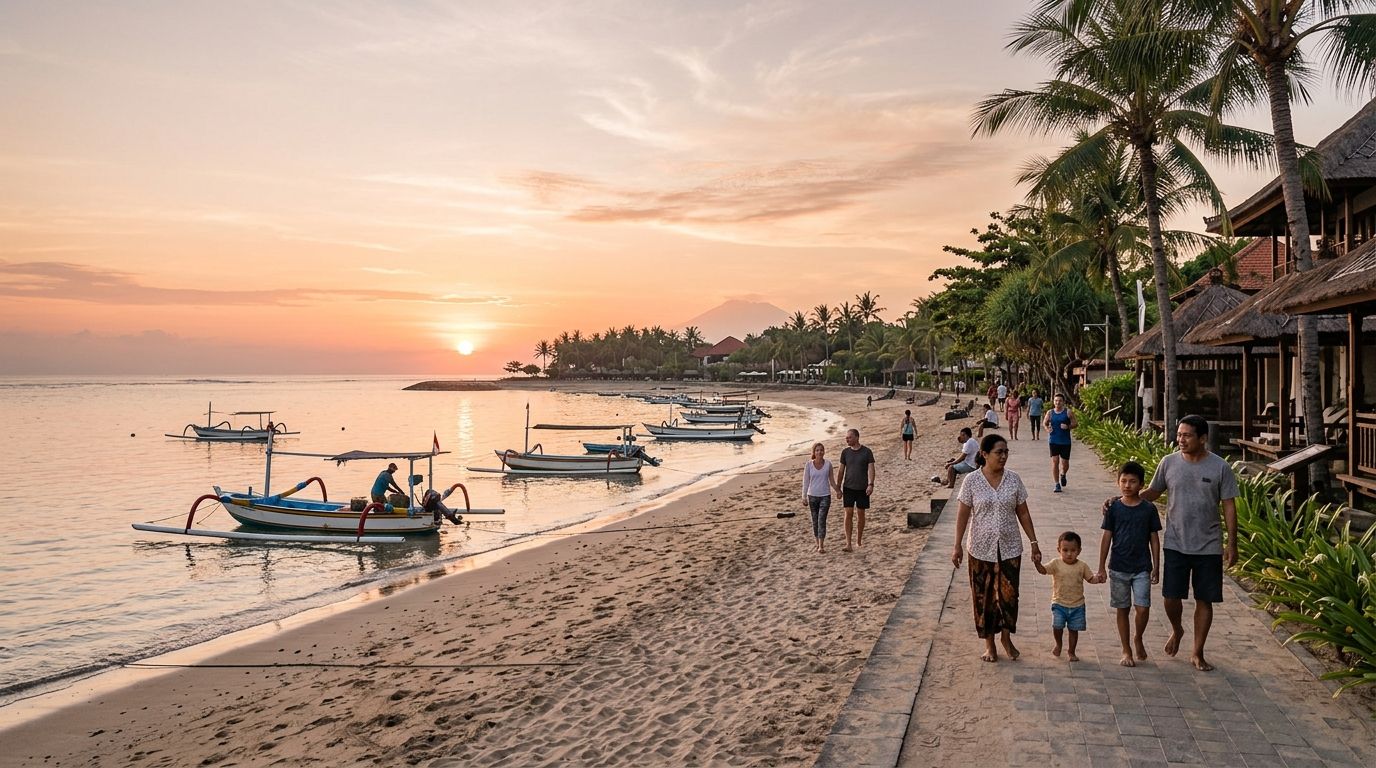
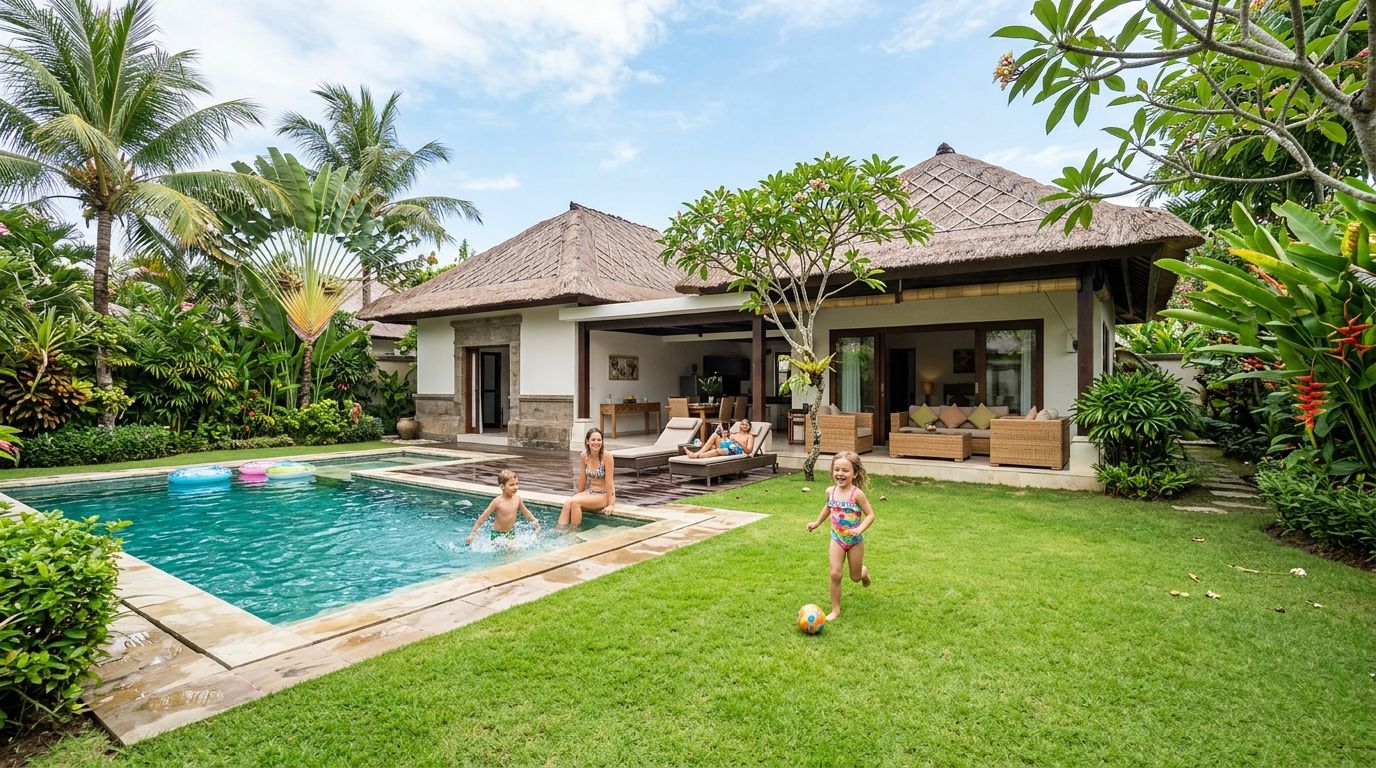
Sanur’s investment identity is balance. The beaches are calm and swimmable year-round thanks to an offshore reef; the 5.5 km beachfront promenade, the longest on the island, anchors a walkable, low-rise resort that functions as a place to live, not just holiday. That distinction is the whole thesis. Where Canggu’s returns ride nightlife-driven peak nightly rates, Sanur’s ride occupancy stability: families on international-school calendars, retirees, remote workers and, increasingly, medical and wellness guests who stay for weeks, not nights.
The everyday-living layer is unusually deep for Bali: the Bali Island School (International Baccalaureate, ages 3-18), daycare, large Western-stocked supermarkets, a golf course, tennis, and, rare for the island, wide roads and proper sidewalks. That depth is what converts a holiday destination into a resilient long-let market. For the broader area-by-area comparison, see our best areas to buy property in Bali 2026 guide; for the pricing baseline across the island, see Bali property prices 2026.
The Sanur SEZ: the structural catalyst
The single biggest reason to look at Sanur Bali property investment now is the Sanur Special Economic Zone (KEK Sanur), Indonesia’s first SEZ dedicated to health and tourism. It bundles several large projects into one master plan:
| SEZ component | What it is | Why it matters for investors |
|---|---|---|
| International hospital (Mayo Clinic-anchored / Bali International Hospital) | ~41-hectare medical campus with international partners | Medical-tourism long-stay; est. +1.5M visitors/yr |
| ICON Bali mall | Island’s largest mall, 37+ restaurants, IMAX, anchor brands | Daily footfall (20,000+); amenity premium & liquidity |
| Upgraded marina & cruise capability | Sanur harbour: ferries to Nusa Penida / Lombok; cruise expansion | Tourist throughput; year-round transit demand |
| $240M+ toll road | Links Sanur to the airport & Nusa Dua | Access & commute, supports residential, not just rental |
| SEZ scope and the +1.5M visitor estimate should be re-verified against the latest BKPM / KEK release before relying on them. Figures are planning estimates, not guarantees. |
The takeaway: infrastructure of this scale is a demand catalyst, not just a scenery upgrade, and it lands in a coastal area that is already roughly 99% built out, so new supply can’t easily absorb it. That supply-demand squeeze is the core of the Sanur thesis. Stress-test it against the island-wide outlook in our Bali real estate forecast 2026.
Sanur prices: land & villas in 2026
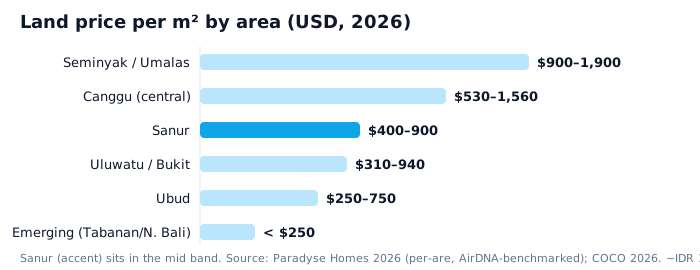
Land in Bali is quoted per are (100 m²); converted to per-m² at ~IDR 16,000/USD, Sanur sits in the mid band, meaningfully below prime Seminyak and central Canggu, but above Ubud and the emerging belts. That position reflects scarcity (the coastal strip is essentially full) balanced against Sanur’s calmer rental profile. Whole-villa prices follow the same logic:
| Area | Land per m² | Typical villa price | Gross yield | Profile |
|---|---|---|---|---|
| Seminyak / Umalas | ~$900-1,900 | $500k, 1.2M | 10-14% | Premium, best exit liquidity |
| Canggu (central) / Berawa | ~$530-1,560 | $400-800k | 12-18% | Deepest short-let demand, year-round |
| Sanur | ~$400-900 | $300-700k | 8-12% | Calm, long-stay, family/retiree, SEZ upside |
| Uluwatu / Bukit | ~$310-940 | $500-900k (3BR ocean view) | 10-16% | Cliff-top luxury; fastest land appreciation |
| Ubud | ~$250-750 | $250-500k | 10-15% | Wellness & long-stay; low volatility |
| Sanur figures in the calmer mid band per market sources; other areas reuse the canonical 2026 dataset. Build cost adds ~$1,000-1,800/m². Island median villa ≈ $256-299k; full range $60k, $6M. Branded oceanfront residences price above the typical band. Source: Bali Villa Realty, Paradyse, Prestige 2026. |
Sanur’s 8-12% gross is deliberately below party-zone Canggu, that is the trade-off for steadier occupancy and longer average stays. Pressure-test any quoted return against holding costs in our Bali property taxes & holding costs guide and the wider Bali property investment 2026 framework.
See real Sanur numbers, not averages
Compare live pricing and projected net yields on Magnum Estate’s Sanur oceanfront residence.
View the Sanur project
Book a free consultation
Sanur rental yields: gross vs net
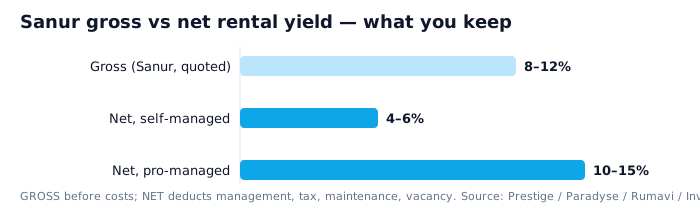
Almost every “yield” you’ll see quoted for Sanur is gross, annual rent ÷ price, before costs. For Sanur, plan for roughly 8-12% gross. What you actually keep is the net yield, after management, tax, maintenance and vacancy: about 4-6% self-managed, or 10-15% under professional management. The gap is operations, data-driven pricing, OTA distribution and cost control. Sanur’s specific advantage is that its occupancy is steadier and average stays are longer, which makes the net number more predictable than in volatile peak-rate markets. Compare the underlying letting models in our long-term vs short-term rental strategy guide.
Who Sanur suits, and who it doesn’t
Suitability & limitations. Sanur is well-suited to: families (schools, daycare, supermarkets), retirees, medical/wellness long-stay guests, and investors prioritising capital preservation and stable occupancy. It is less suited to: investors chasing the highest gross yield or nightlife-driven peak nightly rates (Canggu/Seminyak do that better), and anyone who needs short-horizon flips, the SEZ upside is a multi-year story, not a quick trade. As a foreigner you cannot hold freehold (Hak Milik); use Leasehold or a PT PMA (HGB) and run full notary due diligence, see how foreigners own property in Bali.
Magnum’s Sanur development
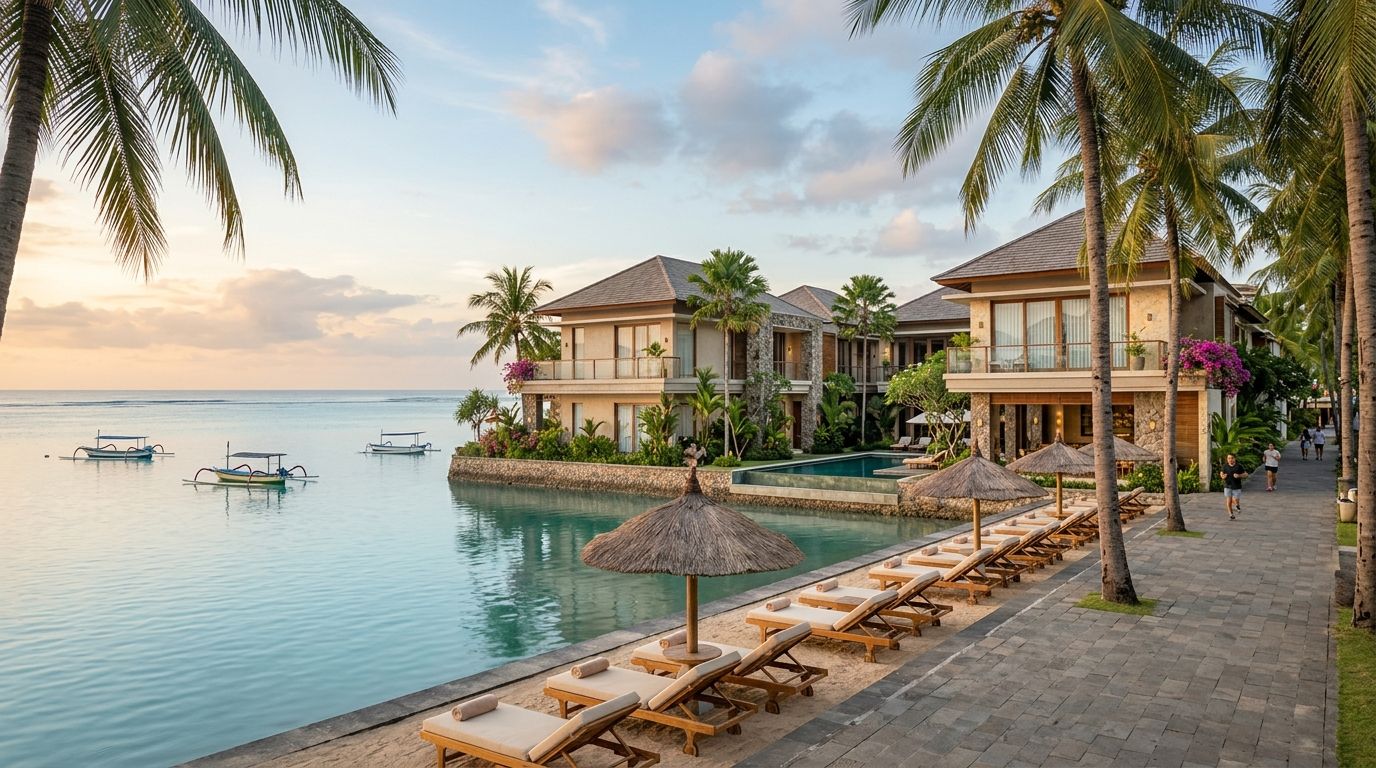
Sanur’s coastal strip is essentially built out, which makes genuine oceanfront stock rare. Magnum Estate’s Sanur residence is positioned for exactly that gap: a branded beachfront development with a private beach club, ~8,000 m² of premium amenities, in-unit features and panoramic ocean views, product designed for the area’s tranquil-luxury, long-stay profile rather than party-zone churn. Scarcity plus the SEZ demand wave is the thesis this project is built on.
Ready to see the real Sanur numbers?
Explore Magnum Estate’s oceanfront residence in Sanur, transparent pricing and projected net yields, or compare with our Umalas project; current availability is on the Sanur villas and apartments for sale page.
Sanur oceanfront residence
Sky Royal Umalas
All Magnum projects
Methodology & sources
Figures are indicative 2026 ranges, reconciled across multiple market datasets and converted at ~IDR 16,000/USD. Land prices are stated per m² (from per-are data, 1 are = 100 m²). Sanur is placed in the calmer mid band (~$400-900/m² land; ~8-12% gross yield) per market sources; all other areas reuse Magnum’s canonical Bali 2026 dataset to avoid drift. Gross yields are rent ÷ price before costs; net yields deduct management, tax, maintenance and vacancy. SEZ figures (Mayo Clinic / hospital scale, +1.5M visitors/yr) are planning estimates to re-verify against the latest BKPM / KEK release. Always commission an independent appraisal and notary (PPAT) due diligence before purchase.
Conclusion
For Sanur Bali property investment in 2026, the case is coherent and unusually defensive: mid-band entry prices, ~8-12% gross yields underpinned by steady long-stay occupancy, a near-full coastal strip, and a real structural catalyst in the Sanur SEZ. It rewards investors who value predictability and capital preservation over the highest headline number. As ever, verify the land price per m², the realistic net yield, and the title and zoning before you commit.
FAQ: Sanur Bali property investment 2026
Is Sanur a good area for property investment in Bali?
Yes for a defensive strategy: a calmer east-coast market with steady long-stay demand, near-full coastal build-out, and the SEZ catalyst. Gross yields ~8-12%, below Canggu, but with steadier occupancy.
How much does property cost in Sanur in 2026?
Land ~$400-900/m² (mid band); villas typically $300-700k, with branded oceanfront higher. Island median villa ≈ $256-299k.
What rental yield can I expect in Sanur?
~8-12% gross. Net is lower: ~4-6% self-managed or ~10-15% professionally managed, after costs.
What is the Sanur Special Economic Zone?
Indonesia’s first health-and-tourism SEZ, anchored by an international hospital (Mayo Clinic / Bali International Hospital), ICON Bali mall, an upgraded marina and cruise capability; projected to add 1M+ visitors/yr.
Who is Sanur best suited to?
Families, retirees and medical/wellness long-stay guests, plus investors who prefer steady occupancy over the highest gross yield. Less suited to nightlife-peak-rate chasers.
Can foreigners buy property in Sanur?
Not freehold (Hak Milik) directly, use Leasehold (Hak Sewa) or a PT PMA holding HGB, with full notary (PPAT) due diligence.
Will Sanur land really become Bali’s most expensive?
That’s a bullish forecast, not a certainty. Sanur sits in the mid band today; the SEZ and land scarcity support appreciation, but Seminyak and central Canggu remain the priciest per m². Treat “most expensive in 5 years” as an estimate.
References & official sources
- BPS, Statistics Indonesia / Bali: 2025 foreign arrivals (6,948,754, +9.72%), occupancy, bali.bps.go.id
- BKPM / Invest Indonesia: Special Economic Zone (KEK Sanur) scope & foreign-ownership (PT PMA) rules, investindonesia.go.id
- Bank Indonesia, Residential Property Price Index: price-growth data & IDR/USD, bi.go.id
- DJP / Ministry of Finance: PBB & transaction taxes, pajak.go.id
- ATR/BPN: land titles (Hak Milik / Hak Sewa / HGB) & zoning, atrbpn.go.id
- Market data (2026): Bali Villa Realty price guide; Paradyse Homes price-per-are study; Prestige Property Bali area/yield analysis; InvestLandBali market report.
- Magnum Estate portfolio data (Sanur net yields by project).
About the author
Stanislav Sadovnikov is the founder of Magnum Estate (PT Magnum Estate International), an award-winning full-cycle Bali real estate developer with 8 projects and 575 units since 2019 (Berawa, Sanur, Umalas, Sky Stars, Sky Royal). He writes about Bali pricing, yields, ownership rules and regulation for international buyers.