






Written by Stanislav Sadovnikov, Founder, Magnum Estate · Last updated 11 November 2026
A building in Bali ages faster than the same building in a temperate climate. Humidity near saturation for much of the year, salt-laden air near the coast, intense ultraviolet radiation and concentrated monsoon rainfall attack materials continuously rather than seasonally. A villa that looks perfect at handover can look tired in three years, and the difference between those outcomes was decided at specification, not at maintenance.
This is the least glamorous thing a buyer can ask about and one of the most financially consequential.
The four attacks
Humidity. Persistent high moisture drives mould and mildew growth on surfaces and inside wall build-ups, degrades timber, and corrodes metal from the inside of assemblies where nobody looks. It also means any trapped moisture stays trapped.
Salt. Near the coast, airborne salt accelerates corrosion of steel, fixings, hardware, air conditioning condensers and reinforcement where concrete cover is inadequate. The effect falls off with distance from the sea but is significant across much of Bali’s developed coastal strip.
Ultraviolet. Equatorial UV degrades polymers, paints, sealants and exposed timber at rates that temperate-climate product lifespans do not anticipate. Sealants are the quiet failure: they go first, and they are what keeps water out.
Water volume. Monsoon rainfall arrives concentrated. Roofs, gutters, downpipes and drainage sized for an average fail at the peak, and it is the peak that causes damage. Sizing for the peak rather than the average is the single most consequential drainage decision on a Bali build.
What actually resists it
| Element | What fails | What works |
|---|---|---|
| Reinforced concrete | Inadequate cover, carbonation, chloride ingress | Specified cover depth, dense well-compacted concrete |
| Steel and fixings | Corrosion at every connection | Stainless or hot-dip galvanised, especially coastal |
| Timber | Rot, insect attack, UV | Durable species, treated, detailed to drain and dry |
| Sealants and joints | UV degradation, then water ingress | UV-stable products, accessible for replacement |
| Paint and render | Blistering, mould, chalking | Breathable systems that let moisture out |
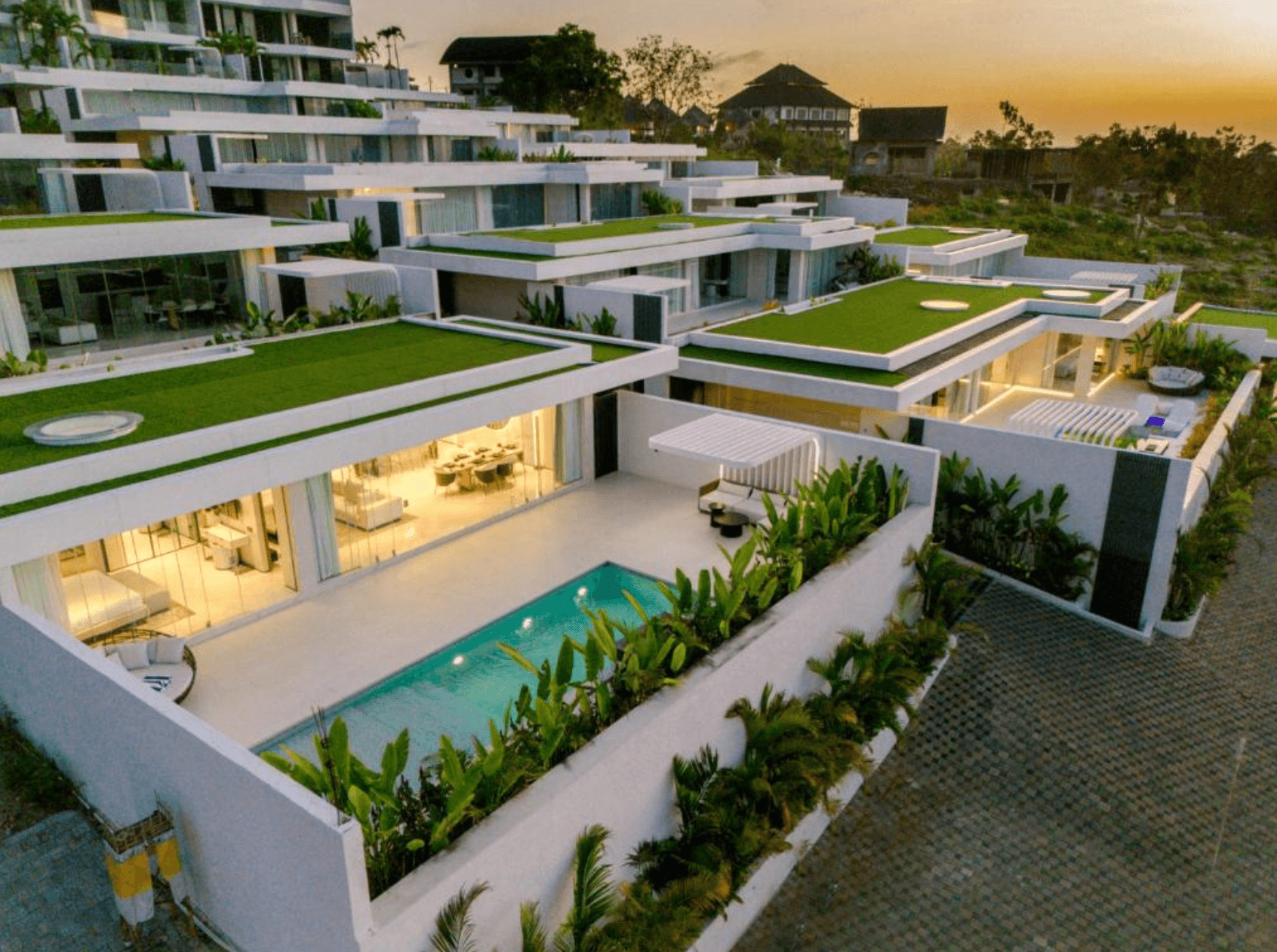
| Flat roofs and terraces | Ponding, membrane failure | Falls to drain, redundant waterproofing, no ponding |
| Air conditioning | Condenser corrosion, coil fouling | Coated coils, siting away from salt spray |
Two principles run through the table. Let assemblies dry. Tropical building failure is overwhelmingly trapped moisture, and a wall or roof that cannot dry in both directions will fail regardless of how well it was sealed. Detail to shed water before you rely on sealing it out. Overhangs, drips, falls and flashings do work that no sealant does for twenty years.

Where buildings fail first
In our experience the visible failures cluster in a predictable order: external sealed joints, then metalwork and fixings, then flat roof and terrace waterproofing, then paint systems, then timber. Structural problems appear last, cost the most to put right, and when they appear in coastal buildings they usually trace back to inadequate concrete cover over reinforcement.
The order is useful because it tells a buyer where to look, and it is roughly the reverse of where most viewings actually look. A building whose sealants and metalwork are in good condition at five years was specified by someone paying attention. A building with rust streaks and failed joints at two years tells you what else was substituted.
Maintenance is a design decision
The most useful thing a designer can do about a tropical climate, after specifying correctly, is make the parts that will fail reachable.
Everything on the list above has a service life. Sealants, coatings, waterproofing membranes, external metalwork and air conditioning will all need attention within the ownership horizon of a typical Bali villa. Whether that attention costs a day or a fortnight is determined by access, and access is determined at design stage.
A roof with no safe route onto it gets inspected less often than one with a route. A gutter that can only be cleared from a ladder on soft ground gets cleared after it blocks. A waterproofing membrane buried under a tiled terrace with no isolating layer cannot be renewed without demolishing the terrace. A condenser sited for appearance rather than airflow and service access fouls faster and costs more to clean.
Three practical rules follow.
Make the water path inspectable. Gutters, downpipes, outlets and terrace drains should be visible and reachable without scaffolding, because they are the components whose failure causes consequential damage rather than just their own.
Avoid buried membranes under non-removable finishes. If waterproofing must be covered, cover it with something that can come off.
Design plant for service, not for concealment. Equipment that is awkward to reach is equipment that gets maintained badly.
The reason this belongs in a buyer’s assessment rather than only an architect’s is that it is visible on a viewing and almost never asked about. Walk the outside of a building and ask how each thing gets cleaned, inspected and replaced. A building that answers those questions easily was designed by someone who expected it to be maintained. A building that does not will be maintained reactively, which in this climate means after the damage.
This also explains a pattern in older Bali stock: the buildings that have aged well are frequently not the most expensively specified ones, but the ones whose maintenance was practical enough to actually happen.
What it means for a buyer or developer
Inspect a building at the joints and the metal, not the finishes. Paint is cosmetic and cheap to redo. Corroded fixings and failed waterproofing are neither.
Ask what the specification said and whether it was substituted. Substitution pressure is highest in a weak-currency year, and it is highest exactly on imported items — stainless fixings, quality sealants, membrane systems — where the saving is invisible on handover day.
Treat distance from the sea as a specification variable. A beachfront villa and an inland villa should not be built from the same ironmongery schedule.
Budget maintenance as a line, not a surprise. Repainting, resealing and waterproofing renewal are scheduled events in this climate. Our villa running costs article sets out where they land.
On an older building, price the deferred maintenance. A ten-year-old villa that has not been resealed and repainted carries a real cost that is not in the asking price, and it is the clearest argument for weighing older stock against new — see building versus buying.
At Magnum Estate we build in-house in this climate and maintain what we have built, which is a strong incentive to specify properly. A developer who hands over and leaves has a different incentive, and it shows up in the ironmongery.
Limitations and sources
- This article is built on our own construction and maintenance experience in Bali, together with general tropical building science principles. It is not sourced to published Indonesian durability research, material testing or climate data retrieved for this article.
- The four degradation mechanisms — humidity, salt, UV and rainfall intensity — are standard tropical and marine building science. We have not retrieved Bali-specific measurements of humidity ranges, UV index, salt deposition rates or rainfall intensity figures, and the article deliberately avoids stating numbers for them.
- The material comparison table reflects general durability practice for hot, humid, marine environments applied to Bali, not an Indonesian standard or specification document.
- The failure-order observation is our own and is anecdotal. We have not conducted or retrieved a systematic building condition survey of Bali stock.
- Concrete cover and durability are governed in Indonesia by SNI 2847:2019, which we have not read in full text.
- Substitution pressure in a weak-currency year is inferred from rupiah movement (Bank Indonesia, 21 October 2026) and our own procurement experience, not from a published study.
- Specific material selection for a specific building requires a qualified architect or engineer. Not engineering advice.