






Written by Stanislav Sadovnikov, Founder, Magnum Estate ·
Reviewed by Magnum Estate legal & investment desk ·
Last updated 3 June 2026
"4-6% / 10-15% Net yield: self vs pro-managed · −10-20 pts Occupancy shock tested · −10-15% ADR cut tested · ~IDR 16,000 FX anchor per USD"
Key figures (2026)
Bali villa cash flow ROI stress test: summary
A bali villa cash flow roi stress test is simple in principle: take your base-case pro-forma and deliberately break it. Drop occupancy by 10-20 percentage points, cut ADR by 10-15%, raise maintenance and capex, flex the IDR/USD rate and any financing cost, then check whether your net yield still survives. Quoted Bali net yields are roughly 4-6% self-managed and 10-15% professionally managed; the test shows which deals keep positive cash flow when the headlines turn.
- Gross ≠ net: gross runs ~7-15%; net is ~4-6% self-managed, ~10-15% pro-managed.
- Occupancy is the biggest lever: prime areas run 70-85%, island ~65%; a 10-20 pt drop is the core shock.
- ADR and cost inflation compound: a −15% rate plus +15% costs can halve net cash flow.
- FX matters: IDR income vs USD targets, a weaker rupiah erodes dollar net yield.
- Resilience test: a strong deal still shows positive NPV and an acceptable payback after the downside.
All scenario outputs below are illustrative model results from labelled assumptions, not quoted market returns.

"Transparency: Magnum Estate develops property in Bali, so we have a commercial interest. This guide is educational, not investment, tax or legal advice, verify every figure independently and consult a certified Indonesian notary (PPAT) and tax advisor before buying."
Transparency
Running a bali villa cash flow roi stress test is the difference between buying on a brochure number and buying on a model you trust. In 2026, simply accepting a “projected 15-20% ROI” is not enough: serious investors take a base case and deliberately worsen the inputs, occupancy, average daily rate (ADR), the IDR/USD rate, financing cost, vacancy and operating-cost inflation, to see whether the net yield holds or breaks. This guide shows the exact downside scenarios to model, reuses Magnum Estate’s reconciled 2026 yield data, and labels every scenario output as an illustrative model result.
Why a stress test beats a “projected ROI”
Promotional materials often quote gross yields of 7-18% per year for Bali villas, and some marketing even floats 20%+ in prime spots. Those numbers are not lies, they are just gross and base-case. They hide management fees, taxes, capex, FX and occupancy risk. A stress test re-introduces all of that on purpose. The discipline mirrors how feasibility studies on Bali villa projects are built: full pro-forma statements, NPV, IRR, payback and sensitivity tests over a 15-20-year horizon, not a single headline percentage. For the underlying return mechanics, start with our Bali villa ROI guide and the longer-horizon 10-year ROI insights; this article is the downside-scenario companion to both.
The metrics your model must track
Before you can shock a model, you need the right gauges on the dashboard. A robust Bali cash-flow model monitors these core metrics:
| Metric | Formula / definition | Why it matters under stress |
|---|---|---|
| Net yield | (annual net income ÷ purchase price) × 100 | The number that actually survives a downside; gross flatters you |
| Cash-on-cash return | (annual net cash flow ÷ your equity) × 100 | Shows leverage risk if financing cost rises |
| Occupancy rate | nights occupied ÷ 365 | The single biggest income driver, and the first to fall |
| Operating-cost ratio | operating costs ÷ gross rental income | Often 30-50% in Bali; rises fast when revenue drops |
| NPV / IRR / payback | discounted cash-flow outputs | Whole-horizon resilience, not a single good year |
| Core cash-flow metrics used in Bali villa feasibility studies and in the Magnum Estate ROI cluster. |
The takeaway: a stress test is only as honest as its cost assumptions. Build the operating-cost ratio from real holding costs, see our
Bali property taxes & villa holding costs guide, before you start cutting revenue. Benchmark the management fees and occupancy assumptions in any pro-forma against a real operator’s numbers rather than a brochure.
Gross vs net: where Bali returns actually leak
Most “8-15% yield” claims you will see are gross, annual rent ÷ price, before any costs. What you keep is the net yield, after management, tax, maintenance and vacancy. This gap is the single biggest source of disappointed Bali investors, and it is exactly where a stress test bites first.
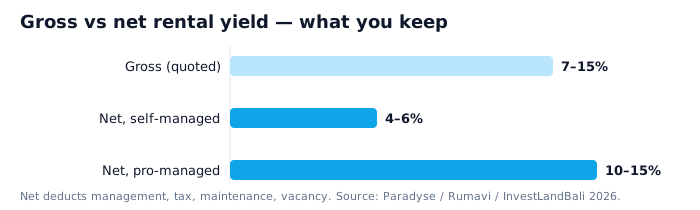
By area, gross yields run highest in Canggu/Berawa and lowest in North Bali. A stress test takes each of these gross figures and erodes it down to net through worsening operations:
| Area | Gross yield (2026) | Typical net, self-managed | Typical net, pro-managed |
|---|---|---|---|
| Canggu / Berawa | 12-18% | 4-6% | 10-15% |
| Uluwatu / Bukit | 10-16% | 4-6% | 10-15% |
| Ubud | 10-15% | 4-6% | 10-15% |
| Seminyak | 10-14% | 4-6% | 10-15% |
| North Bali (Lovina) | 6-10% | under 4-6% | under 10-15% |
| GROSS yields by area: Prestige Property Bali 2026. Net ranges (self vs pro): Paradyse / Rumavi / InvestLandBali 2026. ~IDR 16,000/USD. |
The downside scenarios, modelled
Build one base case, then run three deliberately harsher versions of it. The standard Bali downside scenario cuts occupancy by 10-20 percentage points and ADR by 10-15%, adds 10-15% to maintenance and capex, and layers a financing or FX shock on top. The chart below shows how a single starting net yield compresses as you stack these shocks, these are illustrative model outputs, not market quotes.
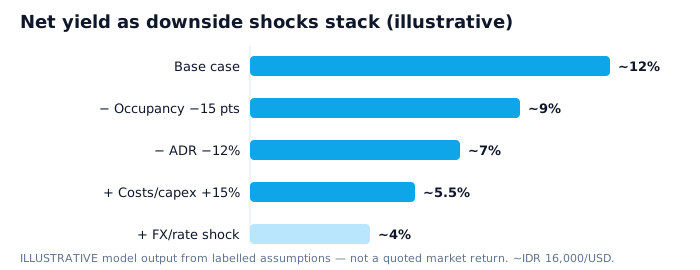
| Scenario | What you change | What it tests |
|---|---|---|
| Base case (conservative) | Occupancy 60-70% (not 80-90%), realistic ADR, full cost stack | The honest starting point, already below brochure assumptions |
| Occupancy shock | Drop occupancy 10-20 pts (e.g. 70%, 52%) | Demand softness, oversupply, a weak season |
| ADR shock | Cut nightly rate 10-15% | Price competition, discounting to fill nights |
| Cost inflation shock | Add 10-15% to maintenance, staff, capex | Sooner-than-planned refurbishment, wage/utility inflation |
| FX & rate shock | Flex IDR/USD weaker; raise any loan-service cost | Dollar-denominated returns vs IDR income; leverage stress |
| The five-shock framework. A resilient deal keeps positive net cash flow and an acceptable payback through the stacked downside. |
The gap between a 4-6% and a 10-15% net result under the same shock is operations: dynamic pricing, OTA distribution, cost control and preventative maintenance. See how management drives the spread in our Bali villa ROI guide and the 10-year ROI insights.
Pressure-test a real deal, not an average
Get a transparent base-case and downside model on live Magnum Estate inventory in Berawa, Sanur and Uluwatu.
View Magnum projects
Book a free consultation
A worked example: does the net yield hold?
Take a single, transparent base case and walk it through the shocks. The numbers below are an illustrative model built from labelled assumptions at ~IDR 16,000/USD, not a quoted return on any specific property.
| Line item | Base case | Downside (stacked shocks) |
|---|---|---|
| Total cost (purchase + reno) | $300,000 | $300,000 |
| Occupancy | 70% | 54% (−16 pts) |
| Gross rent / year | $60,000 | $40,500 (ADR −12%, lower occupancy) |
| Operating costs (mgmt, staff, utilities, marketing) | −$24,000 | −$27,600 (+15%) |
| Tax on rental income (~10%) | −$6,000 | −$4,050 |
| Net cash flow | $30,000 | $8,850 |
| Net yield on total cost | ~10% | ~3.0% |
| ILLUSTRATIVE model output from labelled assumptions; ~IDR 16,000/USD. PBB land/building tax is separate and low (~0.1% of assessed value). Not a quoted market return. |
The lesson is not the exact figure, it is the shape. A base case at a ~10% net yield is robust; the same deal under a stacked downside still produces positive cash flow (~3%), which means it survives but thins out. A deal that goes negative under this same shock is one to walk away from, regardless of how attractive the base-case headline looked. An FX move that further weakens IDR against the dollar would compress the downside column again, which is why currency belongs in the model, not the footnotes.
Which lever breaks the deal first
Not all shocks are equal. In Bali, occupancy almost always does the most damage, because it multiplies through every revenue line at once; ADR cuts and cost inflation are painful but more contained. Management quality sits behind all of them, proactive, data-driven operations are what keep a villa nearer the 10-15% net band instead of sliding toward 4-6% when conditions turn. Currency and regulation are the slow-burn risks: lease decay and a weakening rupiah erode dollar returns gradually rather than in one bad quarter, so a long-horizon model must carry an FX-sensitivity row and a legal-compliance buffer. For the operational side of this, see how rental strategy changes the floor in our long-term vs short-term rental strategy guide.
Limitations & suitability
A stress test is a discipline, not a crystal ball. Its outputs are only as good as its inputs, and the scenarios here are illustrative ranges, not forecasts. This approach is not for buyers who want a passive, guaranteed return, Bali villa income is operationally intensive and genuinely variable. It is also less useful for pure lifestyle buyers who will occupy the villa themselves and rent little. If you are highly leveraged, the FX-and-rate shock matters far more than for an all-cash buyer; model it harder. Always commission an independent appraisal and notary (PPAT) due diligence, and treat every percentage here as a starting point for your own numbers, not a promise.
Conclusion
In 2026, the strongest Bali deals are the ones that still make sense after you try to break them. Run the bali villa cash flow roi stress test on every opportunity: build a conservative base case, cut occupancy and ADR, inflate costs, flex FX and financing, and confirm the net yield stays positive with an acceptable payback. Gross numbers sell; net numbers under stress are what you actually live with.
Want the model run on a real villa?
Explore Magnum Estate’s ocean-view residences in Uluwatu, Berawa and Sanur, with transparent base-case and downside net-yield modelling.
Uluwatu, Sky Stars
Berawa
Sanur
FAQ: Bali villa cash flow ROI stress test
What is a Bali villa cash flow ROI stress test?
It is a modelling exercise: take a base-case villa pro-forma and deliberately worsen the key inputs, occupancy, ADR, financing rate, IDR/USD FX, vacancy and operating-cost inflation, to see whether net yield (roughly 4-6% self-managed or 10-15% pro-managed) survives or breaks.
What net yield should survive a downside scenario?
A resilient base case still shows positive net cash flow and an acceptable payback after the shock. Quoted Bali net yields are ~4-6% self-managed and ~10-15% professionally managed; the test checks how far those compress when occupancy and ADR fall together.
How much can occupancy realistically drop?
Prime occupancy runs ~70-85%, with the island average nearer 65%. A standard downside cuts modelled occupancy by 10-20 percentage points and trims ADR by 10-15% to test the floor.
Does FX affect the stress test?
Yes. Income is largely IDR while many buyers measure returns in USD or EUR, so a weaker rupiah can erode dollar net yield even when occupancy holds. Flex the IDR/USD rate (anchored here at ~IDR 16,000/USD) alongside occupancy and cost.
What separates a 4-6% net yield from a 10-15% one?
Operations: dynamic pricing, OTA distribution, cost control and preventative maintenance, the exact levers a stress test isolates. See our villa ROI guide.
Why model 5-10 years, not 1-2?
NPV, IRR and payback only make sense over longer horizons, because major refurbishment and capex cycles hit every 5-10 years. Thinking in multi-year blocks smooths short-term volatility.
Do taxes change the picture?
Yes. A ~10% tax on rental income, plus annual PBB (~0.1% of assessed value) and transaction taxes, all belong in the model, see our tax & holding costs guide.
Methodology & sources
Yield ranges are indicative 2026 figures, reconciled across multiple market datasets and converted at ~IDR 16,000/USD. Gross yields are rent ÷ price before costs; net yields deduct management, tax, maintenance and vacancy. All stress-scenario outputs (occupancy, ADR, cost, FX and rate shocks, and the worked example) are illustrative model results from labelled assumptions, not quoted market returns for any specific property. Individual deals vary by area, product, lease term, management and financing. Always commission an independent appraisal and notary (PPAT) due diligence before purchase.
References & official sources
- BPS, Statistics Indonesia / Bali: 2025 foreign arrivals (6,948,754, +9.72%), occupancy, bali.bps.go.id
- Bank Indonesia: Residential Property Price Index (RPPI) and IDR/USD reference rate, bi.go.id
- DJP / Ministry of Finance: PBB, rental-income and transaction taxes, pajak.go.id
- ATR/BPN: land titles, lease terms & zoning, atrbpn.go.id
- Market data (2026): Prestige Property Bali area/yield analysis; Paradyse Homes price-per-are study; Rumavi and InvestLandBali net-yield and occupancy reports.
- Magnum Estate portfolio data (net yields by project, scenario benchmarks).
About the author
Stanislav Sadovnikov is the founder of Magnum Estate (PT Magnum Estate International), an award-winning full-cycle Bali real estate developer with 8 projects and 575 units since 2019 (Berawa, Sanur, Umalas, Sky Stars, Sky Royal). He writes about Bali pricing, yields, ownership rules and regulation for international buyers.