






Written by Stanislav Sadovnikov, Founder, Magnum Estate ·
Reviewed by Magnum Estate legal & investment desk ·
Last updated 3 June 2026
"4-6% / 10-15% Bali net yield (self / pro-managed) · ~$100k+ Bali entry villa (emerging area) · 6-8% · 5-7% · 5-6% Dubai · Türkiye · Thailand ROI (est.) · 6.95M Bali 2025 foreign arrivals (+9.7%)"
Key figures (2026)
Dubai vs Bali vs Thailand property: summary
For the dubai vs bali vs thailand property decision in 2026, the short answer is: Bali leads on cash yield and entry price, Dubai leads on ownership certainty and zero income tax, and Thailand leads on condo simplicity and low cost of living. Türkiye sits behind all three on stability. Bali’s figures below are Magnum’s own 2026 managed-portfolio data, not an independent verification; Dubai, Türkiye and Thailand numbers are external estimates carried from public market reports. Independent Q1 2026 figures from the Global Property Guide rank these markets differently, and the 2026 update section below sets both side by side. On the numbers: Bali’s verified gross yield runs 10-18% against an estimated 6-8% in Dubai and 5-6% in Thailand, a roughly 6-9 year payback in prime Bali versus 12-15 years for the other two. Entry cost follows the same pattern, Bali villas start near USD 100,000 against Dubai apartments from about USD 160,000-270,000 and Thailand condos from USD 85,000-170,000. Ownership rules differ too: foreigners buy Bali property via leasehold or a PT PMA rather than freehold, Dubai offers freehold in designated zones, and Thailand caps foreign condo ownership at 49% of a building.
- Best net yield: Bali, gross 10-18% in prime areas, net 4-6% self-managed or 10-15% professionally managed.
- Lowest entry: Bali, emerging-area villas from ~USD 100,000; island median ~USD 256,000-299,000.
- Strongest ownership certainty: Dubai freehold in designated areas (estimate, verify).
- Simplest for a first buy: Thailand condo (foreign quota up to 49% of a building; estimate, verify).
- Foreigner rule in Bali: no direct freehold (Hak Milik), use Leasehold (Hak Sewa) or PT PMA (HGB).

"Transparency: Magnum Estate develops property in Bali, so we have a commercial interest and we are open about it. This guide is educational, not investment, tax or legal advice. Bali figures are our reconciled 2026 dataset; all Dubai, Türkiye and Thailand figures are external estimates that must be re-confirmed against current primary sources before you act. Verify everything independently and consult a certified Indonesian notary (PPAT) and a tax advisor in the relevant jurisdiction."
Transparency
Choosing between dubai vs bali vs thailand property (with Türkiye as a fourth option) is really a choice between four different bets: yield, ownership certainty, lifestyle and currency. We are Bali developers, so we have skin in the game, but the only honest way to compare is to put verified numbers next to clearly-labelled estimates and let the trade-offs show. Below, every Bali figure comes from Magnum’s own reconciled 2026 managed-portfolio dataset (stated in USD at ~IDR 16,000/USD); every Dubai, Türkiye and Thailand figure is flagged external estimate, verify with its local currency noted.
Dubai vs Bali vs Thailand property: the four-market snapshot
Here is the whole comparison on one screen. Read it as a starting frame, not a verdict, the per-criterion sections below add the nuance. Currencies: Bali/Indonesia quoted in USD (IDR ~16,000/USD); Dubai in AED (pegged ~3.67/USD); Türkiye in TRY; Thailand in THB.
| Criterion | Bali (Magnum data) | Dubai est. | Türkiye est. | Thailand est. |
|---|---|---|---|---|
| Currency | USD / IDR (~16,000/USD) | AED (~3.67/USD peg) | TRY (volatile) | THB |
| Entry villa / unit | From ~$100k (emerging); median ~$256-299k | Apartment from ~AED 0.6-1M (~$160-270k) | Apartment from ~TRY (varies widely) | Condo from ~THB 3-6M (~$85-170k) |
| Gross yield | 10-18% prime | ~6-8% | ~5-7% | ~5-6% |
| Net yield | 4-6% self / 10-15% pro | not separated in source | not separated in source | not separated in source |
| Payback | ~6-9 yrs (gross, prime) | ~12-15 yrs | ~16 yrs | ~12-15 yrs |
| Foreigner ownership | Leasehold / PT PMA (no direct freehold) | Freehold in designated zones | Freehold (RP rules tightening) | Condo only (≤49% of building); no land |
| Resale liquidity | High in built-out prime zones | Cooler, heavy new supply | Thin secondary market | Moderate; location-led |
| Bali = Magnum reconciled 2026 dataset (USD, ~IDR 16,000/USD). Dubai / Türkiye / Thailand = external estimates, verify before acting (legacy 2023 market reports; FX and ranges may have moved materially). USD conversions are indicative. |
Entry price & what your budget buys
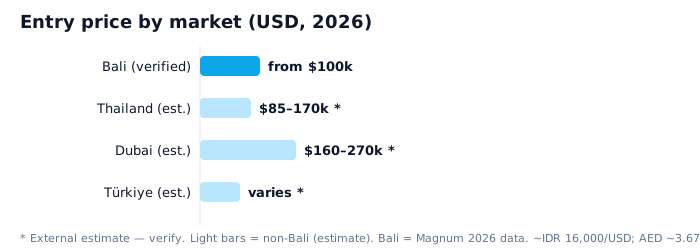
Bali has the lowest verified entry point of the four: emerging-area villas (Tabanan, Seseh, Cemagi, North Bali) start near USD 100,000, the island median villa sits at USD 256,000-299,000, and the full range runs USD 60,000 to USD 6 million. For the precise area-by-area breakdown, see our Bali property prices 2026 guide. Dubai and Thailand entry points below are external estimate, verify: Dubai apartments are commonly cited from ~AED 0.6-1M (~USD 160-270k), Thailand condos from ~THB 3-6M (~USD 85-170k), and Türkiye varies far too widely (and in a fast-moving lira) to quote a stable USD figure.
The takeaway: Bali lets a smaller cheque buy a freestanding, income-producing villa, where Dubai and Thailand at the same budget typically buy an apartment or condo. If you are weighing location within Bali first, start with the best areas to buy in Bali 2026.
Yields: gross vs net across the four markets
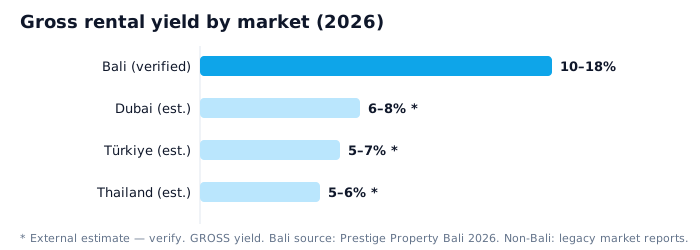
Yield is where Bali separates from the field, but only if you read gross and net correctly. Across Magnum’s own managed-portfolio data, prime-area gross yields run 10-18%, while the headline ROI figures quoted for Dubai (~6-8%), Türkiye (~5-7%) and Thailand (~5-6%) are external estimate, verify and are typically gross too. The number that actually matters is net, and here the legacy comparison sources do not separate it for Dubai, Türkiye or Thailand, another reason to verify before trusting them.
2026 update: what the independent data says
Added 24 August 2026.
The figures above come from Magnum’s own managed portfolio and from agency research. The most widely cited independent source, the Global Property Guide, publishes a different picture for Q1 2026, and a buyer comparing markets deserves both.
| Market | GPG gross yield, Q1 2026 | Magnum / agency figure used above |
|---|---|---|
| Indonesia, national average | 8.30% | not stated |
| Bali villas | 5.80% (range 4.00-7.59%) | 10-18% prime |
| Thailand, national average | 6.49% | 5-6% |
| Bangkok | 6.22% | not stated |
| Phuket | 5.05% | not stated |
| Malaysia | 5.27% | not covered |
| Philippines | 5.10% | not covered |
| Vietnam | 3.85% | not covered |
On those numbers the ranking in this article inverts: Bali villas at 5.80% sit below Thailand’s 6.49% national average and well below Indonesia’s own 8.30%. The Global Property Guide describes Bali as the weakest of the five Indonesian markets it covers, attributing that to high purchase prices relative to achievable rents.
The gap is methodological, and it matters more than either number. The Global Property Guide compares median asking rents against median list prices from a property platform, across all villa types, which includes long-term residential lets to expatriate tenants at monthly rates. Magnum’s figure compares nightly rates at a target occupancy for a managed hospitality unit. One measures a house someone lives in for a year. The other measures a small hotel. A nightly-rate asset should out-yield a long-let asset on gross, and it should also carry far heavier costs, which is why the net figures in this article drop to 4-6% self-managed.
We have not reconciled the two datasets and we are not claiming ours supersedes theirs. What follows from having both is a better question to ask any seller in any of these four markets: is this gross or net, is it a long let or a nightly rate, and what occupancy does it assume. The answer to that spread is wider than the spread between the countries.
Note also that Thailand’s own market softened in the same period: nationwide house prices rose 1.26% year on year in Q1 2026 on Bank of Thailand data, with Bangkok and vicinities down 0.18%.
Sources for this section: Global Property Guide, Indonesia and Thailand price history and rental yields, Q1 2026, drawn from listing-platform data rather than official statistics; Bank of Thailand via Global Property Guide. Converted at ~IDR 16,000/USD. Every non-Bali figure in the older tables above remains an external estimate to verify with local counsel.
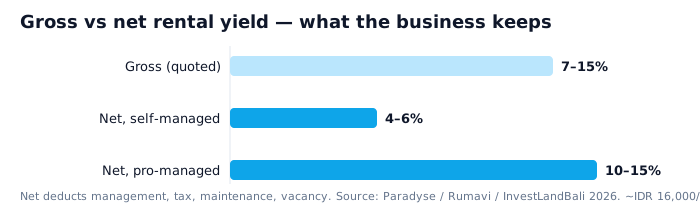
The gap between Bali’s 4-6% and 10-15% net is operations, not luck: data-driven pricing, OTA distribution and cost control. See how management drives the difference in our Bali villa ROI guide, and weigh holding costs in the taxes & holding costs guide.
Compare real Bali numbers, not averages
See transparent pricing and projected net yields across Magnum Estate’s Berawa, Sanur and Uluwatu developments.
View Magnum projects
Book a free consultation
Foreigner ownership rules: the dealbreaker most buyers miss
Ownership structure changes the entire risk profile, and it differs sharply across the four markets:
| Market | What a foreigner can hold | Key constraint |
|---|---|---|
| Bali / Indonesia (Magnum data) | Leasehold (Hak Sewa) or PT PMA company holding Hak Guna Bangunan (HGB) | No direct freehold (Hak Milik); lease terms and PT PMA compliance matter |
| Dubai est. | Freehold in designated freehold zones | Outside designated zones, ownership is restricted, verify the zone |
| Türkiye est. | Freehold, with residence-permit incentives historically attached | RP and rental rules tightening; short-let licensing onerous, verify |
| Thailand est. | Condominium units only, within the 49% foreign quota per building | No direct land ownership; villa land needs a structure, verify |
| Bali = Magnum’s own legal framework summary. Dubai / Türkiye / Thailand = external estimate, verify with local counsel; foreign-ownership law changes frequently. |
Legal note: in Bali, foreigners cannot hold freehold directly, the compliant routes are Leasehold or a PT PMA. Understand the structure before you transfer money: our guide to buying property in Bali as a foreigner walks through Hak Sewa vs HGB and the notary (PPAT) process.
Appreciation & resale liquidity
On verified Bali data, land appreciated roughly 15-30% over the past two years and like-for-like prices grow about 7-15% a year in strong micro-markets, helped by the fact that built-out prime zones are nearly fully developed, scarcity supports both price and resale demand. By contrast, the legacy comparison flagged Dubai’s secondary market as cooler under heavy new supply, Türkiye’s secondary market as thin, and Thailand’s as moderate and location-led, all external estimate, verify. Bali also drew 6,948,754 foreign visitors in 2025 (+9.72%), with prime occupancy of 70-85%, underpinning the rental demand that drives resale.
Taxes & lifestyle
On tax, Bali’s annual land-and-building tax (PBB) is low at about 0.1% of assessed value, though transaction and rental-income taxes apply. Dubai’s headline draw is no personal income tax (estimate, verify current rules, including the 9% corporate tax regime); Türkiye and Thailand each levy property and rental taxes that you should confirm locally. On lifestyle, the four diverge by temperament: Dubai is hyper-modern, safe and tax-light but punishingly hot in summer; Thailand is affordable, easy and familiar; Türkiye is European-facing but politically and currency-volatile; Bali offers a year-round tropical, wellness-and-surf lifestyle in built-out hotspots, at the cost of needing careful developer and title due diligence. For Gulf-based buyers weighing exactly this trade-off, our Bali property guide for UAE investors breaks down the specifics.
| Market | Headline tax angle | Lifestyle in one line |
|---|---|---|
| Bali (Magnum data) | PBB ~0.1%/yr + transaction & rental taxes | Year-round tropical, surf & wellness; built-out prime zones |
| Dubai est. | No personal income tax (verify) | Hyper-modern, safe, tax-light; brutal summer heat |
| Türkiye est. | Property & rental taxes (verify) | European-facing; currency & policy volatility |
| Thailand est. | Property & rental taxes (verify) | Affordable, easy, familiar; strong tourism base |
| Bali = verified. Dubai / Türkiye / Thailand tax lines = external estimate, verify with a local tax advisor. |
Where Bali fits, and wins
In the dubai vs bali vs thailand property comparison, no single market wins on every axis, and we will not pretend otherwise. Bali wins decisively on cash yield and entry price, and on supply scarcity in built-out prime zones that supports resale. Dubai wins on freehold certainty and a zero-income-tax headline. Thailand wins on condo simplicity and low cost of living. Türkiye, on the legacy evidence, trails on stability. If your priority is income and growth from a freestanding, professionally-managed villa, Bali is the strongest of the four, provided you choose a credible developer and verify title.
Methodology & sources: Bali figures are Magnum’s reconciled 2026 dataset, converted at ~IDR 16,000/USD and stated in USD; land is per m² (from per-are data, 1 are = 100 m²); gross yields are rent ÷ price before costs, net yields deduct management, tax, maintenance and vacancy. All Dubai, Türkiye and Thailand figures are external estimates drawn from public 2023-era market reports (ROI, payback, tourist flow) and indicative FX (AED ~3.67/USD peg; TRY and THB live rates); they have not been independently re-verified and must be confirmed against current primary sources (DLD Dubai, TÜİK/CBRT Türkiye, Bank of Thailand) before use. We do not average incompatible sources. Always commission an independent appraisal and notary (PPAT) due diligence before purchase.
Conclusion
The honest verdict on dubai vs bali vs thailand property: match the market to your goal. Want maximum verified net yield and a freestanding villa for the lowest entry? Bali. Want freehold certainty and tax simplicity? Dubai. Want the easiest first condo purchase? Thailand. As Bali developers, our bias is clear, but it rests on the numbers above, with non-Bali figures left as estimates for you to verify.
Ready to see the real Bali numbers?
Explore Magnum Estate’s ocean-view residences in Uluwatu, Berawa and Sanur, transparent pricing and projected net yields, or see the Bali case on its own terms in our invest in Bali guide.
Uluwatu, Sky Stars
Berawa
Sanur
Limitations & who this is not for
This comparison is a starting frame, not personalised advice. The Dubai, Türkiye and Thailand figures are legacy external estimates and may be materially out of date, if you are seriously weighing those markets, get current local data. Bali is not for buyers who want guaranteed freehold, who are uncomfortable with PT PMA / leasehold structures, or who cannot tolerate developer-quality and title due-diligence work. If you need a passive, hands-off freehold apartment, Dubai or a Thai condo may suit you better than a Bali villa.
FAQ: Dubai vs Bali vs Thailand property
Which market has the best yield in 2026?
On verified Bali data, prime villas run gross 10-18% and net 4-6% self-managed or 10-15% professionally managed. Dubai (~6-8%), Türkiye (~5-7%) and Thailand (~5-6%) are external estimates to verify and typically sit below prime Bali on cash yield.
Can foreigners own property in Bali, Dubai and Thailand?
In Bali, no direct freehold (Hak Milik), use Leasehold (Hak Sewa) or PT PMA (HGB). Dubai allows freehold in designated zones; Thailand allows condo units up to a 49% foreign quota but not land. Verify Dubai and Thailand rules with local counsel.
Which market is cheapest to enter?
Bali, on verified data, emerging-area villas from ~USD 100,000, island median ~USD 256,000-299,000. Dubai, Türkiye and Thailand entry points are external estimates and vary by city and product.
What is the payback period for Bali property?
At prime gross yields, a well-run Bali villa can target ~6-9 years gross payback before financing and exit. Dubai, Türkiye and Thailand payback (often cited at 12-16 years) are external estimates to verify.
Where does Bali win versus Dubai and Thailand?
Cash yield, entry price and supply scarcity in built-out prime zones, plus a year-round tropical lifestyle. Dubai wins on freehold certainty and zero income tax; Thailand on condo simplicity and cost of living.
Is Türkiye a good alternative?
On the legacy evidence, Türkiye trails on stability, a volatile lira, tightening residence-permit rules and onerous short-let licensing. Treat all Türkiye figures as estimates and verify current conditions.
References & official sources
- BPS, Statistics Indonesia / Bali: 2025 foreign arrivals (6,948,754, +9.72%), occupancy, bali.bps.go.id
- Bank Indonesia, Residential Property Price Index & IDR rate: official price-growth and FX data, bi.go.id
- DJP / Ministry of Finance: PBB & transaction taxes (Indonesia), pajak.go.id
- ATR/BPN: land titles (Hak Milik / Hak Sewa / HGB) & zoning, atrbpn.go.id
- To verify Dubai figures: Dubai Land Department (DLD) transaction & yield data, dubailand.gov.ae external, verify
- To verify Türkiye figures: TÜİK (Turkish Statistical Institute) & Central Bank of the Republic of Türkiye (CBRT), tuik.gov.tr external, verify
- To verify Thailand figures: Bank of Thailand real-estate statistics, bot.or.th external, verify
- Bali market data (2026): Bali Villa Realty price guide; Paradyse Homes price-per-are study; Prestige Property Bali area/yield analysis; InvestLandBali / Rumavi market reports.
- Magnum Estate portfolio data (net yields by project).
About the author
Stanislav Sadovnikov is the founder of Magnum Estate (PT Magnum Estate International), an award-winning full-cycle Bali real estate developer with 8 projects and 575 units since 2019 (Berawa, Sanur, Umalas, Sky Stars, Sky Royal). He writes about Bali pricing, yields, ownership rules and regulation for international buyers.