





Written by Donny Yosua, Magnum Estate Analyst ·
Reviewed by Magnum Estate legal & investment desk ·
Last updated 3 June 2026
"0 Freehold (Hak Milik) titles a foreigner can hold · 4 Legal routes foreigners can use · ~80 yrs Max Hak Pakai / HGB control (with renewals) · ~IDR 3B Typical Bali min. value (~$190k)"
Key figures (2026)
How foreigners own property in Bali 2026: summary
How foreigners own property in Bali 2026, the short answer: not through freehold. Indonesia’s Basic Agrarian Law reserves Hak Milik (freehold) for Indonesian citizens, so a foreigner can never hold it in their own name. Instead foreigners use one of four legal title routes, and which one you qualify for depends on your residency status
and the property’s value.
- Can own: Hak Pakai (Right to Use) on a home, an apartment under strata title (HMSRS), a registered Hak Sewa lease, or land/buildings via HGB through a PT PMA company.
- Cannot own: Hak Milik freehold land in a personal name, and no nominee workaround is valid.
- Eligibility: personal Hak Pakai / strata title needs a resident permit (KITAS or KITAP); leasehold and PT PMA do not require residency.
- Minimum value: foreign-owned residences face a province-set floor (commonly ~IDR 3B / ~$190k in Bali) under PP No. 18/2021.
- Duration: Hak Pakai and HGB run ~30 years, extendable/renewable to roughly 70-80 years in total.
This page explains the rights and titles. For the step-by-step purchase process, see our pillar guide on buying property in Bali as a foreigner.

"Transparency: Magnum Estate develops property in Bali, so we have a commercial interest. This article is educational, not legal or tax advice. Land law is interpreted case by case and minimum-value thresholds are set at provincial level and change, verify every figure and structure with a certified Indonesian notary (PPAT) and a licensed legal adviser before you commit."
Transparency
Understanding how foreigners own property in Bali 2026 starts with one fact that trips up almost every newcomer: Indonesia does not let foreigners hold freehold land. The country’s land system is built on a ladder of distinct titles, each with its own holder, duration and rights, and your job as a foreign buyer is to match yourself to the title you are actually eligible for. This guide is a pure rights-and-titles explainer: it maps every title to what a foreigner can and can’t do with it, then covers the two gatekeepers most articles skip, your residency status and the minimum property value. It does not walk through the purchase steps; that is the job of our pillar, the foreigner legal guide to buying property in Bali.
The five Indonesian land titles, explained
Indonesian land law (the Basic Agrarian Law No. 5/1960, updated by the Omnibus Law No. 11/2020 and its implementing regulation PP No. 18/2021) recognises a hierarchy of rights. Five matter to property buyers:
| Title | Indonesian name | Who holds it | Duration |
|---|---|---|---|
| Freehold | Hak Milik | Indonesian citizens only | Perpetual |
| Right to Use | Hak Pakai | Indonesians & eligible resident foreigners | ~30 yrs, extendable to ~70-80 |
| Right to Build | Hak Guna Bangunan (HGB) | Indonesian companies, incl. PT PMA | ~30 yrs, renewable to ~80 |
| Leasehold | Hak Sewa | Anyone, incl. foreigners (by contract) | By agreement, typ. 25-30 yrs + |
| Strata title | HMSRS* | Unit owners on Hak Pakai/HGB land | Tied to underlying land right |
| *Hak Milik atas Satuan Rumah Susun, the apartment/condominium strata-ownership right. Source: Basic Agrarian Law No. 5/1960; PP No. 18/2021; ATR/BPN. |
The one rule to remember: only Hak Milik is true freehold, and it is citizens-only. Everything a foreigner can hold is a time-limited right on land that ultimately sits under freehold or state ownership. The structures themselves are compared in the three safe structures section of our pillar guide.
What foreigners can and can’t own in Bali (by title)
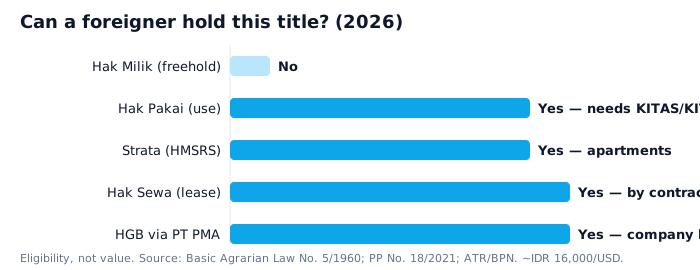
Here is the same picture as a reference table, the heart of how foreigners own property in Bali 2026. Read it as “eligibility”, separate from the value and residency conditions covered below:
| Title | Foreigner can hold? | What it gives you | Key condition |
|---|---|---|---|
| Hak Milik (freehold) | No | Perpetual ownership of land | Citizens only, no exceptions, no nominees |
| Hak Pakai (Right to Use) | Yes | A registered right to use a residence/land | Resident permit (KITAS/KITAP) + minimum value |
| Strata title (HMSRS) | Yes | Ownership of an apartment/condo unit | Building on Hak Pakai/HGB land + minimum value |
| Hak Sewa (leasehold) | Yes | Contractual right to occupy/use for a term | Valid notarised lease; no residency needed |
| HGB (Right to Build) | Indirectly | Control of land + building for business | Held by a PT PMA company you own |
| Eligibility only. Minimum-value and duration rules are detailed below. Source: ATR/BPN; PP No. 18/2021. |
The takeaway: the right title depends on your goal. A resident wanting a home leans to Hak Pakai; a buyer wanting the simplest entry uses Hak Sewa leasehold; a portfolio or rental-business investor uses HGB via a PT PMA. We map titles to areas and budgets in best areas to buy property in Bali 2026.
Eligibility: KITAS, KITAP and the PT PMA route
Whether you can hold a title in your own name turns on residency. This is the gatekeeper most price-focused guides skip, and it changes which route is even open to you:
| Your status | Hak Pakai / strata in own name? | Leasehold (Hak Sewa)? | HGB via PT PMA? |
|---|---|---|---|
| Tourist / no permit | No | Yes | Yes (company holds it) |
| KITAS (limited stay) | Yes | Yes | Yes |
| KITAP (permanent stay) | Yes | Yes | Yes |
| KITAS = Kartu Izin Tinggal Terbatas (limited-stay permit); KITAP = permanent-stay permit. Source: Indonesian Immigration; ATR/BPN guidance under PP No. 18/2021. |
The logic is simple: Hak Pakai and strata title attach to a resident person, so you need a KITAS or KITAP. Leasehold attaches to a contract, so any foreigner can sign one regardless of residency. HGB attaches to a company (the PT PMA), so the residency question moves to the business entity rather than you personally, which is why non-resident investors so often choose it. How each structure is actually set up, shareholders, licensing, exit, is detailed in the pillar guide’s structures section; this page stays on the question of which title your status unlocks.
Minimum-value rules for foreign buyers
Indonesia uses a price floor to keep affordable housing for locals: foreign-owned residences under Hak Pakai or strata title must exceed a provincial minimum value set under PP No. 18/2021 and the implementing ministerial regulation. The floor varies by province and property type, and is stated in rupiah; the USD equivalents below use ~IDR 16,000/USD and should be re-confirmed before you buy:
| Property type | Bali minimum value (typical) | ≈ USD (at IDR 16,000/USD) |
|---|---|---|
| Landed house (Hak Pakai) | ~IDR 3 billion | ~$190,000 |
| Apartment / strata unit (HMSRS) | ~IDR 2 billion | ~$125,000 |
| Indicative provincial floors under PP No. 18/2021; the exact Bali figure is province-set and periodically revised, confirm with ATR/BPN or your notary. ~IDR 16,000/USD. |
What this means in practice: the minimum value rules out the cheapest stock for name-held foreign ownership, but it sits well below most investor-grade villa prices, see where budgets land area-by-area in our Bali area & budget guide. Leasehold and PT PMA routes are governed by their own value and licensing rules rather than this residence floor.
Not sure which title fits your status?
Magnum Estate’s legal desk maps the right title and structure to your residency, budget and goals.
View Magnum projects
Book a free consultation
Apartments and strata title (HMSRS)
Apartments deserve their own note because they are often the cleanest path for a foreigner. Under the strata regime, a foreigner can own a unit (Hak Milik atas Satuan Rumah Susun) when the building stands on Hak Pakai or HGB land. You own your unit and share the common parts, similar to a condominium elsewhere, subject to the same residency and minimum-value conditions as Hak Pakai. This is distinct from owning the underlying land, which a foreigner still cannot do as freehold. For branded residences and managed buildings, strata ownership pairs naturally with professional rental operations; see how that affects returns in our Bali rental strategy guide.
The nominee trap, why it voids your rights
Because freehold is closed to foreigners, some are tempted by a nominee arrangement: putting Hak Milik in an Indonesian person’s name while a side agreement says the foreigner is the “real” owner. This is the single most dangerous shortcut in the whole question of how foreigners own property in Bali, and it is getting riskier, not safer.
Why it fails: a nominee agreement conflicts with the Basic Agrarian Law and can be declared void. If a dispute arises, Indonesian courts have prioritised the registered title holder, the nominee, leaving the foreigner with no enforceable claim to land they paid for. Regulators are also tightening scrutiny. The safe, legal routes above (Hak Pakai, Hak Sewa, PT PMA + HGB) exist precisely so you never need this. We cover enforcement cases in the pillar guide’s nominee section.
Limitations & who this suits
This explainer covers rights and eligibility, not the transaction. It is most useful if you are still deciding what you are allowed to own and under which title. It is not for you if you have already chosen a structure and want the buying steps, due-diligence checklist or notary process, go straight to the foreigner legal guide for that. Three honest caveats: (1) minimum-value thresholds are province-set and revised periodically, so treat the IDR figures as indicative; (2) USD equivalents move with the rupiah; (3) title eligibility can hinge on case-specific facts (zoning, the seller’s own title, building permits) that only a notary’s due diligence will surface. Nothing here replaces licensed legal and tax advice.
Conclusion
The whole of how foreigners own property in Bali 2026 reduces to matching yourself to a title: freehold is off the table, but Hak Pakai, strata title, leasehold and HGB-via-PT-PMA each give a foreigner a legal, durable interest, provided you meet the residency and minimum-value conditions and never touch a nominee deal. Decide the title first; the price and the process follow from it.
See compliant, foreigner-ready residences
Explore Magnum Estate developments structured for legal foreign ownership in Uluwatu, Berawa and Sanur.
Uluwatu, Sky Stars
Berawa
Sanur
FAQ: how foreigners own property in Bali 2026
Can a foreigner own freehold (Hak Milik) land in Bali in 2026?
No. Hak Milik freehold is reserved for Indonesian citizens under the Basic Agrarian Law No. 5/1960. A foreigner uses Hak Pakai, Hak Sewa, strata title, or HGB through a PT PMA instead.
What exactly can a foreigner own?
A residence under Hak Pakai, an apartment under strata title (HMSRS), a leased property under Hak Sewa, or land and buildings controlled by a PT PMA under HGB. Never freehold land in a personal name.
Do I need a KITAS or KITAP?
To hold Hak Pakai or strata title in your own name, yes, you need resident status (KITAS or KITAP). Leasehold and PT PMA ownership do not require personal residency.
Is there a minimum property value for foreigners?
Yes. Foreign-owned residences face a province-set floor under PP No. 18/2021, commonly around IDR 3 billion (~$190,000) for houses in Bali. Confirm the current figure with ATR/BPN or a notary.
How long can a foreigner control the property?
Hak Pakai and HGB run about 30 years and are extendable and renewable to roughly 70-80 years total. Leasehold runs for the contracted term, typically 25-30 years with extension options.
Can foreigners own apartments?
Yes, via strata title (HMSRS) on a building that stands on Hak Pakai or HGB land, subject to the same residency and minimum-value conditions as Hak Pakai.
Why are nominee arrangements off-limits?
They conflict with the Basic Agrarian Law and can be voided; courts have sided with the registered Indonesian title holder, leaving the foreigner with no enforceable right. Use the legal routes instead.
Where do I find the actual buying steps?
This page is a rights explainer. For the step-by-step purchase process and due-diligence checklist, see our foreigner legal guide to buying property in Bali.
Methodology & sources
Title definitions and eligibility follow Indonesia’s Basic Agrarian Law No. 5/1960, the Omnibus Law No. 11/2020 and implementing regulation PP No. 18/2021, as administered by ATR/BPN. Minimum-value thresholds are province-set and stated in IDR; USD figures are conversions at ~IDR 16,000/USD and are indicative, they move with FX and with any regulatory revision. Residency categories (KITAS/KITAP) follow Indonesian immigration rules. This is an educational rights explainer, not legal advice; always confirm current thresholds and your specific eligibility with a certified notary (PPAT) and licensed legal adviser.
References & official sources
- ATR/BPN, Ministry of Agrarian Affairs & Spatial Planning / National Land Agency: land titles (Hak Milik, Hak Pakai, HGB) & zoning, atrbpn.go.id
- BKPM / Invest Indonesia: PT PMA rules & the Positive Investment List, investindonesia.go.id
- Basic Agrarian Law No. 5/1960 (foundational land-rights statute), via FAOLEX (faolex.fao.org)
- Omnibus Law No. 11/2020 (Job Creation) & foreign-investment provisions, via UNCTAD Investment Policy Hub
- Government Regulation PP No. 18/2021: foreign-ownership rights & minimum-value thresholds for residences, confirm current figures via ATR/BPN.
- Magnum Estate legal desk: structure-to-title mapping for foreign buyers (educational, not advice).
About the author
Donny Yosua is a market analyst at Magnum Estate, an award-winning Bali developer (Berawa, Sanur, Sky Stars, Sky Royal). He tracks Bali land titles, foreign-ownership rules and regulation for international buyers.