





Written by Stanislav Sadovnikov, Founder, Magnum Estate ·
Reviewed by Magnum Estate legal desk (pending named PPAT notary) ·
Last updated 3 June 2026
"6 zones Colour-coded land categories (RTRW) · PBG Replaced IMB as the build permit · $250-1,900 Land per m² (emerging, Seminyak) · 0% freehold Foreigners use lease / PT PMA only"
Key figures (2026)
How to choose land in Bali 2026: summary
How to choose land in Bali in 2026, the short answer: make zoning the first filter, not the last. Before you look at price, confirm the plot sits in a buildable zone (yellow/residential or pink/tourism), pull a PKKPR zoning-suitability approval, check the certificate at the National Land Agency (BPN), and confirm you can secure a PBG, the building approval that replaced the old IMB. A cheap green-zone plot you cannot legally build on is worth far less than correctly zoned land at a premium.
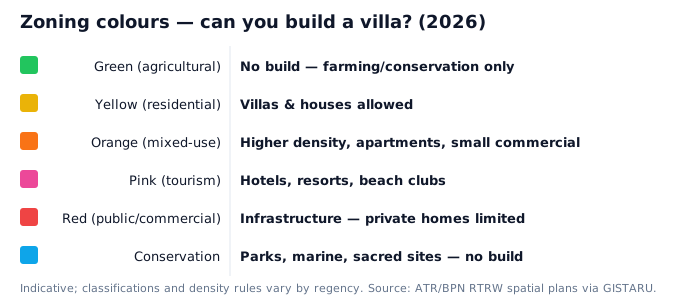
- Zone colours: green = agriculture (no build), yellow = residential, orange = mixed-use, pink = tourism, red = public, plus conservation.
- Green-zone trap: villa construction is banned; new conversion permits have stopped; illegal builds are being demolished, and renting them out is risky too.
- Permit order: PKKPR (zoning), PBG (build), SLF (occupancy). An old IMB on a listing is a red flag.
- Foreign rights: no freehold (Hak Milik); use Hak Sewa lease, Hak Pakai, or HGB via a PT PMA.
- Price vs safety: land runs from under USD 250/m² (emerging) to USD 900-1,900/m² (Seminyak); the discount on cheap plots is usually a zoning or title problem.

"Transparency: Magnum Estate develops property in Bali, so we have a commercial interest. This guide is educational, not investment or legal advice, zoning, permit and ownership rules change and vary by regency. Verify every figure and classification independently and consult a certified Indonesian notary (PPAT) and a licensed land lawyer before you buy."
Transparency
Learning how to choose land in Bali in 2026 starts with a fact that most listings hide: the price per are tells you almost nothing about whether you can legally build. The decisive factors are invisible on a photo, zoning status, permits and land rights. Bali’s provincial government is enforcing spatial-planning rules more strictly than ever, especially around productive rice fields and coastal tourism strips, with demolitions of illegal builds in places like Bingin Beach and South Kuta. This guide decodes the zone colours, the PBG building approval that replaced IMB, the green-zone build-and-rental ban, and the exact steps to verify a plot before you commit.
Why zoning now drives land value in Bali
The question is no longer “is this land cheap?” but “can I legally build what I want here under current Bali zoning rules?” Provincial and regency authorities have made protecting agricultural land and the Subak irrigation culture an explicit priority. The practical consequences for anyone working out how to choose land in Bali:
- Wrong-zone land can become worthless, a bargain plot you cannot build on, or whose villa gets demolished, is a loss, not a deal.
- Correctly zoned land costs more but is safer, residential and tourism plots carry a premium precisely because they are legally usable and liquid on exit.
- “Convertible” yellow land must be checked, current farm use does not guarantee you can build to the density you want; each regency sets its own rules.
Bali zoning colours and what each one allows
Bali uses a colour-coded system shown on official spatial-planning maps (RTRW), viewable through the national GISTARU portal. When deciding how to choose land in Bali, match the colour to your intended use before anything else:
| Zone (colour) | Indonesian name | Villas/houses? | What it’s for |
|---|---|---|---|
| Green | Zona Hijau (agricultural) | No, prohibited | Farming, forestry, conservation; protects rice fields & Subak |
| Yellow | Zona Kuning (residential) | Yes | Houses and private villas; safest for most buyers |
| Orange | Mixed-use residential | Yes (denser) | Apartments, co-living, townhouses, small commercial |
| Pink | Tourism zone | Commercial | Hotels, resorts, beach clubs; stricter design/environmental rules |
| Red | Public / commercial | Limited | Roads, schools, government, some commercial use |
| Conservation | Kawasan lindung | No, prohibited | National parks, marine areas, sacred & heritage sites |
| A “great deal” means nothing if the zoning doesn’t match your intended use. Source: ATR/BPN RTRW spatial plans (GISTARU). |
Green zone vs yellow zone: why it matters most
Many first-time buyers see a beautiful rice-field plot at an attractive price and assume they can “sort the permits out later.” In today’s enforcement climate that is the single most expensive mistake in how to choose land in Bali.
Green zone (agricultural)
- Reserved for farming, forestry and conservation, no villas, no hotels.
- The government has effectively stopped issuing new permits to convert productive farmland into tourism accommodation.
- Enforcement has increased, including demolition of illegal structures. A villa built here can be torn down, and renting it out short-term is itself exposed.
Buying green-zone land for villa construction is, in effect, a bet on breaking the rules. In 2026 that is a high-risk, low-probability gamble.
Yellow zone (residential / convertible)
- The safest classification when working out how to choose land in Bali for houses and private villas.
- Can support Hak Sewa (lease), Hak Pakai or Hak Guna Bangunan once the other conditions are met.
- Some yellow land is temporarily farmed and may be converted, but density and design rules differ by area.
Legal reality: for most foreign investors building villas or small complexes, yellow-zone land in Canggu, Berawa, Sanur, Uluwatu and selected parts of North Bali is the realistic, legally safe choice. Pair this with a full title check, see our property due diligence guide and the legal guide to buying in Bali as a foreigner.
PKKPR, PBG (the permit that replaced IMB) & SLF
Zoning approval and building approval are now separate, sequential steps. Knowing this order is central to how to choose land in Bali you can actually develop:
| Step | Document | What it confirms |
|---|---|---|
| 1 | PKKPR (Kesesuaian Kegiatan Pemanfaatan Ruang) | Zoning suitability: the land’s classification, allowed building types, and the permitted building coverage (KDB) and floor-area ratio (KLB). |
| 2 | PBG (Persetujuan Bangunan Gedung) | The building approval that replaced the old IMB under Indonesia’s 2021 building regulation, required before construction. |
| 3 | SLF (Sertifikat Laik Fungsi) | The function/occupancy certificate confirming the finished building is fit for lawful use. |
| PKKPR is mandatory before you can obtain a PBG or SLF. Source: ATR/BPN; Indonesia building regulation (PP 16/2021). |
Red flag: if a seller or agent quotes an old IMB rather than a PBG, or cannot produce a PKKPR, treat the plot as unverified. Without a PKKPR and independent confirmation you are buying blind. Cross-check holding costs and taxes in our taxes & holding costs guide.
How to verify zoning before buying land in Bali
Relying on a seller’s word is not enough. Professional buyers combine official tools with expert help, this four-step check is the core of how to choose land in Bali without nasty surprises:
- GISTARU / RTRW maps, the national spatial-planning portal shows the zone colour (green, yellow, orange, pink, etc.); cross-check at the regency planning office.
- PKKPR application, the zoning-suitability approval that confirms classification, allowed building types, KDB and KLB.
- Local consultant or architect, verifies setbacks, height limits and minimum plot sizes, which differ by regency.
- Legal review, a notary (PPAT) and independent lawyer confirm the certificate matches the zoning and that no conflicting claims exist, with verification at the National Land Agency (BPN).
Skip the zoning guesswork
Magnum Estate’s developments are built on pre-vetted, correctly zoned land with permits in hand, see live pricing and projected net yields in Berawa, Sanur and Uluwatu.
View Magnum projects
Book a free consultation
What foreigners can do with land for sale in Bali
Foreign nationals cannot own freehold land (Hak Milik). Instead they use legally recognised rights, and in every case the zoning must permit the intended use:
| Right | Typical term | Best for |
|---|---|---|
| Hak Sewa (right to lease) | ~25-30 yrs + extensions | Individual villa buyers; simplest and most common |
| Hak Pakai (right to use) | Up to ~80 yrs (30+20+30) | Residential or commercial use of land & building |
| Hak Guna Bangunan (HGB) | Up to ~80 yrs (30+20+30) | Right to build, usually via a PT PMA company |
| Match the right to the zone: villas, yellow/orange; guesthouses/small hotels, orange/tourism; resorts & beach clubs, pink tourism zones with environmental approvals. Source: ATR/BPN; BKPM (PT PMA rules); Agrarian Law No. 5/1960. |
Avoid nominees: using an Indonesian “nominee” to hold freehold on your behalf is widely warned against, such structures can be deemed illegal and unenforceable in court. Use a compliant lease or PT PMA structure instead, and read more in our mistakes to avoid when buying in Bali.
Zoning, price and the “cheap land” trap
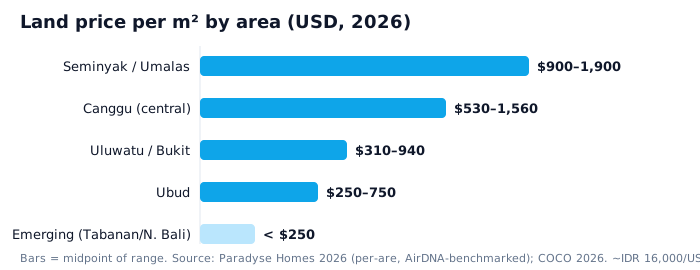
Zoning explains most of the price gap between two plots that look similar. Correctly zoned residential or tourism land with a clean certificate and road access commands a premium; the discount on a “bargain” is usually a zoning, access or title problem. For context, here is the 2026 land-price map per m² (reused from our Bali property prices 2026 guide), and the reminder that a buildable yellow plot in the emerging belt can still beat an unbuildable green plot anywhere:
| Area | Land price per m² | Typical zoning to target |
|---|---|---|
| Seminyak / Umalas | ~$900-1,900 | Yellow / tourism (high density) |
| Canggu (central) | ~$530-1,560 | Yellow / orange; pockets of tourism |
| Uluwatu / Bukit | ~$310-940 | Yellow / tourism (cliff strips) |
| Ubud | ~$250-750 | Yellow; much green nearby, verify |
| Emerging (Tabanan, Seseh, N. Bali) | < $250 | Mixed, green is common, so check first |
| Land stated per m² (from per-are data; 1 are = 100 m²) at ~IDR 16,000/USD. Source: Paradyse Homes 2026 & COCO 2026. Emerging belts hold the most green-zone land, so zoning checks matter most there. |
The takeaway: for the same budget you get far more land in Uluwatu, Ubud or the emerging belt than in Seminyak, but the cheaper the headline price, the more likely the discount hides a zoning issue. Compare the coasts in Canggu vs Uluwatu and the wider market in best areas to buy in Bali 2026.
A practical risk checklist for “land for sale” ads
Before believing any listing, ask the seller to answer these in writing, with documents:
- What zone is the land in, officially? Request the PKKPR or spatial-plan extract showing the colour (yellow, orange, pink, etc.).
- Can you build what you want? A villa in a yellow zone is usually fine; in a green zone it is not.
- What right will you hold as a foreigner? Hak Sewa lease, or a PT PMA for HGB / Hak Pakai?
- Is the land measured and certified? A valid Sertifikat Tanah must be verified with the National Land Agency (BPN).
- Are there setbacks or height limits? Residential zones typically cap height near 15 m and regulate distance from roads, rivers and the coastline.
If a seller cannot answer these in writing, you are not looking at a low-risk investment, no matter how attractive the price per are.
Limitations & suitability
This guide explains how to choose land in Bali at a general level; it does not replace a parcel-specific PKKPR, an architect’s setback study or a notary’s title search. Zoning classifications, density rules and enforcement vary by regency and change over time. Buying raw land to build is not suitable for buyers who want a hands-off, ready-to-rent asset, a short holding horizon, or who cannot fund the permit and construction timeline, for those profiles, a completed or off-plan unit on already-permitted land is usually the better fit.
Methodology & sources
Zoning categories, permit names (PKKPR, PBG, SLF) and foreign-ownership rights are summarised from ATR/BPN guidance, BKPM (PT PMA) rules and Indonesia’s Agrarian Law No. 5/1960. Land prices are indicative 2026 ranges, reused from our reconciled price dataset and stated per m² (from per-are data, 1 are = 100 m²) at ~IDR 16,000/USD; the ranking is monotonic (prime never cheaper than emerging). Individual parcels vary by zone, road access, view, lease term and regency rules. Always commission an independent PKKPR check and notary (PPAT) due diligence before purchase.
Conclusion
In 2026, the smartest answer to how to choose land in Bali is to invert the usual order: decode the zone colour, secure a PKKPR and a path to a PBG, confirm the title at BPN, and only then weigh the price per m². Yellow and pink zones with clean certificates are the realistic, legally safe targets; green-zone “bargains” are a bet against an enforcement wave that is only getting stronger.
Build on land that’s already cleared
Explore Magnum Estate’s residences on correctly zoned, permitted land in Uluwatu, Berawa and Sanur, transparent pricing and projected net yields; the permits behind each project are set out on our Bali real estate developer page.
Uluwatu, Sky Stars
Berawa
Sanur
FAQ: How to choose land in Bali 2026
How to choose land in Bali safely in 2026?
Make zoning your first filter. Confirm the plot is yellow (residential) or pink (tourism) on the GISTARU/RTRW map, obtain a PKKPR, verify the certificate at BPN, then assess price. Cheap green-zone land usually cannot be built on.
What do the Bali zoning colours mean?
Green = agriculture/conservation (no villas); yellow = residential; orange = higher-density mixed-use; pink = tourism; red = public/commercial; conservation zones protect parks and sacred sites.
Can I build a villa on green-zone land?
No. Green zones are for agriculture and conservation; new conversion permits have stopped and illegal builds have been demolished. Renting out an illegal structure is also at risk.
What is PBG and how is it different from IMB?
PBG (Persetujuan Bangunan Gedung) is the building approval that replaced IMB. The order is PKKPR (zoning), PBG (build), SLF (occupancy). An old IMB reference on a listing is a red flag.
What land rights can a foreigner hold?
No freehold (Hak Milik). Foreigners use Hak Sewa (lease), Hak Pakai (use) or HGB (build, via PT PMA), and the zoning must permit the use.
Are nominee arrangements safe?
No. Using an Indonesian nominee to hold freehold for a foreigner is widely warned against and can be unenforceable in court. Use a lease or PT PMA structure.
Why is some land so much cheaper?
Cheap plots are often green-zone, lack access, have unclear title, or cannot legally host a villa. Correctly zoned land with a clean certificate commands a premium.
Is 2026 still a good time to buy land in Bali?
Yes, if you focus on legally clean, correctly zoned yellow, orange or tourism land in growth corridors (Canggu, Berawa, Uluwatu, Sanur, parts of North/West Bali) on a medium-to-long horizon.
References & official sources
- ATR/BPN, Ministry of Agrarian Affairs & Spatial Planning / National Land Agency: land titles (Hak Milik / Hak Pakai / HGB), zoning & RTRW spatial plans, atrbpn.go.id
- GISTARU, national spatial-planning portal: RTRW zone-colour maps, gistaru.atrbpn.go.id
- BKPM / Invest Indonesia: PT PMA & foreign-investment rules, investindonesia.go.id
- Agrarian Law No. 5/1960 (basic land-rights framework, incl. foreign-ownership limits), via faolex.fao.org
- DJP / Ministry of Finance: PBB & transaction taxes, pajak.go.id
- Market data (2026): Paradyse Homes price-per-are study (AirDNA-benchmarked); COCO Development land data; Prestige Property Bali; InvestLandBali market report.
- Magnum Estate portfolio data (zoning & permit status by project).
About the author
Stanislav Sadovnikov is the founder of Magnum Estate (PT Magnum Estate International), an award-winning full-cycle Bali real estate developer with 8 projects and 575 units since 2019 (Berawa, Sanur, Umalas, Sky Stars, Sky Royal). He writes about Bali pricing, yields, ownership rules and regulation for international buyers.