





Written by Stanislav Sadovnikov, Founder, Magnum Estate ·
Reviewed by Magnum Estate legal & investment desk ·
Last updated 3 June 2026
"No freehold Foreigners use leasehold / PT PMA · 4-6% vs 10-15% Net yield: self vs pro-managed · 70-85% Prime occupancy (island ~65%) · $1,000-1,800 Honest build cost per m²"
Key figures (2026)
Buying real estate in Bali expectations vs reality: summary
Buying real estate in Bali expectations vs reality, the honest short answer: the dream (easy freehold, a guaranteed 15%+ net return, fully passive income, instant year-round bookings) rarely survives contact with the market. The reality is friendlier than the horror stories but stricter than the brochures: you buy via leasehold or a PT PMA company, headline yields are gross, real net returns are 4-6% self-managed or 10-15% with professional management, and demand is real but seasonal.
- Ownership: no direct freehold for foreigners, Leasehold (Hak Sewa) or PT PMA (HGB).
- Yield: quoted “12-15%” is gross; net is 4-6% self-managed, 10-15% pro-managed.
- Passive? Only with management, otherwise licensing, pricing, cleaning and repairs are on you.
- Instant rental? Demand is strong (6.95M arrivals in 2025) but occupancy is seasonal: 70-85% prime, ~65% island-wide.
- Cheap = costly: a sound villa costs ~$1,000-1,800/m² to build; below that, corners get cut.

"Transparency: Magnum Estate develops property in Bali, so we have a commercial interest. This guide is educational, not investment or legal advice, verify figures independently and consult a certified Indonesian notary (PPAT) and tax advisor before buying."
Transparency
This buying real estate in Bali expectations vs reality guide is the honest version of the sales pitch. Bali genuinely is one of the strongest property markets in Southeast Asia, it drew nearly 7 million foreign visitors in 2025, but the gap between what buyers expect and what the market actually delivers is where most disappointment (and most lost money) lives. Below we take the four or five expectations almost every first-time buyer arrives with, and set each one against the 2026 reality, with the numbers behind it.
Buying real estate in Bali expectations vs reality, at a glance
The numbers in this table are the same reconciled 2026 figures we use across our guides (converted at ~IDR 16,000/USD). Gross and net yields are kept strictly separate, because conflating them is the single most common cause of disappointment:
| The expectation | The 2026 reality |
|---|---|
| “I’ll own the land freehold, like at home.” | Foreigners can’t hold Hak Milik. You use leasehold (Hak Sewa) or a PT PMA company holding HGB. |
| “I’ll make a guaranteed 15%+ net return.” | Headline yields are gross (7-15%). Net is 4-6% self-managed or 10-15% pro-managed, not guaranteed. |
| “It’s passive income.” | Only with management. Self-managing means licensing, pricing, OTA listings, cleaning, repairs and guest support. |
| “It rents out instantly, all year.” | Demand is real but seasonal: 70-85% occupancy in prime areas, ~65% island-wide, with high/low seasons. |
| “Cheaper villas are better value.” | A sound build is ~$1,000-1,800/m². Below that, corners get cut and you renovate constantly. |
| Reconciled 2026 ranges (~IDR 16,000/USD). Gross = rent ÷ price before costs; net deducts management, tax, maintenance and vacancy. |
Myth 1: “I’ll own it freehold, like back home”
The most common expectation, and the first reality check. Foreign individuals cannot hold freehold title (Hak Milik) in Indonesia. The two legitimate routes are Leasehold (Hak Sewa), typically a 25-30 year term with extension options, or a foreign-owned company (PT PMA) that holds the right to build (Hak Guna Bangunan, HGB). Both are normal and safe when structured by a certified notary (PPAT); both are very different from owning a freehold house in Europe or North America. The good news from the source page still holds: you don’t have to be physically present for the whole transaction. The bad news: the “I’ll just buy land outright” expectation is simply not available to foreigners, and structures sold as workarounds (nominee arrangements) carry real legal risk.
Reality: choose the structure deliberately, lease term and renewal terms decide your real holding horizon. We break the trade-offs down in freehold vs leasehold in Bali and the foreigner’s legal guide to buying in Bali.
Myth 2: “I’ll make a guaranteed 15%+ net return”
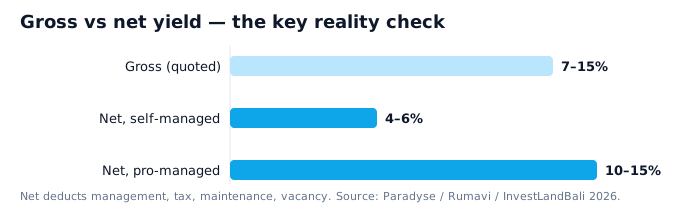
This is where the biggest gap sits. The “12-15%” returns quoted in listings are almost always gross, annual rent divided by price, before a single cost is deducted. What you actually keep is the net yield, after management, tax, maintenance, utilities and vacancy. The original version of this article put it bluntly: a property that needs constant repairs and has no management system won’t make 12-15%, “at best you’ll get 6-8%.” That’s the right instinct, and the reconciled 2026 data is consistent with it:
| Yield measure | 2026 range | What it means |
|---|---|---|
| Gross (quoted in listings) | 7-15% (10-18% prime) | Rent ÷ price, before any costs |
| Net, self-managed | 4-6% | After costs, doing the work yourself |
| Net, professionally managed | 10-15% | After costs and management fees, run as a business |
| Gross and net are different metrics, never compare a quoted gross figure to a net target. Source: Paradyse / Rumavi / InvestLandBali 2026. |
Reality: the gap between 4-6% and 10-15% net is operations, not luck, data-driven pricing, OTA distribution and cost control. See the full breakdown in our Bali villa ROI guide and factor in taxes & holding costs (annual PBB is low, ~0.1% of assessed value, but transaction and rental-income taxes apply).
Myth 3: “It’s passive income”
The brochure says “buy and relax.” The reality is that a Bali villa is an operating business. If you rent it out yourself you need a company and an operating licence; you find tenants, set nightly pricing, manage OTA listings, clean between guests, maintain appliances and the pool, and handle the 11pm “the power is out” message, in a foreign country, in a different time zone. The original article captured this honestly: owners “become tired of this and try to sell,” which is exactly why so much tired stock sits on the market. The realistic choice is between accepting a lower self-managed net of 4-6% for genuinely passive effort, or paying for professional, hotel-style management to reach a 10-15% net while staying hands-off.
Reality: the properties that actually behave like passive income are the ones with on-site management built in. Compare the rental models in our
long-term vs short-term rental strategy
guide before you decide who runs the villa.
Myth 4: “It rents out instantly, all year round”
Demand is genuinely strong: Bali drew 6,948,754 foreign visitors in 2025, up 9.72% year-on-year. But “year-round demand” does not mean “year-round full occupancy.” Prime-area villas run roughly 70-85% occupancy; the island-wide average is closer to ~65%, with clear high and low seasons. A modern villa in a proven location near full demand books well; an older, isolated villa is competing against thousands of near-identical listings, and its occupancy, and nightly rate, drifts down every year as newer stock arrives. Location and product quality, not just the island’s headline tourism number, decide whether your calendar fills.
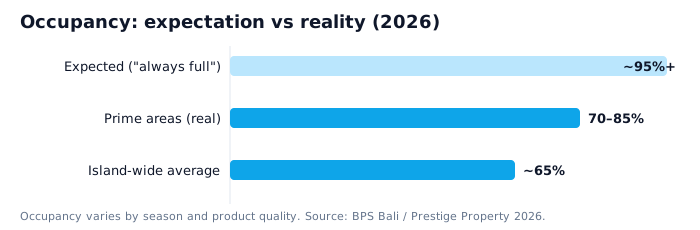
Reality: the area you choose changes the curve more than the marketing does. See how demand differs across the island in best areas to buy property in Bali 2026 and the head-to-head Canggu vs Uluwatu.
Myth 5: “A cheaper villa is the better deal”
The most expensive mistake is buying on headline price alone. A decent, investment-grade villa costs roughly USD 1,000-1,800 per m² to build, before land, pool and landscaping. When a finished villa is priced far below what those inputs allow, something has been cut: a short remaining lease, a tiny or illiquid plot, thin reinforcement and low-grade concrete, a wooden roof that fails in a few years, or cheap cladding (limestone that stains, timber that warps and attracts termites in the humid climate). The buyer then renovates continuously, can’t rent during the works, and eventually sells, feeding the pile of cheap, tired stock the original article described. “Cheap” is rarely a discount; it’s usually a deferred bill.
Reality: sanity-check any “bargain” against build economics and area pricing in our Bali property prices 2026 guide before you assume you’ve found a deal.
See the real numbers, not the brochure
Compare live pricing, build quality and projected net yields across Magnum Estate’s Berawa, Sanur and Uluwatu developments.
View Magnum projects
Book a free consultation
Who buying real estate in Bali is (and isn’t) for
Honesty cuts both ways. Bali property suits buyers who treat it as an operated business or who buy a managed, hotel-style product and accept a leasehold/PT PMA structure. It is a poor fit if you expect bank-deposit certainty, want true freehold ownership, need guaranteed monthly cash flow from day one, or plan to self-manage remotely without time to spare. If a seller promises a fixed, guaranteed double-digit net return with no operational involvement, treat that as a red flag, not a feature, that combination does not exist in this market.
Methodology & sources
Figures are indicative 2026 ranges, reconciled across multiple market datasets and converted at ~IDR 16,000/USD. Build cost is stated per m². Gross yields are rent ÷ price before costs; net yields deduct management, tax, maintenance and vacancy and are kept separate throughout. Occupancy and arrivals are from official statistics. We have intentionally replaced some figures from the earlier version of this page (which conflated the local unit “are” of 100 m² with “acre” and mixed gross/net) with these reconciled ranges. Always commission an independent appraisal and notary (PPAT) due diligence before purchase.
Conclusion
The honest version of buying real estate in Bali expectations vs reality is encouraging, not discouraging: the market is real, demand is real, and double-digit net returns are achievable, but only with a sound structure, a quality build and professional management. Set your expectations to leasehold or PT PMA ownership, a net 4-6% if you self-manage or 10-15% if you don’t, seasonal occupancy, and a build that costs what quality costs. Buy on those terms and the reality tends to beat the brochure.
Ready to see the real numbers?
Explore Magnum Estate’s award-winning, fully managed residences, transparent pricing and projected net yields.
Berawa
Sanur
Uluwatu, Sky Stars
FAQ: buying real estate in Bali expectations vs reality
Can foreigners own freehold property in Bali?
No. Foreigners cannot hold freehold (Hak Milik) directly. You use leasehold (Hak Sewa), typically 25-30 years with extensions, or a PT PMA company holding HGB. See our freehold vs leasehold guide.
What rental yield is realistic?
Quoted gross yields run ~7-15% (10-18% prime). Net is lower: ~4-6% self-managed or ~10-15% professionally managed, after costs.
Is Bali rental income passive?
Only with management. Self-managing means licensing, pricing, OTA listings, cleaning, maintenance and guest support.
Will my villa rent out instantly, year-round?
Demand is strong (6.95M arrivals in 2025) but seasonal: ~70-85% occupancy in prime areas, ~65% island-wide.
Why is cheap Bali property often a trap?
A sound villa costs ~USD 1,000-1,800/m² to build. Below that, corners get cut (short leases, thin concrete, cheap cladding) and you renovate constantly.
Do taxes hurt returns?
Annual PBB is low (~0.1% of assessed value), but transaction and rental-income taxes apply, see our tax guide.
What’s the single biggest expectation gap?
Confusing gross with net yield. A “15%” listing is usually gross; plan around a realistic net of 4-6% (self) or 10-15% (managed).
References & official sources
- BPS, Statistics Indonesia / Bali: 2025 foreign arrivals (6,948,754, +9.72%), occupancy, bali.bps.go.id
- Bank Indonesia, Residential Property Price Index: price-growth & IDR/USD data, bi.go.id
- DJP / Ministry of Finance: PBB, transaction & rental-income taxes, pajak.go.id
- ATR/BPN: land titles (Hak Milik / Hak Sewa / HGB) & zoning, atrbpn.go.id
- BKPM / Invest Indonesia: PT PMA & foreign-ownership rules, investindonesia.go.id
- Market data (2026): Paradyse Homes price/yield study; Prestige Property Bali area/yield analysis; InvestLandBali market report; Rumavi management benchmarks.
- Magnum Estate portfolio data (net yields by project).
About the author
Stanislav Sadovnikov is the founder of Magnum Estate (PT Magnum Estate International), an award-winning full-cycle Bali real estate developer with 8 projects and 575 units since 2019 (Berawa, Sanur, Umalas, Sky Stars, Sky Royal). He writes about Bali pricing, yields, ownership rules and regulation for international buyers.