






Written by Stanislav Sadovnikov, Founder, Magnum Estate ·
Reviewed by Magnum Estate legal & investment desk ·
Last updated 3 June 2026
"25-99 yr Leasehold term (incl. renewals) · IDR 10B PT PMA capital for freehold route · 4-6% / 10-15% Net yield: self- vs pro-managed · 5% + 2.5% BPHTB (buyer) + PPh (seller) on freehold"
Key figures (2026)
Freehold vs leasehold in Bali: summary
Freehold vs leasehold, the short answer for a foreign investor: you cannot personally own freehold (Hak Milik), so the real choice is leasehold (Hak Sewa) for the lowest entry cost and cleanest exit, or a PT PMA company holding HGB for freehold-equivalent permanence. Pick by horizon, not by instinct.
- Lowest entry & fastest resale: leasehold, no company, lower upfront cost, simple assignment of the remaining term.
- Long-term capital preservation: freehold via PT PMA, permanent control, but ~IDR 10B capital and ongoing compliance.
- Term & renewal: leases run 25-30 years, extendable to 80-99; the renewal clause is the value driver.
- Resale liquidity: leasehold below ~15-20 years remaining discounts hard; freehold/HGB holds value better.
- Risk: never use an Indonesian nominee to hold Hak Milik, the contract is void under Indonesian law.

"Transparency: Magnum Estate develops property in Bali, so we have a commercial interest. This guide is educational, not investment or legal advice, verify every figure independently and consult a certified Indonesian notary (PPAT) and a licensed tax advisor before signing anything."
Transparency
This freehold vs leasehold guide is written for the foreign investor weighing a Bali purchase in 2026, not as a legal-mechanics deep-dive, but as a decision framework across the five things that move returns: upfront cost, term length, renewal, resale liquidity and risk. The catch most buyers miss: a foreigner cannot personally hold freehold (Hak Milik) in Indonesia at all, so the practical comparison is leasehold versus a company-held freehold equivalent. For the underlying legal structures themselves, see our companion leasehold vs freehold vs PT PMA structures deep-dive, and the broader legal guide to buying property in Bali as a foreigner.
The two routes foreign investors actually use
Indonesian land law reserves Hak Milik (freehold) for Indonesian citizens. A foreigner therefore has two compliant paths to investment-grade Bali property:
- Leasehold (Hak Sewa): a fixed-term right to use land and the villa on it, typically 25-30 years, with negotiated extensions that can total 80-99 years. The land title stays with the Indonesian owner; you hold a registered, transferable lease.
- Freehold via PT PMA: a foreign-owned Indonesian company (PT PMA, ~IDR 10 billion in stated capital) holds the property on Hak Guna Bangunan (HGB) or Hak Pakai, renewable rights that deliver freehold-equivalent permanence and full development control.
Everything below compares these two real-world options, because that is the choice you will actually make. The legal mechanics of each title sit in the structures deep-dive; here we stay on the money and the risk.
Freehold vs leasehold: the investor comparison
The single most useful view is a side-by-side on the five investor variables. Figures are indicative 2026 ranges (see methodology); tax rates should be re-confirmed with a tax advisor before purchase.
| Investor variable | Leasehold (Hak Sewa) | Freehold via PT PMA (HGB / Hak Pakai) |
|---|---|---|
| Who can hold it | Foreigner directly, in own name | Foreign-owned company (PT PMA) |
| Upfront / setup cost | Lowest, no company, lower entry price | Higher, ~IDR 10B PT PMA capital + setup & accounting |
| Acquisition taxes | Lease PPh ~10% on rental value; PPN 11% on new developer sales | BPHTB 5% (buyer) + PPh 2.5% (seller); PPN 11-12% on new sales |
| Annual tax (PBB) | ~0.1-0.3% (often paid by landowner per contract) | Up to ~0.5% of assessed value |
| Term | 25-30 yr, extendable to 80-99 yr | Renewable HGB/Hak Pakai, effectively perpetual |
| Resale liquidity | Fast, simple assignment; discounts as term shortens | Holds value; sale of company shares or title is more complex |
| Ongoing compliance | Minimal | Annual company reporting & tax filing |
| Best for | 5-15 yr rental plays, lower capital | Long-term hold, development, multi-generational assets |
| Indicative 2026 ranges, ~IDR 16,000/USD. Tax rates per DJP/pajak.go.id, re-verify before purchase. PPnBM (luxury goods tax) up to ~20% can apply to luxury freehold purchases. |
Legal note: “freehold” for a foreigner always means a structure, never personal Hak Milik. The mechanics of HGB, Hak Pakai and PT PMA are covered in the leasehold vs freehold vs PT PMA deep-dive, read it before you commit capital, and have a PPAT notary verify the title.
Upfront cost & taxes
Cost is where the two routes diverge most. Leasehold wins on entry: you pay the lease premium (often a single up-front sum or staged installments) with no company to incorporate, and the buyer’s acquisition-tax load is lighter. Freehold via PT PMA front-loads cost, roughly
IDR 10 billion in stated company capital plus incorporation, plus a 5% BPHTB
land-and-building acquisition tax on the buyer and 2.5% PPh on the seller.
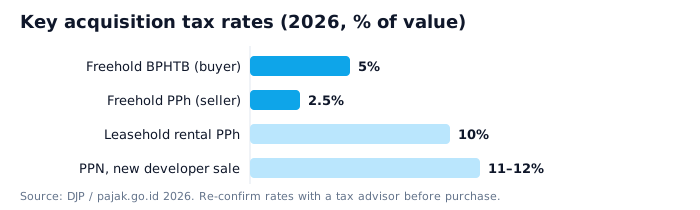
| Tax | Freehold purchase | Leasehold |
|---|---|---|
| Acquisition (BPHTB, buyer) | 5% of transaction value | Not applicable (lease, not transfer) |
| Income tax on sale (PPh, seller) | 2.5% of selling price | n/a, rental PPh ~10% on lease income (20% without NPWP) |
| Annual land & building tax (PBB) | Up to ~0.5% of assessed value | ~0.1-0.3%, usually paid by landowner unless agreed otherwise |
| VAT (PPN) on new developer sale | 11-12% | 11% |
| Luxury goods tax (PPnBM) | Up to ~20% on luxury property | n/a |
| Source: DJP / pajak.go.id 2026. Rates are indicative and change, verify with a licensed tax advisor. |
Whichever route you pick, model the figures on net, not gross. Across Bali, net rental yields run roughly 4-6% self-managed and 10-15% professionally managed after fees, tax, maintenance and vacancy. Layer holding costs from our
Bali taxes & holding costs guide
and see the return math in the villa ROI guide.
Term length & renewal
Freehold via PT PMA gives effectively perpetual control: HGB and Hak Pakai are renewable rights, so the asset does not “run out”. Leasehold is term-bound, typically 25-30 years at the first grant, extendable by negotiation to a total of 80-99 years. For a leasehold investor the renewal clause is the entire game: a pre-agreed extension at a fixed or capped price turns a depreciating asset into a durable one, while an open-ended “to be negotiated later” clause hands pricing power to the landowner exactly when you have the least leverage.
Resale liquidity
This is the variable most first-time buyers underestimate. A leasehold is easy and fast to assign, you transfer the remaining term, but its value decays as the clock runs down. Above ~30 years remaining, resale and rental confidence is strong; below ~15-20 years remaining, buyers and lenders discount steeply and the pool of buyers shrinks. Freehold via PT PMA holds value better because there is no expiry, though the sale itself (share transfer or title assignment) is more involved and slower than handing over a lease. Match this against your exit horizon and the area’s underlying demand, compare hotspots in best areas to buy property in Bali 2026.
Not sure which route fits your numbers?
Magnum Estate structures both leasehold and PT PMA purchases across its Berawa, Sanur and Uluwatu developments, with transparent pricing and projected net yields.
View Magnum projects
Book a free consultation
Risk & the nominee warning
Each route carries distinct risk. Leasehold risk is mostly contractual: a weak or vague renewal clause, unverified title behind the lease, or zoning that bars short-term rental. Freehold via PT PMA risk is mostly operational: compliance, annual reporting and the cost of keeping the company in good standing.
Nominee warning (read this twice): do not use an Indonesian “nominee” to hold Hak Milik on your behalf. Such arrangements are void under Indonesian law, you have no enforceable ownership, and the property can be lost entirely. The only compliant freehold-equivalent route is a properly constituted PT PMA. A PPAT notary should verify every title and contract. See the pitfalls in how to avoid common legal mistakes when buying property in Bali.
Which route fits your plan
| Your priority | Better route | Why |
|---|---|---|
| Lowest entry cost | Leasehold | No company; lighter buyer taxes |
| 5-15 year rental income play | Leasehold | Term covers the hold; clean exit |
| Simple, fast resale | Leasehold | Assign the remaining lease term |
| Permanent / multi-generational hold | Freehold (PT PMA) | No expiry; full control |
| Development or business use | Freehold (PT PMA) | HGB supports build & operate |
| Long-term capital preservation | Freehold (PT PMA) | Value not eroded by a ticking term |
| Neither route is universally “better”, match it to your horizon, capital and exit plan. |
Methodology & sources
Figures are indicative 2026 ranges and amounts are stated in USD or IDR at ~IDR 16,000/USD. Tax rates (BPHTB, PPh, PBB, PPN, PPnBM) reflect current DJP/pajak.go.id guidance and should be re-confirmed with a licensed advisor before any transaction. Net yields are stated after costs as 4-6% (self-managed) and 10-15% (professionally managed); gross figures are not used here to avoid conflating the two. Ownership routes follow Indonesian land law: foreigners cannot hold Hak Milik; compliant options are Hak Sewa (leasehold) or a PT PMA on HGB/Hak Pakai. Always commission independent PPAT notary due diligence.
Conclusion
For a 2026 Bali investor, freehold vs leasehold is really a question of horizon and capital. Leasehold is the low-cost, high-liquidity route for a defined rental hold, provided the renewal clause is strong and the remaining term is long. Freehold via PT PMA is the permanence-and-control route for long-term or development plays, at the price of higher setup and ongoing compliance. Decide on structure, location and contract strength first; the headline price comes second.
See both ownership routes on real inventory
Explore Magnum Estate’s ocean-view residences in Uluwatu, Berawa and Sanur, structured leasehold or PT PMA, with transparent pricing and projected net yields.
Uluwatu, Sky Stars
Berawa
Sanur
FAQ: freehold vs leasehold in Bali
What is the difference between freehold and leasehold in Bali?
Freehold (Hak Milik) is permanent land ownership; leasehold (Hak Sewa) is a fixed-term right to use it, typically 25-30 years with renewals up to 80-99. Foreigners cannot hold Hak Milik personally, so the real foreign-investor choice is leasehold versus a PT PMA holding HGB.
Can a foreigner own freehold property in Bali?
No, not personally. Freehold-equivalent control is reached only through a PT PMA company on HGB or via Hak Pakai. A nominee holding Hak Milik for you is illegal and the contract is void.
Which is the better investment, freehold or leasehold?
It depends on horizon. Leasehold suits 5-15 year rental plays with the lowest entry and fastest exit; freehold via PT PMA suits long-term or development holds and capital preservation.
What happens when a leasehold ends in Bali?
Rights revert to the landowner unless extended. The renewal price and terms are set by the contract, so a pre-agreed, capped extension clause is the key protection.
How many years left on a lease is safe to buy?
Around 30 years or more supports strong resale and rental confidence. Below ~15-20 years remaining, value and liquidity drop sharply, always check the remaining term.
How much does the PT PMA freehold route cost to set up?
Expect ~IDR 10 billion in stated company capital plus incorporation and ongoing accounting/reporting, on top of a 5% BPHTB acquisition tax. See the structures deep-dive for the mechanics.
Do taxes differ between the two routes?
Yes. Freehold purchases carry 5% BPHTB (buyer) and 2.5% PPh (seller); leasehold has no transfer tax but ~10% rental PPh. Annual PBB is higher on freehold (up to ~0.5%) than leasehold (~0.1-0.3%). Verify with our tax guide and a tax advisor.
References & official sources
- ATR/BPN (National Land Agency): Hak Milik, Hak Pakai & Hak Guna Bangunan titles, zoning, atrbpn.go.id
- BKPM / Invest Indonesia: PT PMA rules & foreign-ownership / Positive Investment List, investindonesia.go.id
- DJP / Ministry of Finance: BPHTB, PPh, PBB, PPN & PPnBM rates, pajak.go.id
- Basic Agrarian Law No. 5/1960: foundation of Indonesian land rights (Hak Milik / Hak Sewa / Hak Pakai), faolex.fao.org / investmentpolicy.unctad.org
- Market context (2026): Prestige Property Bali, Paradyse Homes & InvestLandBali ownership/yield analyses (~IDR 16,000/USD).
- Magnum Estate portfolio data (net yields by ownership route).
About the author
Stanislav Sadovnikov is the founder of Magnum Estate (PT Magnum Estate International), an award-winning full-cycle Bali real estate developer with 8 projects and 575 units since 2019 (Berawa, Sanur, Umalas, Sky Stars, Sky Royal). He writes about Bali pricing, yields, ownership rules and regulation for international buyers.